


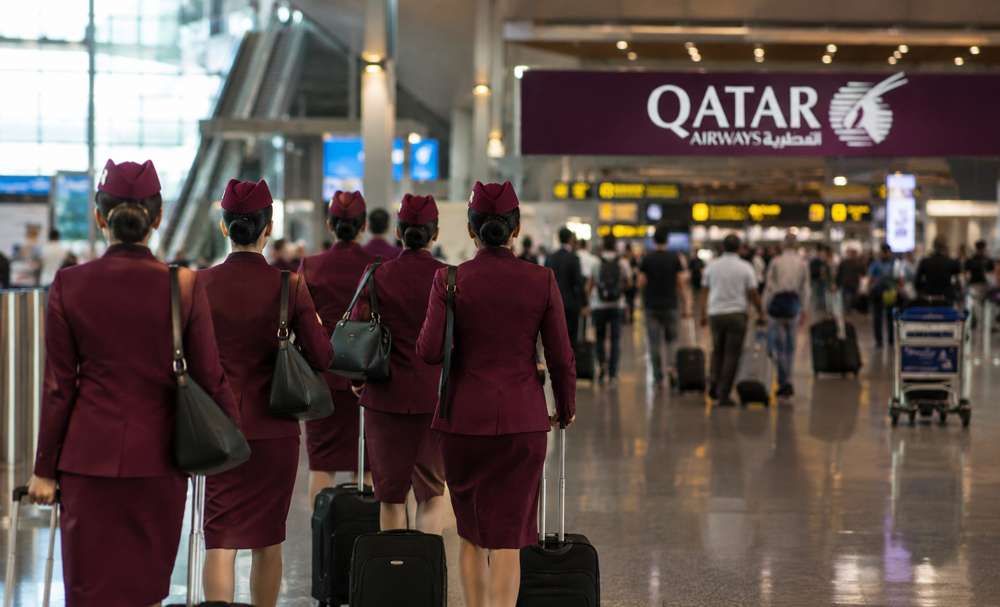
Crew protest highlights growing tensions over bonuses, pay structure, and restrictive accommodation policies at the state-owned airline
DOHA — Qatar Airways is facing an unprecedented wave of employee unrest after cabin crew members reportedly organized the airline’s first large-scale “sickout,” underscoring mounting frustration over compensation, housing restrictions, and working conditions at the Gulf carrier.
The action, which reportedly disrupted operations at Hamad International Airport, comes after the airline informed staff that it would not issue an annual profit-sharing bonus despite posting strong financial results for the 2025–2026 fiscal year.
According to reports circulating among crew forums and social media groups, the coordinated sick leave campaign reflects deeper dissatisfaction that has been building for months among flight attendants employed by the Doha-based airline.
Bonus Cancellation Sparks Backlash
The immediate trigger for the unrest was management’s decision to cancel the annual profit-sharing payment. Employees were informed through an internal memo that the airline would withhold the payout even after the Qatar Airways Group reported a net profit of QR 7.08 billion, or nearly $2 billion, for the fiscal year.
Management reportedly justified the decision by citing financial pressures tied to the recent Persian Gulf crisis, which forced the carrier to suspend flights for several weeks earlier this year. Executives argued that retaining cash was necessary to preserve the airline’s long-term stability.
The move drew sharp comparisons with rival carrier Emirates, which reportedly distributed bonuses equivalent to roughly 20 weeks of basic salary to employees despite facing similar regional disruptions caused by airspace closures and military tensions involving Iran.
Reduced Flight Schedules Weigh on Earnings
Crew members say the bonus cancellation compounded broader concerns about declining income. Qatar Airways is currently operating at approximately 55% of its pre-conflict flight schedule, according to industry reports, reducing opportunities for employees to earn additional income from flight-hour allowances and layover payments.
Cabin crew compensation at the airline relies heavily on flying hours and overseas allowances rather than base salary alone. With fewer active routes and lower flight frequencies, many employees report a significant drop in monthly earnings.
Staff complaints shared with aviation industry outlets also claim that base salaries and hourly flight pay have seen little meaningful growth in recent years, while layover meal allowances remain substantially below pre-pandemic levels.
Crew members argue that rising living costs in Doha have made the situation increasingly difficult, especially as the airline continues to report strong financial performance.
Overtime Policy Changes Add to Frustration
Employee dissatisfaction has also centered on changes to overtime compensation.
Under the airline’s previous policy, cabin crew received double hourly pay for flying beyond 1,000 hours annually. Many long-haul crew members reportedly exceeded 1,100 flight hours each year, making overtime payments a substantial component of overall compensation.
Last year, the airline replaced the overtime system with a discretionary annual bonus structure. The subsequent cancellation of this year’s bonus effectively removed both forms of additional compensation, according to employees.
Crew members now argue they have lost a guaranteed overtime mechanism without receiving the replacement incentive that management had introduced.
Housing Rules Face Renewed Scrutiny
Beyond compensation concerns, Qatar Airways’ employee accommodation policies have again come under criticism.
Approximately 90% of cabin crew reportedly live in company-provided housing governed by strict monitoring and attendance rules. Employees describe a tap-in and tap-out system regulating movement during designated rest periods and standby assignments.
Crew members claim that during mandatory nine-hour rest windows they are permitted to leave accommodation only twice for a combined total of 90 minutes. During home standby periods, which can reportedly last up to eight hours, staff say they are not allowed to leave at all.
Employees are permitted to move out of company housing only under limited circumstances, primarily for married workers. Even then, crew members say the housing allowance of 1,200 QAR per month has remained unchanged for more than a decade and is insufficient to cover independent accommodation in Doha’s rental market.
Labor Restrictions Raise Stakes
The reported sickout is particularly significant given Qatar’s restrictive labor environment.
Unions, strikes, and public demonstrations are prohibited in the country, leaving workers with limited channels to collectively challenge employers. Qatar formally ended the controversial Kafala sponsorship system in 2018, but labor rights advocates have continued to scrutinize workplace conditions for expatriate workers across multiple industries.
It remains unclear whether employees involved in the reported action could face disciplinary consequences.
Leadership Changes Create Uncertainty
Working conditions at Qatar Airways have long drawn international attention, particularly during the tenure of former CEO Akbar Al Baker, whose management style attracted criticism from labor and human rights organizations.
Some restrictions were eased after Badr Al Meer assumed leadership in 2023. Under his administration, the airline softened certain curfew rules and encouraged employees to engage more openly on social media platforms.
However, another leadership transition followed in late 2025 when Hamad Ali Al-Khater took over as Group CEO after previously serving as Chief Operating Officer at Hamad International Airport.
The company has not publicly outlined whether the latest leadership team intends to continue, expand, or reverse the welfare-related reforms introduced under the previous administration.
Flight Operations Show Delays, Not Shutdowns
Despite the employee action, operations at Hamad International Airport have continued, though with disruptions.
Flight tracking service data indicated that roughly 130 departures from Doha experienced delays on Monday, while no cancellations were reported. Aviation tracking platforms also flagged operational irregularities affecting outbound flights from the airline’s main hub.
