


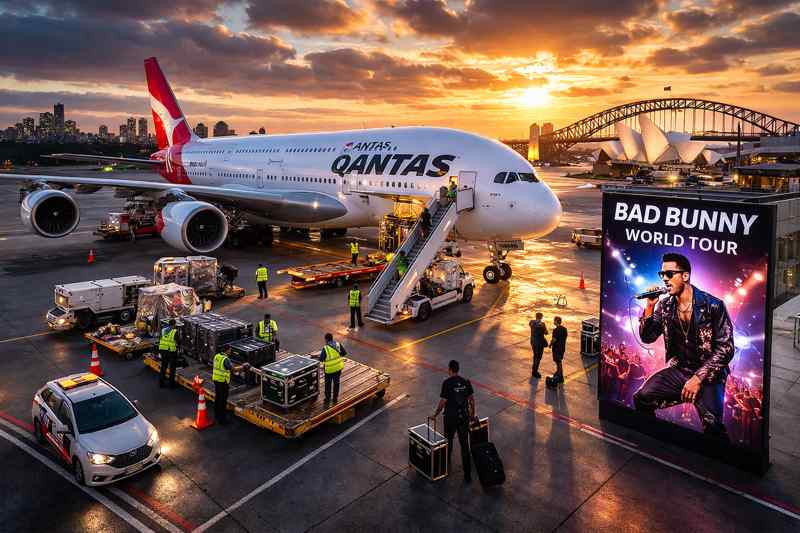
SYDNEY — Australia’s flag carrier Qantas appears to have operated an unusual ultra-long-haul charter flight involving its flagship Airbus A380, with flight activity and industry reports pointing to a possible link with global music star Bad Bunny’s latest world tour.
The aircraft, registered VH-OQA, completed a nearly 15-hour nonstop journey from Sydney to São Paulo on Sunday under flight number QF-6043, before returning to Australia via Auckland. The timing coincides with the South America-to-Australia transition of Bad Bunny’s “Debí Tirar Más Fotos World Tour,” which is scheduled to begin its Sydney leg on February 28.
Charter flights for sports teams and global music tours are common. However, using an Airbus A380 is unusual.
Airlines, including Qantas, typically do not disclose the clients behind private charter operations, citing privacy agreements and commercial confidentiality.
Ferry Flight to Brazil Signals Dedicated Charter
On Sunday, Qantas dispatched Airbus A380 VH-OQA from Sydney to São Paulo under flight number QF-6043, a format typically used to designate ferry flights. These flights reposition aircraft without passengers onboard.
The 13,387-kilometer sector lasted nearly 15 hours. The aircraft could complete this ultra-long-haul nonstop flight because it was not carrying passengers, which reduced weight and improved range performance.
This movement marked Qantas’ first visit to Brazil in nearly a decade. The airline last operated charter services to the country during the Rio Olympic Games in 2016.
By early Monday, the aircraft departed São Paulo operating as QF-308, a flight number typically used for charter services. The routing included a technical stop in Auckland for refueling before continuing to Sydney.
Flight activity suggests a dedicated charter aligned with the artist’s transition from South America to Australia following two sold-out concerts in Brazil.
Why an Airbus A380 Charter Is Rare in Music Tours
Charter flights are a routine part of logistics for major global tours, allowing artists, crew, and equipment to move efficiently between continents. However, the use of an Airbus A380 — the world’s largest passenger aircraft — remains highly uncommon.
Most tours rely on smaller widebody aircraft due to operational flexibility and cost considerations. The A380’s size limits the number of airports it can serve, and its operating costs are significantly higher than smaller aircraft.
Deploying a superjumbo for a single client reflects the scale and commercial significance of major global tours.
If confirmed, this operation would represent one of the rare instances of an Airbus A380 being used specifically for a music tour transfer between continents.
Complex Logistics Behind High-Profile Charters
Operating a charter of this scale involves extensive planning and coordination. Airlines must manage crew duty limits, fuel planning, airport handling, and regulatory approvals across multiple jurisdictions.
Working a high-profile charter flight is also highly competitive for cabin crew. Airlines may hand-select crew members, sometimes with input from the artist or team.
Other airlines maintain dedicated charter pools to handle VIP and specialty operations.
Among global carriers, Emirates is the largest Airbus A380 operator and one of the few airlines known to charter the aircraft type. In 2021, Emirates canceled an A380 charter for Arsenal F.C. after a player tested positive for COVID-19. The aircraft had been painted with a prominent “Choose to Vaccinate” slogan, drawing attention when the flight was withdrawn.
Charter Highlights Commercial Power of Global Tours
The suspected Qantas charter underscores the growing scale and economic impact of global concert tours, which now function as complex international logistics operations involving hundreds of personnel and large volumes of equipment.
Using a dedicated Airbus A380 allows for maximum capacity and efficiency when moving between distant tour locations on tight schedules.
While neither Qantas nor Bad Bunny’s representatives have publicly confirmed the arrangement, the aircraft’s unusual routing, timing, and charter flight designations strongly indicate a connection to the artist’s tour.
As global touring continues to expand, such rare, high-capacity charter operations highlight the commercial opportunities airlines see in supporting the world’s biggest entertainment acts.
