


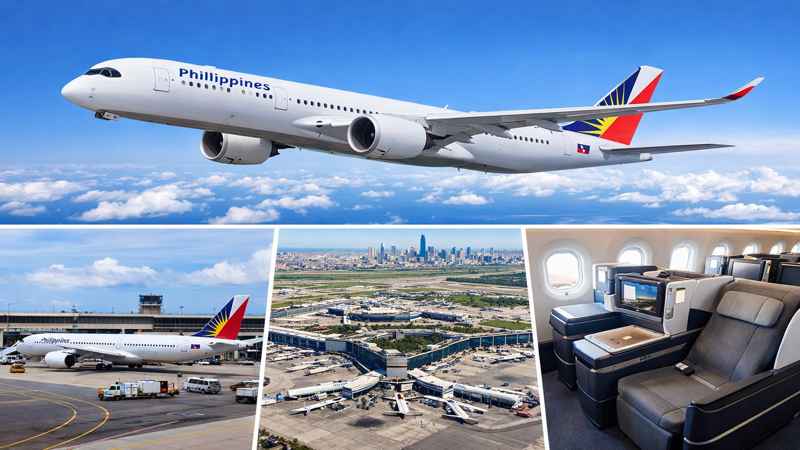
MANILA — Philippine Airlines has filed an application with U.S. regulators seeking permission to launch nonstop passenger flights between Manila and Chicago beginning in the summer 2026 travel season, a move that would further expand its long-haul network and strengthen its presence in the North American market.
The proposed service would connect Ninoy Aquino International Airport in Manila with O’Hare International Airport in Chicago, covering approximately 8,132 miles. That distance would make it one of the longest nonstop commercial passenger routes in the world and one of the airline’s most extensive U.S. operations.
The new Manila (MNL) to Chicago (ORD) service is subject to approval by the US Department of Transportation and is planned for the IATA summer 2026 traffic season.
Airline Files Formal Request for Approval
Philippine Airlines has formally requested authorization from the US Department of Transportation to operate scheduled passenger flights between Ninoy Aquino International Airport in Manila (MNL) and Chicago O’Hare International Airport (ORD). The distance of 8,132 miles places the route among the world’s longest nonstop commercial flights.
The airline has asked for expedited approval to begin ticket sales as soon as regulatory clearance is granted. The planned launch aligns with the IATA summer 2026 season, which runs from late March to late October, OMAAT flagged.
The proposal is consistent with the existing air service agreement between the Philippines and the United States.
The agreement permits Philippine carriers to operate flights from the Philippines to Honolulu (HNL), San Francisco (SFO), Los Angeles (LAX), Guam (GUM), Saipan (SPN), and four additional US points selected by the Philippine government. Chicago would fall under one of those additional designations.
Regulatory approval is generally considered procedural under the current bilateral framework.
Chicago Would Expand Midwest Access
Philippine Airlines currently serves several US destinations, including Guam (GUM), Honolulu (HNL), Los Angeles (LAX), New York (JFK), Saipan (SPN), San Francisco (SFO), and Seattle (SEA). Seattle became the airline’s newest US gateway in late 2024.
Chicago represents a strategic addition. The metropolitan area has one of the largest Filipino populations in the United States, ranking roughly seventh among US cities by Filipino community size. The top four cities in that ranking, Los Angeles, San Francisco, New York, and Honolulu, are already served by the airline.
The carrier previously operated flights to Las Vegas as an extension of its Vancouver service, though that routing has since ended. Adding Chicago would restore Midwest connectivity and expand the airline’s mainland US footprint beyond the West Coast and New York.
Fleet Modernization Supports Long-Haul Plans
Philippine Airlines has undergone significant restructuring in recent years following the global pandemic’s severe impact on air travel demand.
In 2021, the airline entered bankruptcy protection and reduced its fleet as part of its recovery strategy.
In 2023, the airline ordered 9 Airbus A350-1000 aircraft. These aircraft are designed for ultra-long-haul operations and provide higher capacity and improved fuel efficiency compared to earlier variants. The gradual induction of these aircraft supports expansion into new long-distance markets such as Chicago.
Philippine Airlines is not a member of a major global alliance. Its US routes primarily serve point-to-point demand and connecting traffic between the Philippines and North America. Competitive transpacific fares and strong diaspora traffic remain central to its network strategy.
Expansion Reflects Recovery Strategy
If approved, the Manila to Chicago service would further strengthen Philippine Airlines’ competitive position in the U.S. market and broaden its network beyond its traditional gateways.
The planned addition reflects the airline’s steady recovery following restructuring and its investment in more capable long-range aircraft to support expansion.
Further details, including flight frequency, aircraft assignment, and schedule, are expected once final regulatory approval is granted and the route is formally launched.
