


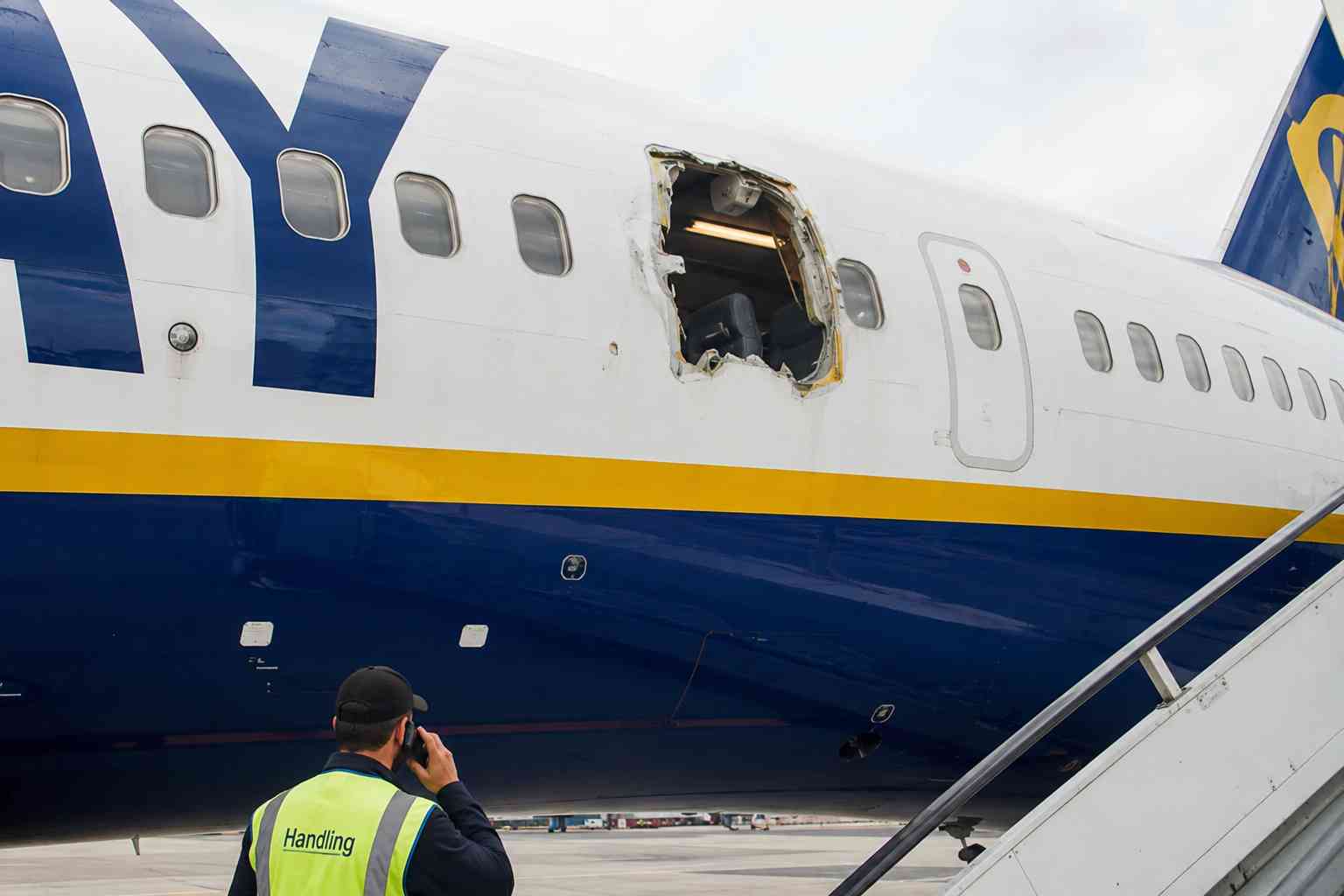
US Safety Investigators Assume Lead Role After Midair Cabin Emergency on Ryanair Flight
DUBLIN — The National Transportation Safety Board (NTSB) has formally assumed control of the investigation into a Ryanair-operated flight that suffered a midair window blowout shortly after takeoff from Greece, an incident that reportedly left one passenger partially pulled outside the aircraft before fellow travelers helped bring him back into the cabin.
The emergency occurred on July 10 aboard a Boeing 737-800 operated by Malta Air, a Ryanair subsidiary, during a scheduled flight from Thessaloniki, Greece, to Memmingen, Germany. The incident prompted an immediate return to Thessaloniki and has drawn international attention as investigators work to determine the cause of the cabin decompression event.
The NTSB confirmed Thursday that the incident took place within Greek airspace, correcting an earlier assessment that placed the event over neighboring North Macedonia. The revised determination paved the way for Greece’s Hellenic Air and Rail Safety Investigation Authority to transfer responsibility for the investigation to the U.S. agency.
Investigation Shifts to NTSB Following Airspace Review
Under international aviation rules, a national safety authority can transfer an investigation to another agency under certain circumstances. After reviewing the aircraft’s flight path, Greek authorities elected to hand the inquiry to the NTSB, which accepted the transfer and will now lead the investigation.
Greece will continue to participate in the inquiry as a party to the investigation.
The change in jurisdiction came after investigators determined that the emergency unfolded entirely within Greek airspace. Earlier reports had indicated the aircraft was over North Macedonia when the incident occurred.
The NTSB’s involvement places one of the world’s most experienced aviation investigative bodies at the center of a case that has raised questions about both cabin integrity and a reported engine-related issue.
Sequence of Events During the Flight
The aircraft departed Thessaloniki Airport on a morning flight bound for Memmingen, located near Munich in southern Germany. According to passenger accounts reported by Greek media, travelers heard a loud bang shortly after departure before oxygen masks automatically deployed throughout the cabin.
Witnesses said the aircraft began descending soon afterward as the crew responded to the loss of cabin pressure.
Cabin Decompression and Passenger Response
Aviation experts say a window failure at altitude can result in rapid decompression, a sudden reduction in cabin pressure that may create a powerful suction effect near the opening.
Shye Gilad, a former airline captain who teaches at Georgetown University’s business school, explained the dangers associated with such events and emphasized the importance of seat belt use.
“The seat belt can help in those first few seconds. It’s a difference maker, and people should keep their seat belts fastened at all times,” he said.
Gilad noted that incidents involving cabin breaches are uncommon in modern commercial aviation. He described such events as “very rare” because “it takes a lot to breach a cabin.”
Videos shared by Radio Thessaloniki appeared to show passengers wearing oxygen masks after the cabin lost pressure. Additional footage reportedly showed the damaged window area and emergency responders assisting passengers after the aircraft landed safely.
Passenger Injuries and Medical Treatment
A 61-year-old passenger sustained injuries during the incident, according to a Greek hospital official. The individual reportedly suffered neck and shoulder injuries as well as friction burns.
Authorities have not publicly identified the passenger, and it was not immediately clear whether he remained hospitalized as of Thursday.
Ryanair stated that one passenger requested and received medical assistance following the aircraft’s return to Thessaloniki.
The airline also said a replacement aircraft was dispatched to transport affected passengers to Germany after the emergency landing.
Questions Remain Over Reported Engine Issue
While the cabin decompression remains the central focus of the investigation, conflicting accounts have emerged regarding a possible engine-related problem.
The NTSB previously stated that it had been informed the flight returned to Thessaloniki because of “a right engine issue and cabin decompression.”
However, Ryanair has not publicly addressed the reported engine concern. When asked to comment, the airline reiterated its earlier statement that the aircraft returned after a window became dislodged.
The discrepancy between the NTSB’s account and Ryanair’s explanation is expected to be examined as part of the ongoing investigation.
Flight Data Reveals Rapid Descent
Flight records indicate the Boeing 737-800, which was delivered new to Ryanair in 2008, climbed to more than 15,000 feet approximately six minutes after takeoff before initiating a rapid descent.
The aircraft descended to around 6,000 feet and remained at that lower altitude for roughly 30 minutes, according to flight-tracking service Flightradar24. Aviation experts note that descending to a lower altitude is a standard procedure following cabin depressurization because passengers can breathe safely without supplemental oxygen.
After remaining at the lower altitude, the aircraft returned to Thessaloniki and landed approximately one hour after departure.
Investigation Continues
The NTSB-led investigation will focus on determining how the window became dislodged, whether any mechanical or maintenance issues contributed to the incident, and whether the reported engine issue played any role in the emergency.
As investigators analyze flight data, maintenance records, and witness accounts, the incident remains a rare but serious example of the challenges airlines face in maintaining cabin integrity and passenger safety during flight.
