


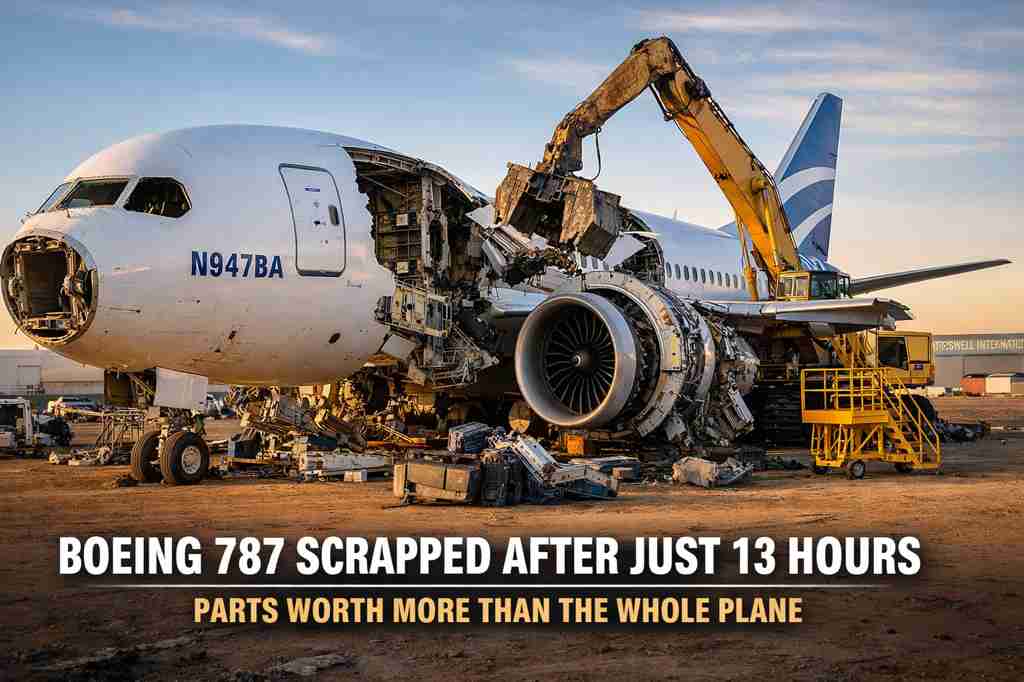
A Nearly New Dreamliner Meets an Unusual End
EVERETT — A Boeing 787-8 Dreamliner that flew for only 13 hours is being dismantled for parts, underscoring how supply chain pressures and surging demand for components are reshaping aircraft economics.
The aircraft, registered as N947BA, is currently undergoing teardown at Roswell International Air Center in New Mexico. Despite its minimal flight history, the jet never entered commercial service and is now considered more valuable in pieces than as a complete aircraft.
The dismantling is being carried out by C&L Aviation, which said the project marks a milestone: the first GE Aerospace-powered 787 to be disassembled in the United States and the first “new” Dreamliner to be scrapped globally. The move reflects a broader shift in the aviation market, where parts shortages are driving up the value of individual components.
Early Design Flaws Limited Commercial Viability
“Terrible Teens” Legacy
N947BA, bearing Boeing serial number 35507 and line number 17, belongs to a group of early-production Dreamliners commonly referred to as the “terrible teens.” These aircraft were built before full certification and were later found to have structural weaknesses where the wings joined the fuselage.
To address the issue, Boeing implemented custom reinforcements. However, these modifications added weight and reduced the aircraft’s maximum takeoff weight by as much as 12 tonnes. The result was a jet that proved difficult to market and inefficient to operate compared to later production models.
Originally intended for Royal Air Maroc, the aircraft was ultimately rejected due to assembly defects and performance limitations.
Failed Luxury Conversion Plans
In 2017, the aircraft found a potential second life when Crystal Cruises acquired it, planning to transform it into a high-end private jet for its Crystal Luxury Air venture. The concept envisioned 60 first-class seats and exclusive 14- to 28-day global itineraries.
Those plans never materialized.
By 2021, amid pandemic-driven financial restructuring, Crystal sold the aircraft for $25 million. The jet remained in storage at Southern California Logistics Airport in Victorville for seven years before being relocated to Roswell in 2024 for dismantling.
Strong Demand for Parts Drives Decision
Engines Alone Exceed Aircraft Value
The financial rationale behind scrapping the aircraft is straightforward. A global shortage of spare parts, combined with ongoing supply chain disruptions, has significantly increased the value of serviceable components from the 787 program.
N947BA is powered by two GEnx-1B engines from GE Aerospace. According to aviation analyst IBA, each engine is valued at approximately $20 million at half-life. Together, the engines alone are worth around $40 million—already exceeding the aircraft’s last sale price by $15 million.
When additional components are factored in, the numbers become even more compelling. The landing gear set is estimated at $4–6 million, avionics and major replaceable units at $2–4 million, and auxiliary power unit (APU) and nacelle hardware at $2–3 million. Combined with other reusable parts, the total estimated value ranges between $50 million and $56 million.
Selling the aircraft intact, given its limited flight history and complex background, would have been far less predictable and likely less profitable.
Low Usage Increases Appeal as Donor Aircraft
C&L Aviation President Tim Brecher noted that the aircraft’s extremely low cycle count makes it particularly attractive as a source of high-quality spare parts.
At the same time, much of the global 787 fleet is approaching major 12-year maintenance checks, increasing demand for replacement components. Airlines are seeking reliable parts quickly, but supply chains have struggled to keep pace.
This imbalance has created a seller’s market for dismantled aircraft components, especially those with minimal wear.
Not the First, and Likely Not the Last
A Growing Trend in Dreamliner Teardowns
While N947BA’s case is unusual due to its limited use, it is not the first Dreamliner to be dismantled. Boeing’s own early test aircraft were previously scrapped, as they were never intended for long-term airline operations.
More recently, two former Norwegian Air Shuttle 787-8 aircraft were dismantled in Scotland in 2023 after approaching costly maintenance thresholds.
What sets N947BA apart is that its teardown was driven not by age or maintenance economics, but by a combination of design limitations and strong parts demand.
Other Early Aircraft Under Watch
Another early-build Dreamliner, registered as VP-CSC and carrying line number 19, shares a similar “terrible teens” background. The aircraft has been in storage for over eight years and has logged only three flights.
While no dismantling decision has been announced, industry observers suggest that aircraft with similar profiles could face the same fate if parts values continue to outpace whole-aircraft demand.
Market Signals for the Aviation Industry
The dismantling of a nearly new widebody jet highlights a broader shift in aviation economics. In an environment defined by supply chain constraints and aging fleets, the value of parts can surpass that of complete aircraft—even those with minimal usage.
For airlines, lessors, and maintenance providers, the case of N947BA serves as a clear signal: in today’s market, the sum of an aircraft’s parts can be worth far more than the whole.
