


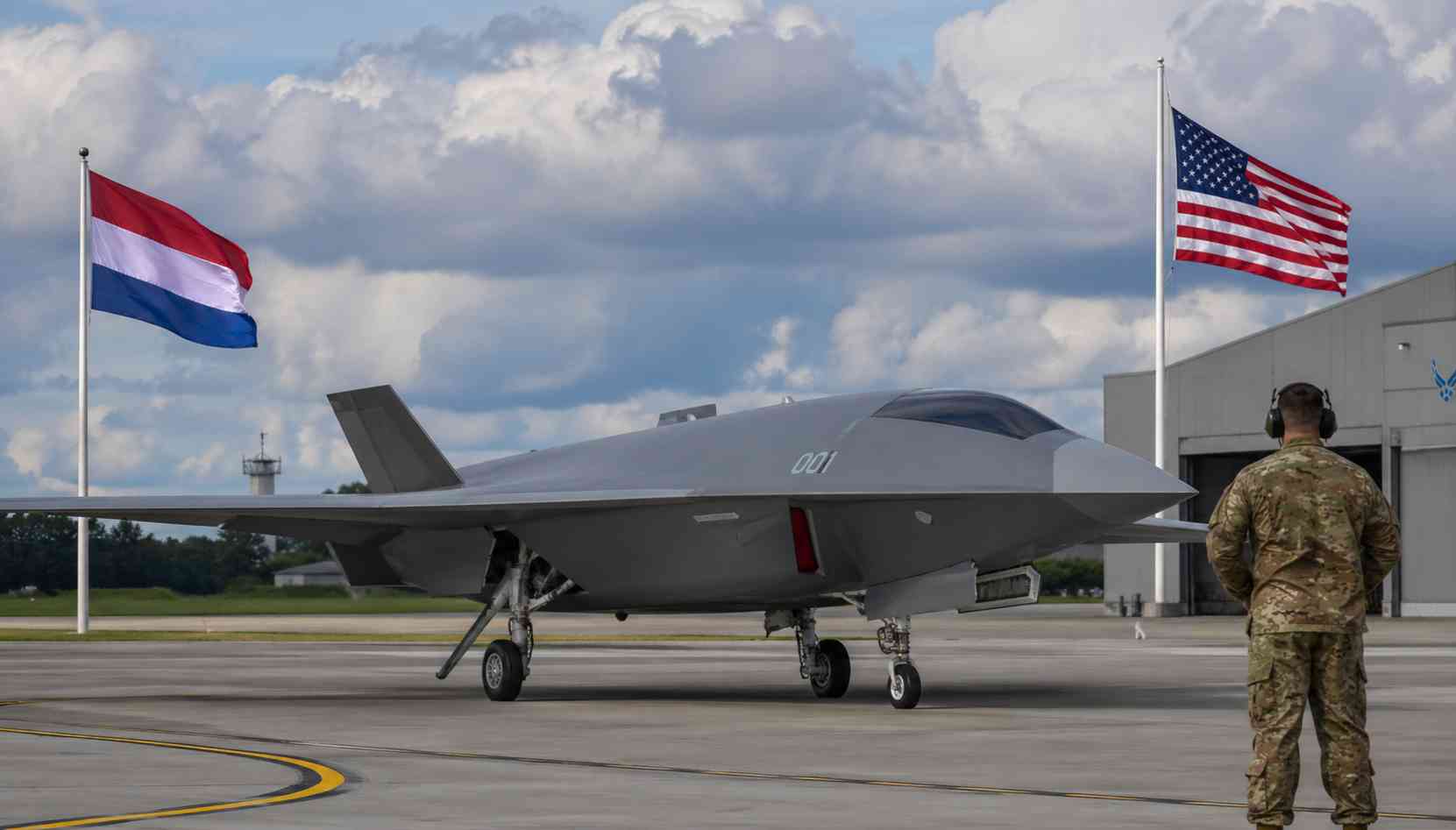
Amsterdam Aligns with Washington on Next-Generation Air Combat Development
AMSTERDAM — The Netherlands has formally joined a major U.S.-led effort to develop autonomous combat aircraft, committing a prototype platform to a collaborative program with the United States Air Force in a move that underscores deepening transatlantic defense ties and the growing importance of unmanned systems in modern warfare.
The agreement, announced by the Netherlands Ministry of Defence, marks a significant step toward improving interoperability between allied air forces. Under the deal, the Netherlands will provide a prototype Collaborative Combat Aircraft (CCA) for joint testing and operational development in the United States.
The partnership builds on a 2025 letter of intent and reflects a broader push among NATO allies to align early on emerging defense technologies. While the program is military-focused, officials noted its proximity to broader aerospace ecosystems, including those linked to Amsterdam Airport Schiphol, highlighting increasing overlap between civil and defense aviation sectors.
Advancing Interoperability Through Shared Development
At the core of the agreement is a shared objective: ensuring that future autonomous aircraft can seamlessly integrate into joint missions across allied forces. The Netherlands’ contribution of a prototype aircraft will support testing of operational concepts, particularly those involving human-machine teaming and coordinated mission execution in contested environments.
Defense officials on both sides emphasized the importance of early-stage collaboration. By aligning systems, standards, and operational doctrines during development, the two countries aim to avoid compatibility challenges that have historically complicated multinational deployments.
The initiative will involve close cooperation with the USAF’s Experimental Operations Unit, which is tasked with translating emerging technologies into real-world mission capabilities. The unit plays a central role in refining how CCAs will operate alongside crewed aircraft in future combat scenarios.
Focus on Open-Architecture Autonomous Systems
A defining feature of the program is its emphasis on open-architecture systems. These frameworks enable different platforms to communicate and share data without being constrained by proprietary technologies, allowing for greater flexibility and scalability.
The shift toward modular, software-driven defense systems reflects the rapidly evolving nature of modern threats. Open architectures make it easier to upgrade capabilities, integrate new technologies, and adapt to changing mission requirements without extensive redesign.
For the Netherlands, participation in this development phase provides early access to cutting-edge technologies and operational insights, positioning its air force to play a more integrated role in future coalition missions.
Global Momentum Behind CCA Programs
The U.S.-Netherlands partnership comes amid accelerating global interest in collaborative combat aircraft. Multiple allied nations are investing in similar initiatives, with industry players competing to develop deployable autonomous platforms.
Recent exercises tied to the USAF’s CCA Increment 1 program have featured aircraft such as the YFQ-44A developed by Anduril Industries and the YFQ-42A from General Atomics Aeronautical Systems. These efforts aim to field operational systems in the near term, signaling a shift from experimentation to deployment.
Beyond Europe, international collaboration is expanding. Australia and Japan have launched joint initiatives involving the MQ-28A Ghost Bat, developed by Boeing Defense Australia, further illustrating the emergence of a global network focused on autonomous air combat capabilities.
Strategic Implications for NATO and Allied Defense
The Netherlands’ decision to join the U.S.-led program reflects a broader strategic shift within NATO toward integrated, technology-driven defense planning. Autonomous systems are expected to play a central role in future air combat, operating alongside traditional crewed aircraft to enhance mission effectiveness and reduce risk to personnel.
By participating at an early stage, the Netherlands not only strengthens its own defense capabilities but also reinforces the principle of interoperability as a cornerstone of allied operations. As air forces adopt increasingly advanced systems, the ability to operate seamlessly across national boundaries will remain critical.
The agreement signals a clear commitment from both nations to shape the future of air combat collaboratively, leveraging shared expertise and resources to address emerging security challenges.
