


Scoot tops 2025 emissions rankings as low-cost carriers dominate efficiency metrics
LONDON — Singapore-based low-cost carrier Scoot has emerged as the world’s most emissions-efficient airline, according to Cirium’s 2025 EmeraldSky Annual Review, underscoring the growing advantage of budget carriers in the race to lower aviation emissions.
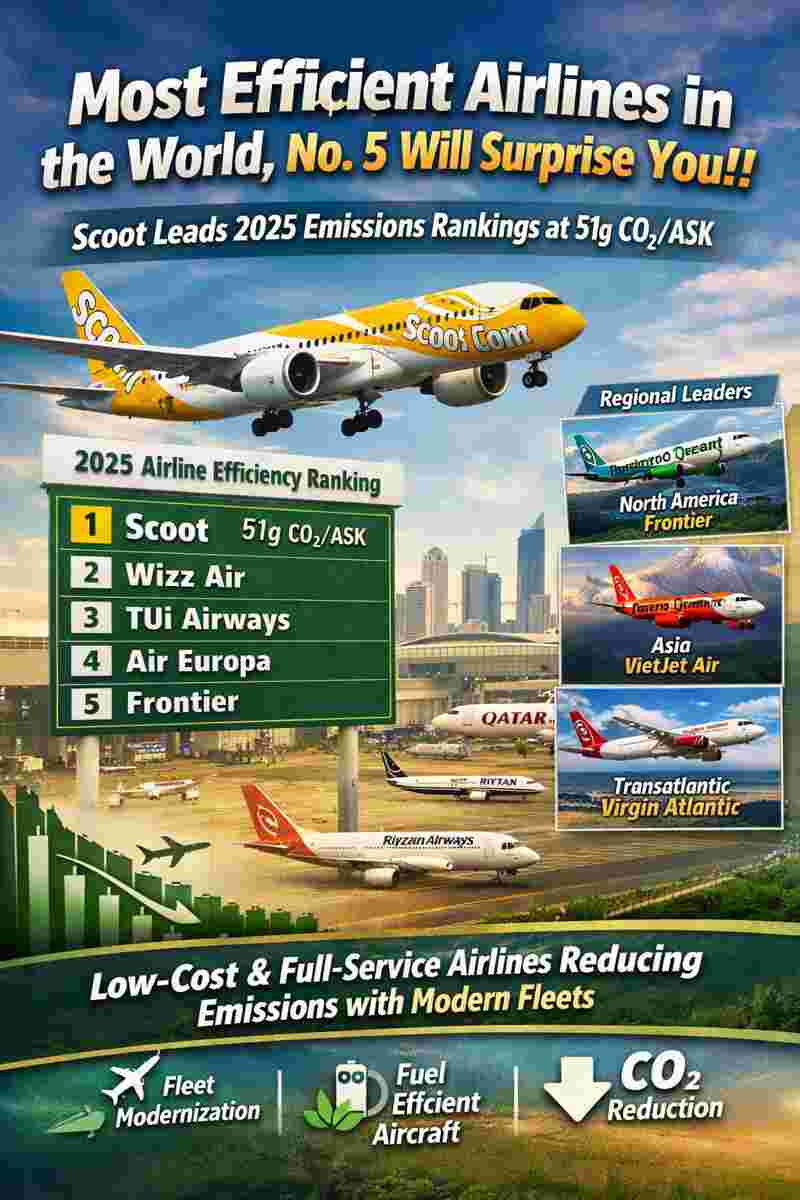
The report, released by the global aviation analytics firm, ranks the world’s 100 largest airlines based on carbon dioxide (CO₂) emissions per available seat kilometre (ASK), a key industry metric used to measure operational efficiency. Scoot took the top spot with a CO₂ intensity of 51 grams per ASK, overtaking last year’s leader Wizz Air.
Cirium’s findings highlight a broader industry trend: airlines with high seat density, modern fleets, and optimized route networks are achieving significant gains in emissions efficiency, often translating into lower operating costs.
Low-Cost Airlines Lead Global Rankings
Scoot’s rise to the top reflects the structural advantages of low-cost carriers. By maximizing seating capacity and operating longer average routes, the airline is able to distribute emissions across more passengers, reducing per-seat carbon output.
Wizz Air secured second place, followed by TUI Airways, Air Europa, and Frontier Airlines, which collectively rounded out the top five and earned EmeraldSky Gold status.
The dominance of budget airlines in the upper tier of the rankings was a defining feature of this year’s report. Their relatively young fleets and high utilization rates allow them to operate more efficiently compared to many legacy carriers.
Airlines ranked between sixth and tenth, including TUIfly and Virgin Atlantic, were awarded Silver status. Meanwhile, carriers such as Condor, Iberia, and IndiGo fell into the Bronze tier, indicating moderate but improving efficiency levels.
Full-Service Carriers Show Strength in Capacity Metrics
While low-cost airlines led overall efficiency rankings, full-service carriers performed strongly when measured by total available seat kilometres.
Qatar Airways topped this category, achieving a CO₂ intensity of 60 grams per ASK despite operating predominantly long-haul routes. The airline’s performance reflects ongoing investments in fleet modernization and fuel-efficient aircraft.
Ryanair ranked second, benefiting from its extensive short-haul network and high aircraft utilization. Turkish Airlines secured third place, demonstrating that a hybrid model combining long-haul and regional operations can also deliver strong efficiency outcomes.
The report notes that these results illustrate how different business models can achieve similar environmental performance when supported by strategic investments in aircraft and operations.
Regional Leaders Highlight Global Progress
Cirium’s analysis also identified top-performing airlines across key geographic markets, pointing to widespread improvements in emissions efficiency.
Frontier Airlines led the intra-North America category, while Wizz Air topped the European rankings with strong short-haul performance. In Southeast Asia, VietJet Air emerged as the most efficient operator, outperforming both Singapore Airlines and Lion Air.
JetSmart led Latin America, while Virgin Atlantic dominated transatlantic routes, driven by efficient widebody aircraft operations.
In transpacific markets, Air Canada ranked first, followed by Delta Air Lines and Cathay Pacific. These rankings highlight the increasing role of next-generation aircraft in improving efficiency on long-haul routes, traditionally one of the most emissions-intensive segments of aviation.
Fleet Modernization Drives Emissions Reductions
Beyond airline-level rankings, the report emphasizes measurable progress at the route level. Airlines including Korean Air and American Airlines recorded emissions reductions of more than 20 percent on select routes after replacing older aircraft with newer, fuel-efficient models.
Cirium’s analysis reinforces the importance of fleet renewal and operational optimization as key drivers of sustainability in aviation. Airlines investing in modern aircraft and higher seat density continue to outperform competitors on both environmental and financial metrics.
The findings also underscore a growing alignment between sustainability and profitability. Lower emissions per seat often correspond with reduced fuel consumption and operating costs, strengthening the business case for continued investment in efficiency improvements.
As the aviation industry faces increasing pressure to reduce its environmental footprint, Cirium’s 2025 EmeraldSky Annual Review suggests that both low-cost and full-service carriers have viable pathways to achieving meaningful emissions reductions—provided they prioritize modernization and operational discipline.
