


USAF moves to scale low-cost, long-range strike capability
WASHINGTON, D.C. — The United States Air Force has issued a Request for Information (RFI) for a new class of affordable, long-range air-to-surface missiles designed to be launched from cargo aircraft in large volumes, signaling a significant shift in how the service plans to deliver mass strike capability in future conflicts.
The program, titled Family of Affordable Mass Missiles — Beyond Adversary’s Reach (FAMM-BAR), calls for production of between 1,000 and 2,000 missiles annually over a five-year period. The initiative reflects growing urgency within the Pentagon to expand munitions stockpiles while reducing per-unit costs.
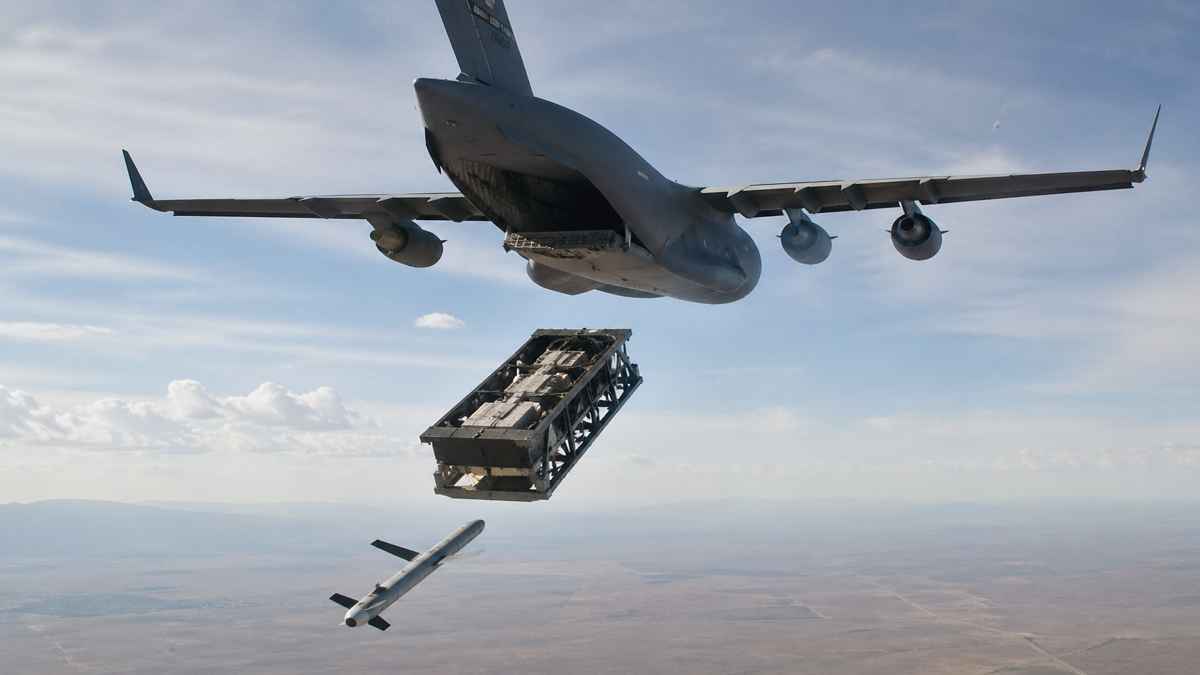
At its core, FAMM-BAR focuses on an anti-ship cruise missile with a minimum range of 1,000 nautical miles and a speed of at least Mach 0.7. The Air Force intends for these weapons to be deployed via palletized systems aboard cargo platforms such as the Boeing C-17 Globemaster III and Lockheed Martin C-130 Hercules, building on prior demonstrations under the Rapid Dragon program.
USAF Seeks Missile Launch from Cargo Plane
The Air Force’s stated objective is to streamline combat operations by developing a single, adaptable munition capable of long-range engagement at a significantly lower cost than existing systems. The missile is primarily intended to target slow-moving maritime vessels, aligning with potential operational scenarios in the Indo-Pacific.
The RFI outlines five key requirements: a range of at least 1,000 nautical miles, a minimum speed of Mach 0.7, compatibility with palletized cargo deployment, the ability to receive mid-course updates, and a production rate exceeding 1,000 units annually. These specifications place FAMM-BAR in a similar performance category to the BGM-109 Tomahawk Block V Maritime Strike, but with a focus on affordability and flexible deployment.
The Air Force is also exploring whether the missile can be adapted for use on fighters and bombers. Early testing of a lugged variant has already been conducted on the General Dynamics F-16 Fighting Falcon, suggesting broader platform compatibility could be feasible.
Multi-Service Potential Across Army, Navy, and Air Force
Although led by the Air Force, the FAMM-BAR effort has potential implications for other branches. The RFI invites contractors to assess whether their designs could support surface-to-surface use by the United States Army and United States Navy.
However, officials emphasized that this inquiry is exploratory. The Air Force clarified that it does not constitute a formal requirement from other services, nor does it obligate contractors to modify designs to meet joint-use scenarios.
Another key requirement is resilience in contested environments. The Air Force is seeking assurances that the missile can maintain navigation accuracy in the face of GPS jamming, a growing concern as adversaries invest heavily in electronic warfare capabilities.
Budget Growth and Expanding Missile Family
FAMM-BAR represents the longest-range variant within a broader family of affordable cruise missiles. Existing variants, including palletized and lugged versions, offer shorter ranges of 250 to 500 nautical miles.
The fiscal 2027 budget includes $300 million in mandatory funding and $55 million in discretionary funds for the procurement of 1,000 FAMM missiles. Overall missile procurement funding is set to rise sharply, reaching $11.36 billion—nearly triple the previous year’s allocation—with projections climbing to $16 billion by 2029.
Additional funding has been earmarked under separate legislation, further underscoring the Pentagon’s focus on scaling missile production.
Rapid Dragon Heritage and Cost Advantage
The FAMM-BAR concept builds directly on the Rapid Dragon program, which demonstrated that cargo aircraft can deploy cruise missiles using palletized systems without permanent modifications.
In a 2021 test, a pallet dropped from a C-17 successfully launched a missile that received in-flight targeting updates and struck a naval target. The system enables a single C-130 to launch up to 12 missiles and a C-17 to deploy as many as 45 in one sortie.
This approach effectively transforms transport aircraft into stand-off strike platforms. However, existing missiles like the AGM-158 JASSM-ER come at a cost of roughly $2.5 million each. FAMM aims to reduce that figure dramatically, targeting a unit cost of approximately $218,000.
Strategic Pressure and Industry Competition
The push for affordable mass munitions comes amid concerns about dwindling U.S. missile inventories. Sustained operations in the Middle East and the demands of potential high-end conflicts—particularly in the Indo-Pacific—have highlighted the need for scalable, cost-effective strike options.
Defense analysts estimate that a major conflict could require the ability to strike more than 100,000 targets, a volume that current procurement models cannot sustain.
This demand is fueling competition across the defense industry. Companies including Lockheed Martin, Anduril Industries, Leidos, and CoAspire are all developing low-cost cruise missile concepts aimed at meeting the Air Force’s requirements.
The RFI response deadline is April 29, 2026. Following submissions, the Air Force will evaluate industry proposals to determine the next phase of the FAMM-BAR program.
As the Pentagon prioritizes affordability and scale, FAMM-BAR could mark a pivotal step in reshaping how the U.S. military approaches long-range strike operations in future conflicts.
