


U.S. Air Force Signals Renewed Hypersonic Push With Budget and Platform Expansion
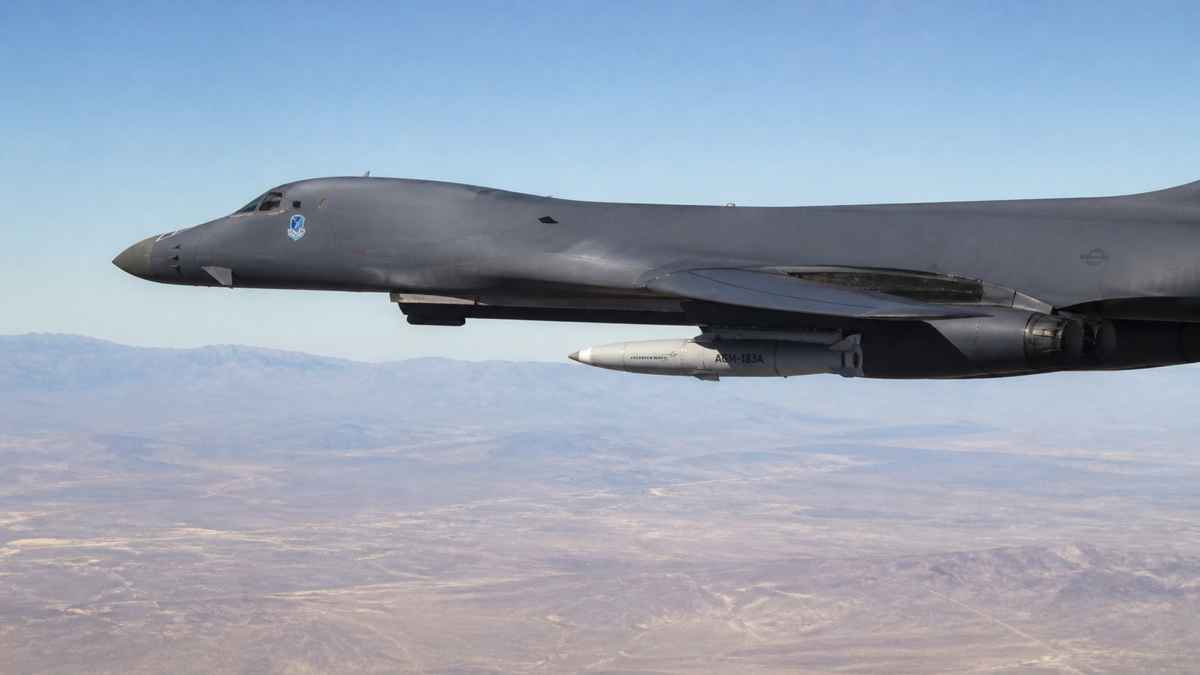
The U.S. Air Force has released its first official imagery of a B-1B Lancer bomber carrying the AGM-183 Air-launched Rapid Response Weapon (ARRW), marking a significant step in the service’s evolving hypersonic weapons strategy. The footage, shared via Edwards Air Force Base’s social media channels, highlights the bomber’s expanding role as a test and deployment platform for next-generation strike capabilities.
The development aligns with the Air Force’s Fiscal Year 2027 budget request, which includes nearly $350 million for ARRW Increment 2 and a new air-launched ballistic missile (ALBM) program. The funding signals a reversal from earlier plans to cancel ARRW in 2023, underscoring renewed institutional support for hypersonic systems amid intensifying global competition.
B-1B Lancer Repositioned as Hypersonic Weapons Platform
External Payload Capacity Drives Strategic Relevance
Originally designed during the Cold War, the B-1B Lancer was equipped with up to eight external hardpoints capable of carrying nuclear-armed cruise missiles. Following the aircraft’s transition away from nuclear missions, these external pylons fell largely into disuse. However, the Air Force has reactivated these capabilities to support hypersonic weapons integration.
By 2020, service leadership had already outlined plans to modify portions of the B-1B fleet to carry ARRW externally. The decision to use external pylons was driven by speed and cost efficiency, enabling faster integration compared to internal modifications.
The bomber now plays a central role in testing the Load Adaptable Modular (LAM) pylon, a system designed to carry heavy and oversized weapons. Each B-1B can be outfitted with up to six LAM pylons, capable of supporting either two 2,000-pound-class weapons or a single payload exceeding 5,000 pounds. The ARRW falls into the latter category.
Recent testing confirmed the aircraft’s ability to carry and release heavy hypersonic-class payloads, validating the platform’s suitability for future operational deployment. The same external stations have also supported tests involving Joint Direct Attack Munitions (JDAM), AGM-158 Joint Air-to-Surface Standoff Missiles (JASSM), and advanced targeting pods.
ARRW Program Revived With Expanded Capabilities
Increment 2 and ALBM Signal Broader Strike Ambitions
The AGM-183A ARRW is designed as a boost-glide hypersonic weapon. It uses a rocket booster to achieve high سرعت and altitude before releasing a glide vehicle that travels toward its target along a low, unpredictable trajectory. This combination of speed and maneuverability significantly reduces interception windows for adversaries.
Although the Air Force had previously moved to terminate ARRW in favor of the Hypersonic Attack Cruise Missile (HACM), ongoing developments suggested continued interest in maintaining a diversified hypersonic portfolio.
The Fiscal Year 2026 budget formally reinstated ARRW procurement, while the 2027 request builds on that momentum through Increment 2. While specific enhancements remain undisclosed, the updated variant is expected to deliver improved performance and operational flexibility.
In parallel, the newly funded ALBM program aims to introduce an additional long-range air-launched strike capability, complementing both ARRW and HACM systems. Budget documents indicate a broader strategy to accelerate hypersonic weapons production, with approximately $1.8 billion allocated across the Future Years Defense Program to scale development and deployment.
Fleet Modernization Extends B-1B Service Life
Operational Demand Delays Retirement Timeline
The renewed focus on hypersonic integration has also influenced the long-term outlook for the B-1B fleet. Previously slated for retirement by 2030, the aircraft is now expected to remain operational through at least 2037.
The Fiscal Year 2027 budget allocates $342 million between 2027 and 2031 to modernize the remaining 44 B-1B bombers. These upgrades aim to sustain combat effectiveness while adapting the platform for emerging mission requirements.
The decision reflects growing demand for bomber capacity across multiple theaters. Recent combat operations, ongoing global bomber task force deployments, and rising geopolitical tensions—particularly in the Indo-Pacific region—have reinforced the strategic value of long-range strike platforms.
The B-1B continues to hold a unique position within the Air Force inventory due to its unmatched conventional payload capacity. As new external weapons configurations are integrated, that capability is expected to expand further.
Strategic Implications for U.S. Air Power
The combination of renewed ARRW investment, ALBM development, and B-1B modernization points to a broader recalibration of U.S. airpower strategy. By leveraging existing platforms like the B-1B alongside next-generation systems such as the B-21 Raider, the Air Force is pursuing a layered approach to long-range strike.
This strategy emphasizes flexibility, rapid deployment, and technological advantage—key factors in maintaining deterrence and operational readiness in an increasingly contested global environment.
As hypersonic weapons move closer to operational deployment, the B-1B’s transformation from a legacy bomber to a cutting-edge strike platform illustrates how existing assets can be adapted to meet future threats.
