


$300 Million Operation Revives Debate on Combat Search and Rescue Readiness
WASHINGTON, D.C. — The United States Air Force mounted a high-risk, large-scale combat search and rescue (CSAR) mission in early April 2026 after an F-15E Strike Eagle was shot down over Iran, marking the first such recovery of American airmen from hostile territory in nearly three decades.
The 48-hour operation, involving 21 aircraft, special operations forces, and intelligence assets, successfully recovered both crew members but came at a steep cost of at least $300 million in destroyed equipment.
The mission has reignited longstanding debates over the readiness, cost, and strategic importance of CSAR operations in modern warfare, particularly against advanced adversaries.
A High-Stakes Rescue Under Fire
The incident began on April 3, 2026, when the F-15E was downed, forcing its pilot and weapons systems officer—identified by call signs DUDE 44A and DUDE 44B—to eject into Iranian territory.
Rescue forces moved quickly. Within hours, a daylight operation extracted the pilot. However, the second crew member remained evading capture for roughly 36 additional hours as Iranian state television broadcast a bounty for his capture.
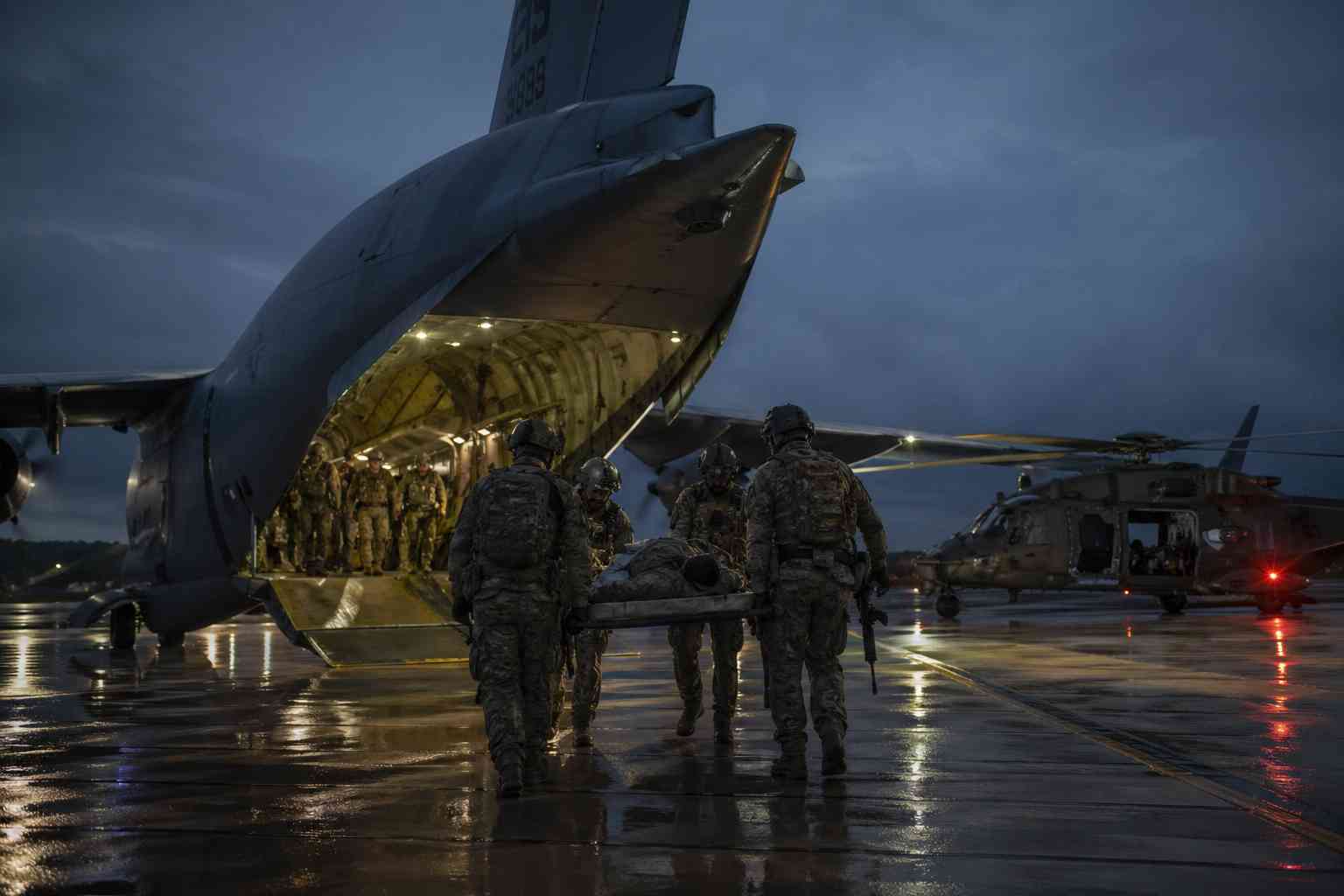
The rescue effort included A-10 attack aircraft, HC-130 rescue airlifters, and HH-60W helicopters, alongside additional joint-force assets. The mission encountered significant challenges, including hostile fire and difficult terrain.
Two HC-130 aircraft and two Army MH-6 helicopters became immobilized in soft ground and were destroyed to prevent capture. An A-10 aircraft was hit by anti-aircraft fire and later ditched in friendly territory.
Despite the losses, military leadership emphasized the mission’s success. Chairman of the Joint Chiefs of Staff Gen. Dan Caine stated that the operation demonstrated the U.S. military’s commitment to valuing human life over equipment.
Echoes of Past Conflicts
The mission drew immediate comparisons to similar rescues during the Balkan conflicts of the 1990s.
In 1995, Capt. Scott O’Grady survived six days behind enemy lines in Bosnia after his F-16 was shot down, evading capture until a Marine rescue team extracted him. Four years later, then-Lt. Col. David Goldfein endured a similar ordeal in Serbia, escaping capture before being rescued under fire.
Both incidents became defining examples of the risks and importance of CSAR missions, shaping doctrine and reinforcing what many describe as an unwritten promise: no American airman will be left behind.
Strategic Risks of Capture
Military leaders and veterans argue that the stakes extend far beyond individual lives.
A captured U.S. pilot can quickly become a strategic liability, influencing political decisions and public opinion. Analysts point to the 1993 Battle of Mogadishu, where images of fallen American soldiers being dragged through the streets had a profound impact on U.S. policy, contributing to a withdrawal from Somalia.
Retired Air Force Col. Brandon Losacker noted that failure to recover the DUDE 44 crew could have significantly altered U.S. strategic options. He described CSAR missions as critical not just tactically, but politically and psychologically.
Technology and Intelligence Shift the Battlefield
Unlike earlier rescues, the 2026 operation showcased advanced technology and intelligence integration.
Rescue teams used specialized systems capable of detecting a survivor’s heartbeat from miles away. Space Force personnel and intelligence analysts verified that emergency signals were genuine and not enemy decoys.
The CIA also played a role, conducting a misdirection operation that diverted Iranian forces during the extraction. Meanwhile, special operations units secured the area as enemy troops closed in.
However, the operation also highlighted new challenges. Iranian media leveraged social platforms to broadcast images of the crash site, potentially aiding efforts to locate the downed airman.
Retired Gen. Goldfein noted that the speed and reach of modern information sharing present both opportunities and risks for future rescue missions.
Future of Combat Search and Rescue
The mission has renewed scrutiny of CSAR capabilities as the U.S. military prepares for potential conflicts against near-peer adversaries.
In regions like the Indo-Pacific, vast distances and sophisticated air defenses raise concerns about the viability of traditional helicopter-based rescues.
The Air Force had previously reduced its planned procurement of HH-60W rescue helicopters, shifting focus toward autonomous and unmanned alternatives. Congress has partially reversed those cuts, but debate continues over the optimal mix of capabilities.
Goldfein has advocated for a flexible approach, suggesting that high-threat environments require large, coordinated rescue forces, while lower-risk scenarios could rely on unmanned systems.
O’Grady, however, has questioned any reduction in dedicated CSAR units, arguing that their specialized training and mission focus cannot be easily replaced.
Speed as the Decisive Factor
One consistent lesson across decades of CSAR missions is the importance of speed.
Advances in surveillance and communication have made it increasingly difficult for downed personnel to evade capture for extended periods. While some Vietnam-era pilots survived weeks behind enemy lines, experts say such scenarios are unlikely today.
From the moment an aircraft is downed, the clock begins ticking.
The DUDE 44 mission underscores that reality—and reinforces a long-standing principle within the U.S. military: the commitment to bring every service member home, no matter the cost.
