


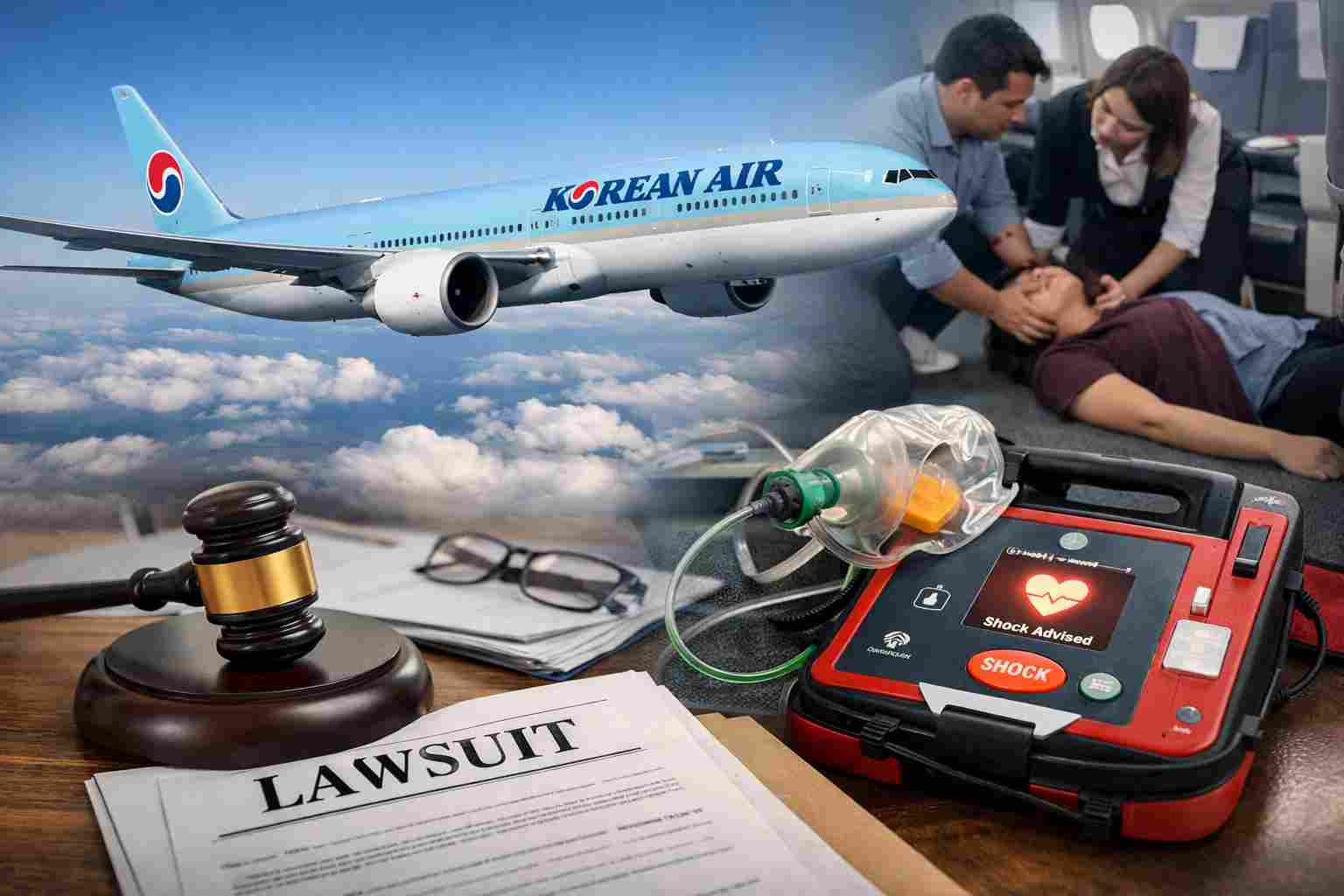
Lawsuit Alleges Critical Failures During In-Flight Medical Emergency
A wrongful death lawsuit filed in a U.S. federal court in Virginia alleges that a series of critical missteps by cabin crew aboard a Korean Air international flight led to the death of a 33-year-old passenger during a medical emergency in March 2024.
The complaint centers on the death of Porscha Tynisha Brown, a U.S. Department of Defense employee, who was traveling from Washington Dulles International Airport to Incheon International Airport on Korean Air Flight KE94. According to the filing, Brown’s death could have been prevented if proper emergency procedures had been followed.
Charles Gormly, acting as the special administrator of Brown’s estate, has filed the lawsuit, asserting that Brown “would have in all likelihood survived” had the crew responded appropriately. Korean Air has acknowledged the lawsuit and stated it will participate in legal proceedings but declined further comment due to the ongoing litigation.
Oxygen Mask Allegedly Not Connected
The lawsuit outlines a troubling sequence of events that began approximately 12 hours into the flight. After the second meal service, Brown reportedly told a companion she was feeling unwell before heading toward the restroom. Moments later, the flight crew issued a public announcement asking for medically trained passengers.
Brown was soon found collapsed in the aisle, clutching her chest and struggling to breathe. Cabin crew provided an oxygen mask, which fellow passengers believed was supplying oxygen. However, the lawsuit claims the mask was never connected to an oxygen source.
“The lawsuit states that throughout the emergency, Brown never received any supplemental oxygen from the tank that Korean Air personnel had provided.”
Defibrillator Use Called Into Question
As Brown’s condition deteriorated, volunteer passengers stepped in to assist. The crew retrieved an automated external defibrillator (AED), but according to the complaint, they failed to provide instructions on how to use it.
The device reportedly issued repeated audio prompts indicating that a shock was advised. However, none of the assisting passengers administered the shock, allegedly because they were not instructed to do so.
The complaint further alleges that the crew did not take control of the situation and instead alternated between observing, taking notes, and panicking.
Volunteer responders also administered epinephrine in an attempt to stabilize Brown, but the effort was unsuccessful.
Emergency Landing and Death in Japan
With Brown unresponsive, the flight was diverted to Osaka, Japan. Upon landing, she was transported to Rinku General Medical Center, where she was pronounced dead. Her death certificate listed acute cardiac failure as the cause.
In the aftermath, Brown’s traveling companions were left to navigate the complexities of international procedures to return her remains to the United States.
Brown, a Maryland native, worked as a workplace safety specialist at Fort Belvoir in Virginia. She held a master’s degree and had planned to pursue further academic achievements. Just days before her trip, she had received an award of excellence from her garrison commander.
Legal Claims and Industry Context
Filed on March 27, 2026, in the U.S. District Court for the Eastern District of Virginia, the lawsuit accuses Korean Air of failing to adhere to its own emergency protocols. Allegations include delays in recognizing the severity of the situation, inadequate medical response, and failure to divert the flight sooner.
Attorney Hannah Crowe, representing Brown’s estate, emphasized the importance of adherence to established procedures, stating that all airlines have strict protocols for handling in-flight medical emergencies and that failing to follow them can have fatal consequences.
Co-counsel Darren Nicholson described the crew’s conduct as particularly concerning, noting that basic procedures were not followed.
The lawsuit seeks damages for wrongful death, lost income, medical expenses, and emotional distress.
Broader Concerns About In-Flight Medical Emergencies
While tragic, incidents like this are not isolated. Studies estimate that in-flight medical emergencies occur between 18.2 and 39 times per million passengers, or roughly once every 212 flights.
Experts note that survival rates for cardiac arrest at cruising altitude are significantly lower than on the ground, partly due to limited medical resources and training.
Attorney Abram Bohrer, who specializes in aviation-related cases but is not involved in this lawsuit, highlighted the inherent risks, stating that outcomes can be poor when flight crews lack sufficient training to manage medical crises effectively.
Under aviation regulations, airlines are required to carry basic medical equipment and ensure crew members are trained in its use. Whether those standards were met on Flight KE94 will ultimately be determined in court.
As the case proceeds, it raises broader questions about airline preparedness and accountability in life-or-death situations at 30,000 feet.
