


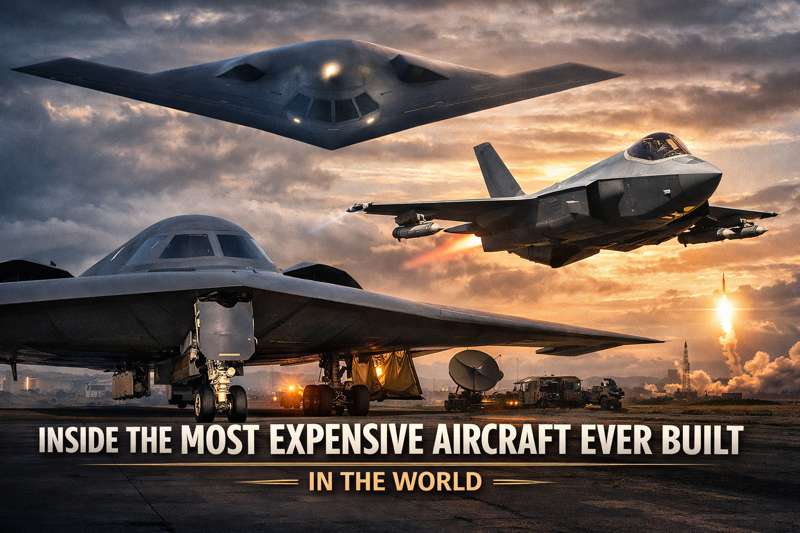
When most people think of expensive aircraft, they often picture ultra-luxurious private jets such as those used by billionaires and heads of state. But in reality, the world’s most expensive aircraft are military platforms built not for comfort, but for strategic dominance and national defense.
These aircraft carry extraordinary price tags because they embody decades of research, classified technologies, and engineering breakthroughs. Their costs reflect not only the physical jet itself, but the extensive development, testing, and sustainment required to ensure they perform in the most demanding and hostile environments.
Unlike commercial airliners, which benefit from mass production that lowers unit costs, military aircraft are typically built in small numbers. As a result, the total cost of development is spread across a limited fleet, dramatically increasing the per-unit price.
What Drives the Cost of Modern Military Aircraft
The price of advanced military aircraft is driven by far more than size or materials. Modern bombers and fighter jets integrate stealth shaping, radar-absorbent coatings, advanced propulsion systems, secure communications, and highly integrated sensor networks.
Research and development is one of the most significant contributors to overall cost. Many programs take two to three decades to progress from initial concept to operational deployment. Over that time, evolving threats, technological advances, and changing mission requirements often increase complexity and expense.
Additionally, military aircraft must undergo extensive testing, certification, and long-term sustainment planning, all of which are included in program costs.
The B-2 Spirit: The Most Expensive Aircraft Per Unit
The Northrop Grumman B-2 Spirit stealth bomber is widely regarded as the most expensive aircraft ever built on a per-unit basis. When development costs are included, each aircraft is estimated to cost more than $2 billion. Only 21 were produced, making it one of the rarest and most expensive aviation platforms in history.
Introduced in the late 1990s, the B-2’s flying-wing design was revolutionary. Its stealth capabilities allow it to penetrate heavily defended airspace undetected and deliver both conventional and nuclear payloads.
The aircraft incorporates radar-absorbent materials integrated directly into its structure, advanced defensive systems for real-time threat detection, and fused avionics that combine navigation, sensor, and mission data into a single interface.
Its aerial refueling capability enables missions lasting more than 40 hours, allowing it to strike targets anywhere in the world. However, its specialized coatings and systems require intensive maintenance, contributing to its high lifetime cost.
Despite its expense, the B-2 remains a central pillar of long-range strategic airpower due to its unmatched combination of stealth and range.
The F-35 Lightning II: The Most Expensive Program Ever
While not the most expensive aircraft per unit, the Lockheed Martin F-35 Lightning II holds the distinction of being the most expensive aircraft program in history. Its total lifecycle cost is estimated at more than $1.7 trillion, covering development, production, and decades of operation.
The F-35 represents a shift in military aviation toward information-centric warfare. It functions as a flying data hub, sharing real-time intelligence with other aircraft, ships, and ground forces.
Much of its cost is tied to software development and systems integration, reflecting the growing importance of digital capabilities alongside traditional performance metrics such as speed and maneuverability.
This approach highlights how modern military aircraft serve not just as weapons platforms, but as critical nodes in a larger defense network.
The B-21 Raider: The Next Generation of Strategic Bombers
The Northrop Grumman B-21 Raider is expected to become one of the most expensive aircraft programs ever undertaken, although precise figures remain classified.
Designed to replace both the B-1 and B-2 bombers, the B-21 incorporates next-generation stealth technology, open-system architecture, and adaptability for future upgrades.
Unlike the B-2, the B-21 is expected to be produced in larger numbers, which may help reduce its per-unit cost. However, total program costs are still projected to reach tens of billions of dollars.
The Raider reflects a continuing trend: as threats evolve, military aircraft become more technologically sophisticated—and more expensive.
Why Commercial Aircraft Cost Less
Even the largest commercial aircraft, such as long-haul widebody jets, rarely approach the costs of military platforms. While their price tags can reach hundreds of millions of dollars, commercial programs benefit from large production volumes and shared development expenses.
Commercial aircraft are also designed for efficiency, reliability, and passenger comfort—not stealth, survivability, or electronic warfare.
They do not require classified systems, hardened communications, or advanced countermeasures, which significantly reduces development complexity and cost.
The Strategic Value Behind the Price
The enormous cost of the world’s most expensive aircraft reflects their strategic importance rather than their physical size or luxury.
These platforms enable missions that no other systems can perform, including global strike capability, nuclear deterrence, and real-time battlefield coordination.
Their development has also driven technological advances that later benefit civilian aviation, including composite materials, fly-by-wire controls, and advanced avionics.
The Future of High-Cost Aviation
As new aircraft like the B-21 Raider enter service, the cost of cutting-edge aviation technology is likely to continue rising.
These aircraft represent the outer limits of engineering and national investment, demonstrating how far governments are willing to go to maintain air superiority.
Ultimately, the most expensive aircraft ever built are defined not by luxury, but by their role in national security and their contribution to technological progress.
