


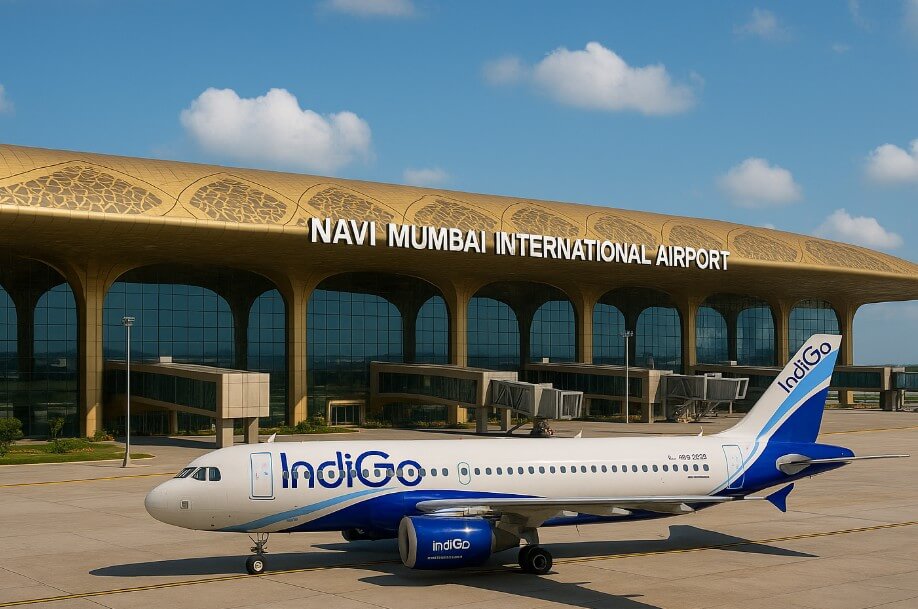
IndiGo Airlines is expanding its domestic network with a slate of new flights from the upcoming Navi Mumbai International Airport (NMI), positioning itself as an early mover at the long-awaited aviation hub designed to support Mumbai’s rising passenger and cargo traffic. The carrier announced four new routes and increased frequencies that will connect the airport to key cities across western and southern India beginning in late December 2025.
The rollout includes daily nonstop services to Coimbatore and Chennai starting December 29, five weekly flights to Vadodara starting December 30, and an increase to five weekly flights to North Goa beginning December 26. Bookings for the new services are now available on IndiGo’s official channels.
The additions strengthen IndiGo’s footprint in a region that has faced severe capacity constraints at Mumbai’s primary airport, Chhatrapati Shivaji Maharaj International Airport (BOM). With NMI preparing to launch its first operational phase, IndiGo’s expanded schedule gives local travelers more direct connections while helping accelerate commercial activity at the new site.
Expanded Connectivity for the Region
IndiGo’s new network out of NMI is designed to offer consistent connectivity for both business and leisure travelers, particularly those who live or work in Navi Mumbai and the eastern stretches of the metropolitan region.
The daily flights to Coimbatore and Chennai provide southbound access to two major economic and educational centers. Services to Vadodara target rising demand along the western industrial corridor, while the increased North Goa frequencies support travel flows during the destination’s peak tourist season.
The flight schedule includes:
Effective December 26, 2025
-
North Goa (GOX) → NMI: Flight 6E 0647, Tue/Wed/Fri/Sat/Sun, Dep. 14:15 Arr. 15:20
-
NMI → North Goa (GOX): Flight 6E 0646, Tue/Wed/Fri/Sat/Sun, Dep. 12:45 Arr. 13:45
Effective December 29, 2025
-
NMI → Coimbatore (CJB): Flight 6E 0860, Daily, Dep. 09:00 Arr. 10:45
-
Coimbatore (CJB) → NMI: Flight 6E 0861, Daily, Dep. 11:15 Arr. 13:05
-
Chennai (MAA) → NMI: Flight 6E 0898, Daily, Dep. 06:10 Arr. 08:15
-
NMI → Chennai (MAA): Flight 6E 0899, Daily, Dep. 19:40 Arr. 21:35
Effective December 30, 2025
-
NMI → Vadodara (BDQ): Flight 6E 0890, Tue/Wed/Fri/Sat/Sun, Dep. 15:00 Arr. 16:05
-
Vadodara (BDQ) → NMI: Flight 6E 0891, Tue/Wed/Fri/Sat/Sun, Dep. 16:40 Arr. 17:45
A Major New Hub for Indian Aviation
Navi Mumbai International Airport represents one of India’s most ambitious aviation infrastructure projects. Developed at an estimated cost of $2.1 billion, the airport is intended to relieve congestion in the Mumbai metropolitan region while serving as a long-term catalyst for economic development.
The airport’s first phase will operate with one runway and a main terminal designed to handle 20 million passengers annually. Over the next decade, the site is planned to expand to four runways and multiple terminals, ultimately supporting up to 90 million passengers per year.
The design draws inspiration from the lotus flower, integrating cultural symbolism with modern terminal planning and sustainable construction practices. The architecture features modular layouts and streamlined passenger-flow systems intended to support operational efficiency and scalability.
Multimodal Transport and Cargo Growth
Built across 1,160 hectares, NMI is designed as a multimodal transport node with connectivity to the Mumbai Trans Harbour Link, suburban rail networks, Mumbai and Navi Mumbai Metro systems, and planned water-transport corridors. This interlinking aims to reduce travel time for passengers, improve freight movement, and strengthen cargo corridors across western India.
In addition to passenger traffic, the airport will include dedicated cargo facilities capable of managing perishables, express freight, and high-value goods. These capabilities will reinforce India’s logistics strategy and support growth in manufacturing, e-commerce, and export-oriented sectors.
Governance and Long-Term Planning
Navi Mumbai International Airport Private Limited is responsible for the airport’s development and long-term operations. Ownership is divided between Mumbai International Airport Limited—holding a 74 percent stake through Adani Airport Holdings Limited—and CIDCO, which retains a 26 percent stake. The structure is designed to support coordinated planning, operational stability, and sustainable growth.
The airport is also a central component of India’s Viksit Bharat 2047 infrastructure vision, which prioritizes large-scale investments in transport and urban development. Plans for an “aero city” surrounding the site are expected to attract commercial development, mirroring hub-and-spoke airport cities in markets such as Dubai, London, and Singapore.
Outlook
With IndiGo’s new routes set to begin just as NMI opens to the public, the airline’s expansion signals growing confidence in the airport’s role as a major aviation gateway. As operations ramp up and additional carriers finalize their schedules, NMI is positioned to become a key contributor to India’s long-term aviation growth and the broader economic ambitions of the Mumbai Metropolitan Region.
