


Allied Maintenance Milestone at Ramstein
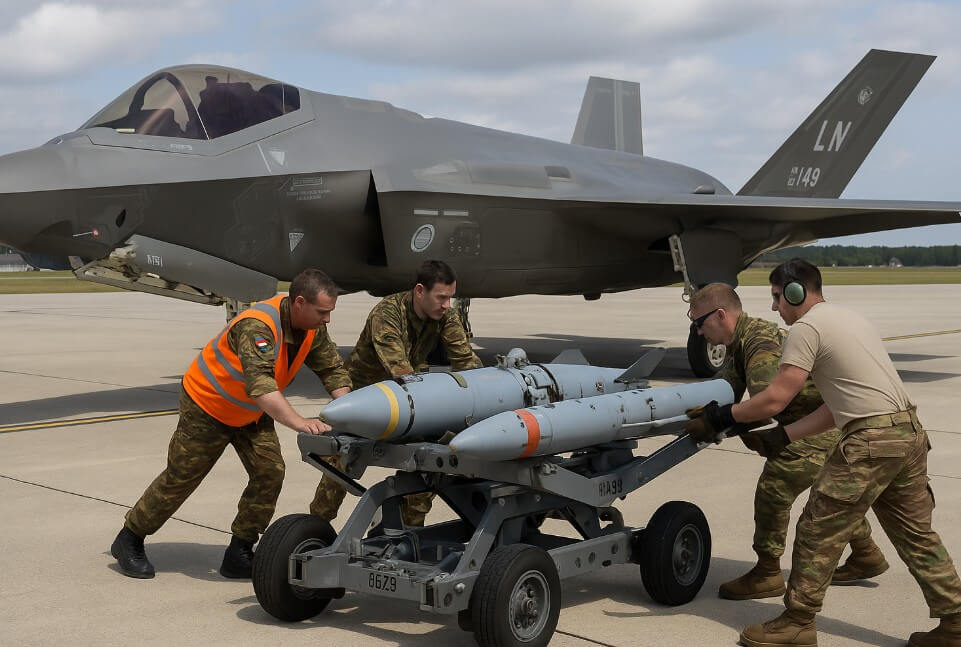
A recent weapons-loading demonstration at Ramstein Air Base marked a significant step forward in European defense cooperation, as Royal Netherlands Air Force maintainers successfully armed a United States Air Force F-35A fighter jet. The aircraft, assigned to the USAF’s 48th Fighter Wing and normally based at RAF Lakenheath in the United Kingdom, was prepared using Dutch ground equipment and procedures.
The event demonstrated that allied personnel can safely and effectively service fifth-generation aircraft across national lines, a capability increasingly seen as critical as Europe’s fleet of F-35s expands. Conducted under operationally realistic conditions, the demonstration validated that cross-national maintenance can meet full certification standards, even when aircraft and crews originate from different countries.
Supporting Agile Combat Employment
Military planners view the Ramstein test as directly aligned with the U.S. Air Force’s Agile Combat Employment (ACE) strategy. ACE emphasizes dispersing aircraft across multiple, unpredictable locations to complicate adversary planning and improve survivability during crises. For the strategy to succeed, aircraft must be able to refuel, rearm, and undergo basic maintenance at allied bases without relying solely on home-nation personnel.
During the demonstration, Dutch maintainers executed a complete weapons-loading process on the U.S. aircraft, focusing on equipment compatibility, procedural alignment, and real-time coordination between Dutch and American teams. The ability to rapidly integrate across national boundaries enhances operational flexibility, particularly in scenarios where fighters may need to divert to unfamiliar bases or operate from forward locations with limited infrastructure.
Growing Integration Among European F-35 Operators
The Ramstein event reflects a broader trend of increasing integration among European F-35 operators. Over the past year, the United States and the Netherlands have conducted bilateral training exchanges aimed at harmonizing ground-handling procedures. Earlier phases of cooperation focused on cross-national aircraft refueling, establishing a foundation of trust and technical familiarity before progressing to more complex tasks such as weapons loading.
As more European nations field the F-35, aligning daily maintenance practices has become a priority. While the aircraft itself is designed around common systems and software, differences in national regulations, equipment, and training standards require deliberate coordination to ensure true interoperability.
European Air Group Director Brigadier General Patrick Goossens has stressed that collaborative readiness is becoming indispensable. As the number of fifth-generation aircraft grows across Europe, maintaining synchronized procedures—even for routine tasks—is essential to ensuring allied forces can operate as a unified enterprise rather than as separate national fleets.
Strategic and Economic Implications
Recent defense analysis has reinforced the importance of cross-servicing arrangements. A RAND report released in September concluded that expanding such cooperation with European allies directly supports ACE by reducing dependence on fixed home bases and enabling faster response times during regional contingencies.
From an industry and cost-efficiency standpoint, interoperability also carries financial implications. According to aviation analytics firm Cirium, seven European air forces currently operate a combined 215 F-35 aircraft, with an additional 21 on order. Letters of intent from other countries could increase the European total by more than 400 aircraft over the coming years.
As fleet sizes grow, harmonized procedures for weapons loading, refueling, and maintenance can reduce duplication of resources, improve aircraft availability, and strengthen the overall return on investment for governments that have committed billions of dollars to the F-35 program.
A Proof of Concept for Future Operations
Although the Ramstein demonstration was conducted in a controlled environment, defense officials view it as a key proof of concept for future operations across Europe. The ability for one nation’s maintainers to arm another registers as more than a technical achievement; it signals a shift toward deeper operational trust and shared responsibility among allies.
With security demands rising and the ACE concept becoming central to Western airpower planning, cross-servicing is expected to play an increasingly prominent role. The successful Netherlands–USAF weapons-loading demonstration suggests that Europe’s growing F-35 enterprise is moving closer to functioning as a fully interoperable force, capable of responding quickly and collectively to emerging threats.
