


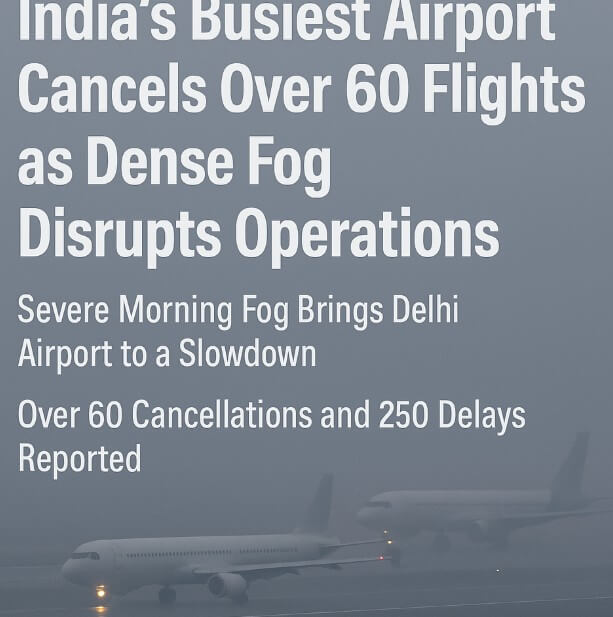
Severe Morning Fog Brings Delhi Airport to a Slowdown
Dense fog blanketed India’s capital early today, sharply reducing visibility and disrupting flight operations at Indira Gandhi International Airport (DEL), the country’s busiest aviation hub. The weather event triggered widespread delays, cancellations, and diversions through the morning hours, forcing airlines to activate contingency plans and issue travel advisories to passengers.
Authorities confirmed that low visibility conditions persisted across Delhi and much of North India, creating operational challenges for airlines and air traffic control. While airport operations continued under established fog protocols, the scale of disruption highlighted Delhi Airport’s central role in India’s aviation network and how weather-related issues there can quickly affect the broader system.
Over 60 Cancellations and 250 Delays Reported
According to officials, the dense fog led to more than 60 flight cancellations, five diversions, and over 250 delays at Delhi Airport alone. Airlines notified passengers of the likelihood of schedule changes as early as the morning, warning that recovery would depend on improvements in visibility.
IndiGo (6E) cancelled 36 flights operating to and from Delhi as poor visibility affected both arrivals and departures. Air India (AI) cancelled 19 flights and noted that all carriers at the airport were operating under significant visibility constraints. Air India Express (IX) and Akasa Air (QP) also issued advisories, citing continued weather-related disruption and urging passengers to remain alert to schedule updates.
Delhi Airport confirmed early in the day that operations were impacted but ongoing under fog protocols designed to prioritise safety while allowing limited movements. Visibility reportedly improved around 13:03, enabling a gradual recovery of flight schedules, although knock-on delays continued as airlines worked to realign aircraft and crew rotations.
Airlines and Airport Teams Activate Contingency Measures
As the disruption unfolded, airport teams coordinated closely with air traffic control to manage runway usage, gate availability, and passenger movement across terminals. Ground staff assisted affected travellers with rebooking, schedule adjustments, and real-time information as conditions evolved.
Airlines maintained that flight safety remained the top priority and stressed that normal operations would resume only once visibility conditions met required safety thresholds. The Ministry of Civil Aviation issued a fog alert for North India and advised passengers to check flight status before departing for the airport to avoid long waits and congestion.
Ripple Effects Across North India’s Aviation Network
The fog conditions were not limited to Delhi. Several regional airports across North India also experienced disruptions linked to the same weather system. Bhopal and Silchar reported cancellations of Delhi-bound services, underscoring the network-wide impact of operational slowdowns at the capital’s primary hub.
With approximately 1,300 daily aircraft movements, Delhi Airport functions as a critical connection point for domestic and international travel. Any significant disruption there can quickly cascade through airline schedules nationwide, affecting passengers far beyond the immediate region.
Role of CAT III Operations During Fog Season
Aircraft capability played a decisive role in determining which flights were able to operate. Flights not equipped for CAT III operations experienced the most significant delays. CAT III is an advanced landing system that enables aircraft to take off and land safely during very low visibility conditions, such as dense fog.
The system is especially important during winter months in North India, when fog events are frequent and prolonged. Airlines with a higher proportion of CAT III–certified aircraft are generally better positioned to maintain operations during such conditions, while others face increased cancellations and delays.
Passenger Advisory and Ongoing Monitoring
Authorities urged passengers to rely on airline websites, mobile apps, and official airport channels for the latest updates before travelling. Ground teams continued to monitor conditions and assist travellers as schedules stabilised throughout the afternoon.
Airlines and airport officials indicated that operations would continue to be closely monitored, with full stabilisation expected once visibility remained consistent. The disruption served as a reminder of the operational challenges posed by seasonal fog and the importance of preparedness at major aviation hubs.
As winter weather continues across North India, passengers are advised to plan ahead, stay informed, and allow additional time when travelling through Delhi Airport.
