


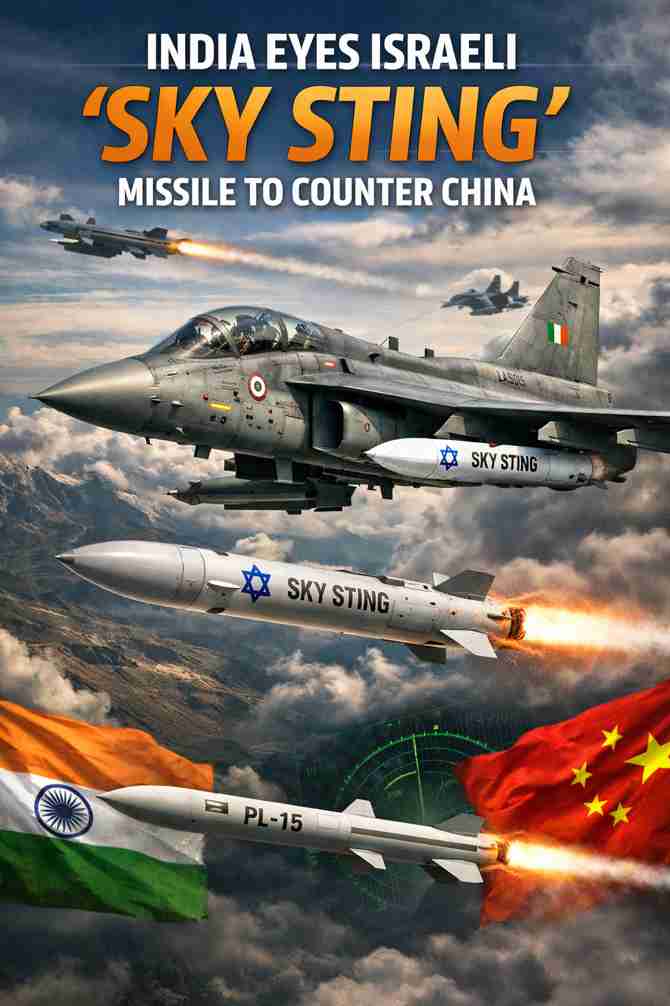
TEL AVIV, Israel — India is advancing talks with Israel to acquire a new generation of long-range air-to-air missile, a move that could reshape the balance of air power in Asia and help address capability gaps as China deploys increasingly advanced weapons.
The discussions center on the Sky Sting missile, developed by Rafael Advanced Defense Systems, and gained momentum during Prime Minister Narendra Modi’s recent state visit to Israel. The proposed missile, with a strike range of about 250 kilometers, is being evaluated for integration on India’s domestically produced Tejas Mk1A fighter jets and possibly the Su-30MKI fleet operated by the Indian Air Force.
The potential procurement reflects growing urgency in New Delhi to counter China’s deployment of long-range missiles such as the PL-15 and PL-17, which have extended Beijing’s reach in beyond-visual-range (BVR) aerial combat.
Advanced Missile Designed for Long-Range Engagement
Sky Sting represents Israel’s latest effort in missile technology, incorporating artificial intelligence and advanced propulsion to compete with the world’s most capable systems. The missile uses a three-pulse solid fuel rocket motor, allowing it to maintain speed and maneuverability across different flight stages while reaching speeds exceeding Mach 5.
Weighing between 180 and 200 kilograms, the missile is designed to be compatible with lightweight fighters such as the HAL Tejas Mk1A, manufactured by Hindustan Aeronautics Limited. Indian defense planners are also assessing its compatibility with heavier aircraft like the Su-30MKI to extend engagement ranges across multiple squadrons.
Sky Sting includes an AI-enabled radio frequency seeker designed to distinguish targets more effectively in electronic warfare environments. A secure two-way data link enables pilots to update targeting information mid-flight, improving accuracy and flexibility during missions.
India is expected to initially purchase limited quantities directly, with the possibility of local production through technology transfer agreements if the system is approved.
Indigenous Missile Program Faces Integration Hurdles
The Israeli proposal comes as India continues to develop its own long-range missile under the Astra program, led by the Defence Research and Development Organisation and produced by Bharat Dynamics Limited.
The current Astra Mk1 has a range of about 110 kilometers, while future variants promise significantly longer reach. However, technical challenges integrating Astra Mk1 with the Israeli-origin EL/M-2052 radar selected for the Tejas Mk1A have slowed deployment timelines.
These delays have broader implications. The Indian Air Force currently operates just 29 fighter squadrons, well below its sanctioned strength of 42. With older aircraft scheduled for retirement, timely induction of Tejas Mk1A fighters has become critical to maintaining combat readiness.
A ready-to-integrate missile like Sky Sting could help accelerate aircraft deliveries while India continues refining its indigenous radar and missile programs.
Debate Over Strategic Dependence Versus Capability Needs
The Sky Sting proposal has sparked debate within India’s defense community over balancing self-reliance with operational necessity.
Some analysts argue importing advanced missiles risks undermining India’s domestic development efforts at a critical stage. Others contend that filling immediate capability gaps does not contradict long-term goals of defense independence.
India has followed similar dual-track approaches before, combining foreign acquisitions with domestic development to maintain readiness while building local expertise.
Air Chief Marshal AP Singh recently emphasized that India cannot prepare for future conflicts with outdated tools, underscoring the urgency of equipping forces with modern systems.
Israel Remains Key Partner in India’s Defense Modernization
Israel has become one of India’s most important defense partners, supplying systems integrated across multiple platforms. The Tejas fighter already incorporates Israeli radar, targeting pods, and air-to-air missiles.
India also operates Israeli-origin systems including the SPYDER air defense system and precision-guided munitions, reflecting a long-standing partnership that has helped bridge capability gaps while domestic technologies matured.
If approved, Sky Sting would deepen that cooperation and further integrate Israeli technology into India’s air combat infrastructure.
Strategic Impact on Regional Air Power
China’s deployment of long-range air-to-air missiles has altered the strategic calculus in Asia, increasing engagement distances and reducing reaction times for adversaries.
A missile with comparable range and advanced electronic resistance could significantly enhance India’s deterrence posture. When paired with modern radar and networked operations, long-range missiles improve survivability and increase the likelihood of striking first in aerial combat.
The final decision will hinge on cost, technology transfer terms, and alignment with India’s long-term defense manufacturing strategy.
Whatever the outcome, the Sky Sting proposal highlights India’s effort to balance immediate operational readiness with its broader ambition of building a self-reliant defense industry—while ensuring it remains competitive in an increasingly contested regional airspace.
