


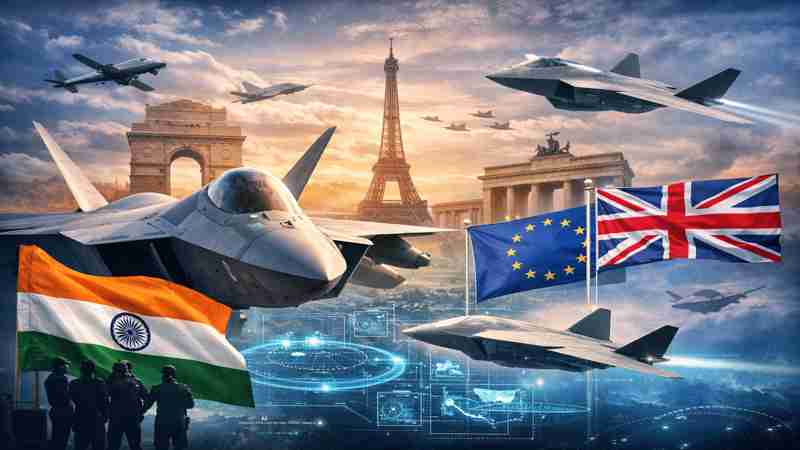
Strategic Shift in Air Combat Planning
NEW DELHI — India is evaluating a potential entry into a European sixth-generation fighter jet program, signaling a significant evolution in its long-term defense planning and air combat capabilities.
The move follows input from the Ministry of Defence to a parliamentary panel, confirming that the Indian Air Force (IAF) is studying global partnerships to prepare for next-generation warfare. The assessment underscores a broader shift in strategy as India seeks to balance domestic development with international collaboration.
Two European Programs Under Consideration
India’s review is focused on two major multinational initiatives currently shaping the future of aerial combat. These include the Global Combat Air Programme (GCAP), led by the United Kingdom, Italy, and Japan, and the Future Combat Air System (FCAS), spearheaded by France, Germany, and Spain.
Both programs aim to deliver operational sixth-generation fighter aircraft by the mid-2030s. Defense officials say the IAF will weigh technological advantages, industrial participation, and long-term strategic value before making any commitment.
Advancing Beyond Fifth-Generation Capabilities
Sixth-generation fighters are expected to go far beyond the capabilities of today’s stealth aircraft. These platforms are designed to integrate artificial intelligence, advanced sensors, and network-centric warfare systems to operate effectively in highly contested environments.
According to NDTV, the aircraft under development will function as part of a broader “system of systems.” This includes unmanned aerial vehicles, collaborative combat drones, and real-time data-sharing networks known as combat clouds.
Such integration is increasingly viewed as essential in modern warfare, where coordination between manned and unmanned systems determines operational success.
Access to Critical Technologies
A key incentive for India’s participation is the potential access to advanced technologies that would otherwise be costly and time-consuming to develop independently.
These include adaptive engines, directed-energy weapons, and next-generation electronic warfare systems. Early involvement in such programs could accelerate India’s technological capabilities and reduce development timelines for future platforms.
Boost to Domestic Aerospace Industry
Joining a European fighter program could also strengthen India’s domestic aerospace ecosystem. Participation may open doors to technology transfer agreements, increased local manufacturing, and deeper integration into global supply chains.
Major aviation hubs such as New Delhi and Bengaluru are expected to play a central role in supporting such collaborations. The move could further drive innovation across defense research organizations and private sector companies.
Addressing IAF Modernization Challenges
The Indian Air Force continues to face challenges in modernizing its fleet, including delays in fighter induction and the need to maintain operational readiness.
India is already advancing its indigenous fifth-generation Advanced Medium Combat Aircraft (AMCA) program. However, defense planners emphasize that preparing for sixth-generation capabilities is equally critical to maintaining long-term competitiveness.
Evolving Nature of Modern Warfare
Recent global conflicts have highlighted the growing importance of drones, electronic warfare, and integrated combat networks. Air superiority is increasingly defined not just by aircraft performance, but by connectivity, data sharing, and system-wide coordination.
The concept of a “system of systems” reflects this shift, where multiple platforms operate together seamlessly to achieve mission objectives.
Strategic Implications for India
A decision to join either GCAP or FCAS would position India among a select group of nations shaping the future of air combat. It would also reinforce its ambition to remain a leading air power through the 2040s and beyond.
However, the decision will require careful consideration of costs, strategic autonomy, and the complexities of multinational defense collaboration.
As India continues its evaluation, the outcome could have lasting implications for its defense capabilities and its role in the global aerospace industry.
