


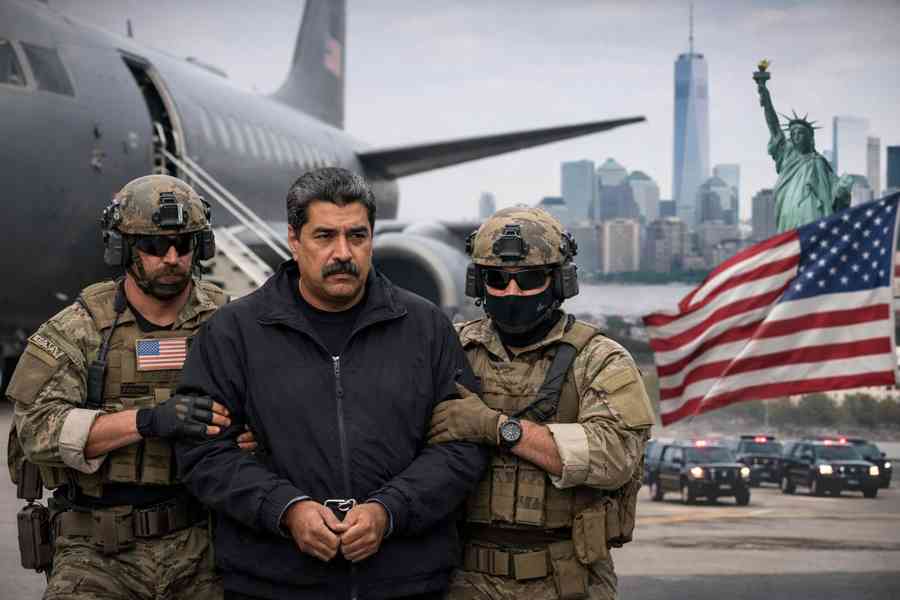
The United States military has captured Venezuelan President Nicolás Maduro in Caracas and transported him to New York in a high-risk operation that has rapidly reshaped Venezuela’s political landscape and intensified global diplomatic tensions. U.S. officials say the action effectively removed Maduro from power, while Venezuelan authorities insist the country’s leadership remains intact and legitimate .
The operation marks one of the most aggressive U.S. interventions in Latin America in decades, raising urgent questions about sovereignty, international law, and the future of governance in a nation holding the world’s largest proven oil reserves.
A Coordinated Military Operation in Caracas
According to U.S. officials, Special Operations forces entered Maduro’s presidential compound shortly after 02:00 local time, guided by intelligence sources inside Venezuela. Maduro attempted to reach a secure panic room but was detained before securing the door. Officials confirmed minimal casualties and no fatalities among U.S. forces.
Simultaneously, U.S. air operations targeted military bases, airports, and communication sites around Caracas to create diversions. Maduro and First Lady Cilia Flores were later transferred to federal custody upon arrival in New York.
The Pentagon has not released full operational details, citing security concerns, but confirmed that the mission was designed to avoid civilian harm while ensuring rapid extraction.
Who Holds Power in Venezuela Now?
Following Maduro’s removal, Venezuela’s Supreme Court swore in Vice President Delcy Rodríguez as interim president. Rodríguez stated that Maduro “remains the legitimate national leader” and continues to command loyalty from key institutions.
Opposition leaders have disputed that claim but currently lack operational control of state functions. Venezuela’s Interior Minister Diosdado Cabello called for public calm, urging unity amid growing uncertainty.
The United States has indicated support for a group-led political transition but has not confirmed a timeline, structure, or list of participants. U.S. officials emphasized that governance decisions must ultimately involve Venezuelan stakeholders.
Economic Stakes and Oil Sector Implications
Beyond politics, the intervention carries major economic implications. U.S. leadership has suggested that American energy companies could assist in restoring Venezuela’s oil sector, which has deteriorated despite vast reserves. Venezuela’s heavy crude requires specialized refining, and years of sanctions and underinvestment have sharply reduced output.
Venezuelan officials argue the operation targets national resources rather than democratic reform, a claim Washington has denied. Still, energy markets are closely watching how control over oil infrastructure may evolve.
Criminal Charges Filed in New York
U.S. prosecutors in New York have charged Maduro with narcotics trafficking and weapons offenses. Maduro denies the allegations, arguing that the United States is pursuing regime change under the pretext of anti-drug enforcement.
Analysts note that Venezuela has long functioned as a transit route for narcotics produced elsewhere in the region. Maduro rose to power in 2013 after serving under former President Hugo Chávez, with his tenure marked by hyperinflation, political repression, and international sanctions.
Global Reaction Deeply Divided
International response has been swift and polarized. Russia, China, Iran, Cuba, and several Latin American governments condemned the U.S. action as a violation of sovereignty. Brazil’s President Luiz Inacio Lula da Silva warned of regional instability, while Colombia’s President Gustavo Petro called it an attack on Latin American independence.
Argentina’s President Javier Milei welcomed the move. In Europe, reactions were more cautious. UK Prime Minister Keir Starmer declined to say whether international law was violated, while France and Germany emphasized the need to respect legal frameworks.
The United Nations expressed concern over compliance with international standards and warned of the precedent set by military intervention.
What Comes Next for Venezuela?
The immediate challenge is preventing internal unrest while establishing a credible political transition. European leaders have referenced the potential role of opposition figures, while regional governments continue to call for diplomatic restraint.
With Maduro now in U.S. custody and Venezuela’s interim leadership contested, the country faces a period of profound uncertainty. How Washington manages the next phase — politically, legally, and economically — will shape not only Venezuela’s future, but broader regional stability.
