


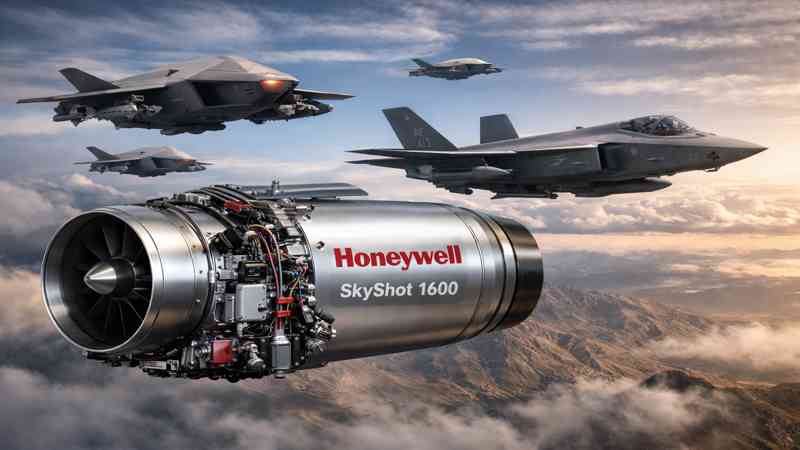
PHOENIX — Honeywell has secured a prototype contract from the U.S. Air Force to develop a new propulsion system for autonomous collaborative combat aircraft, a key component of the military’s strategy to integrate drone wingmen with piloted fighter jets.
The effort focuses on Honeywell’s SkyShot 1600, a newly developed small-thrust-class engine designed for unmanned aircraft operating in highly contested environments. The award represents the next phase of propulsion development under the Air Force’s Propulsion Consortium Initiative 2.0, which aims to accelerate innovation in defense aviation technology.
Contract Framework and Oversight
The contract was issued as an Other Transaction Authority Project Agreement through SOSSEC, Inc., which manages technology development partnerships for the military. The agreement falls under OTA No. FA8626-24-9-0005 between the Air Force Life Cycle Management Center and SOSSEC, supporting the Air Force Propulsion Directorate.
The selection of Honeywell reflects the Air Force’s push to rapidly prototype and field propulsion systems capable of powering a new class of unmanned aircraft. These collaborative combat aircraft are intended to operate alongside crewed fighters, performing missions that range from surveillance and reconnaissance to electronic warfare and tactical strike support.
Engine Designed for Flexibility and Mission Adaptation
Honeywell’s SkyShot 1600 has been engineered specifically for autonomous and semi-autonomous platforms. Its flexible architecture allows it to be configured as either a turbojet or a turbofan, depending on operational needs.
This adaptability gives military planners the ability to tailor aircraft performance based on mission priorities, such as maximizing speed, improving fuel efficiency, or extending flight endurance. The design also enables integration across multiple unmanned aircraft concepts currently under development.
The company said the engine combines proven propulsion technologies with newer advancements to meet evolving military requirements for performance, affordability, and rapid deployment.
Performance and Scalability
The SkyShot 1600 supports thrust levels ranging from 800 to 2,800 pounds, placing it within the performance range needed for collaborative combat aircraft expected to maneuver aggressively in combat scenarios.
Its modular design allows for scalability, meaning the engine can be adapted to provide additional thrust if future aircraft designs require higher output. This flexibility is critical as the Air Force continues refining operational concepts for autonomous aircraft and their roles in future conflicts.
The propulsion system is also designed to meet demanding G-force performance standards, ensuring it can handle the high-speed maneuvers and dynamic mission profiles required when operating alongside advanced fighter jets.
In addition, the ability to choose between turbojet and turbofan configurations allows operators to balance competing priorities such as speed and fuel efficiency.
Digital Engineering to Speed Development
Honeywell said it is using advanced digital modeling tools and modern manufacturing techniques to accelerate development of the SkyShot 1600. Digital engineering allows engineers to rapidly test design changes, evaluate performance, and integrate systems more efficiently.
These methods are expected to shorten development timelines while supporting more cost-effective production. The approach also aims to improve supply chain resilience, which has become an increasing priority for defense contractors amid rising global demand for military equipment.
Faster and more efficient production could prove essential if the Air Force moves forward with large-scale procurement of collaborative combat aircraft in the coming years.
Strategic Importance for Honeywell and the Air Force
The contract reinforces Honeywell’s position as a major supplier of aerospace systems for defense applications. Honeywell Aerospace Technologies provides engines, avionics, connectivity systems, power units, and control systems used across military, commercial, and space platforms worldwide.
For the Air Force, the project represents another step toward operationalizing autonomous aircraft designed to extend the reach and effectiveness of its fighter fleet.
Defense officials have increasingly emphasized unmanned systems as a force multiplier, capable of performing dangerous missions while reducing risks to human pilots and lowering operational costs.
The SkyShot 1600 program is expected to play a role in shaping how these next-generation aircraft are powered and deployed, as the military prepares for future combat environments where autonomy and advanced propulsion will be central to maintaining air superiority.
