


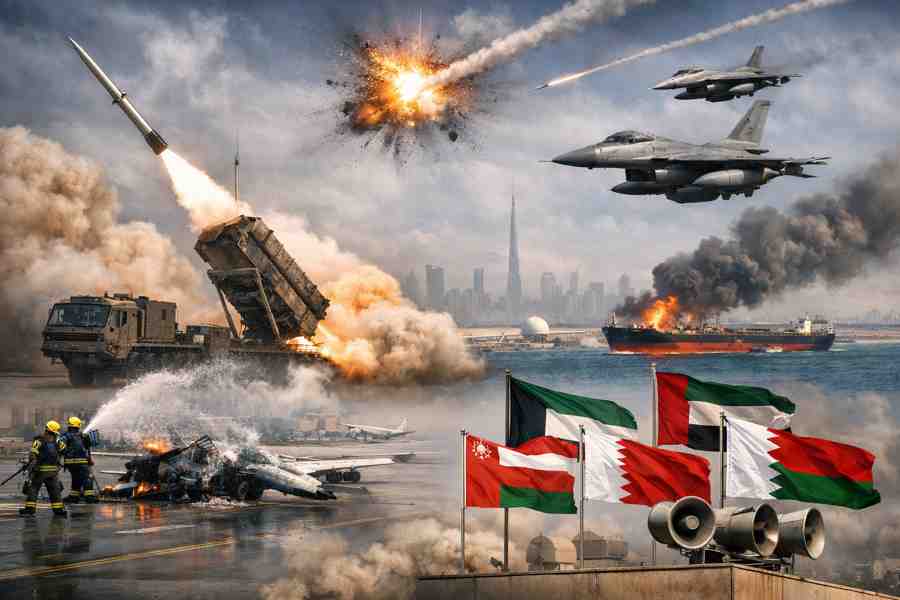
RIYADH — Air defense systems across the Gulf have intercepted more than 3,133 Iranian missiles and drones targeting civilian areas and strategic infrastructure, as the regional conflict involving Iran, the United States, and Israel entered its 12th day.
The interceptions were reported across Saudi Arabia, the United Arab Emirates (UAE), Kuwait, Qatar, Bahrain, and Oman, highlighting the scale of aerial threats facing the region. Despite the attacks, key aviation hubs and energy infrastructure have largely remained operational as authorities activate defensive and emergency response measures.
Several aviation hubs in the region, including Dubai International Airport (DXB) in Dubai and Bahrain International Airport (BAH) in Manama, implemented precautionary measures while maintaining normal operations. Airlines such as Jazeera Airways (J9) continued operating select regional flights despite heightened security conditions across Gulf airspace.
Saudi Arabia Intercepts Missiles and Drones
Saudi Arabia’s Royal Air Defense Forces reported intercepting 25 ballistic missiles and 151 drones since the beginning of hostilities. Military officials said several of the incoming threats were aimed at Prince Sultan Air Base near Al-Kharj, southeast of Riyadh.
Air defense units successfully destroyed six ballistic missiles that were heading toward the base, as well as another missile targeting the kingdom’s Eastern Province.
Additional interceptions included drones approaching the Shaybah oil field, Hafar Al-Batin, and areas east of Al-Kharj.
Saudi authorities said the defensive operations were part of broader efforts to safeguard critical infrastructure, including oil facilities and aviation hubs. Officials added that the kingdom’s air defense forces remain on high alert as missile and drone activity continues in the region.
UAE Faces Large Volume of Aerial Threats
The United Arab Emirates recorded one of the highest numbers of attempted strikes during the conflict. Defense authorities said they intercepted 270 missiles and 1,475 drones targeting multiple locations across the country.
In Dubai, two drones crashed near Dubai International Airport (DXB), leaving four civilians injured.
Officials confirmed that two Ghanaian nationals and one Bangladeshi national sustained minor injuries, while an Indian national suffered moderate injuries.
Despite the incident, airport operations continued without disruption.
In Abu Dhabi, emergency response teams quickly contained a fire at the Old Abu Dhabi Airport after debris from an intercepted projectile sparked a small blaze.
Authorities said the loud explosions heard in several cities were caused by missile interceptions and fighter aircraft engagements. Officials reassured residents that defense systems remained capable of responding to aerial threats.
Defensive Operations Across Gulf States
Other Gulf nations also reported intercepting Iranian projectiles as part of regional defensive operations.
According to Aawasat, Kuwait confirmed intercepting 239 missiles and 456 drones during the conflict.
Qatar’s armed forces repelled a missile attack, prompting authorities to advise residents to remain indoors temporarily until the security situation stabilized. Officials later confirmed that conditions had returned to normal.
In Bahrain, residents reported hearing multiple explosions across different parts of the country, leading authorities to activate warning sirens. As a precaution, several aircraft at Bahrain International Airport (BAH) were relocated to alternate airports.
Oman also intercepted several drones near its coastal areas. Some unmanned aircraft struck fuel storage tanks at the Port of Salalah, though officials reported no casualties and confirmed that petroleum supplies remain stable.
Maritime Incident Reported Near UAE
In a separate incident at sea, a container ship approximately 25 nautical miles northwest of Ras Al Khaimah reported damage from a suspected projectile.
Authorities confirmed that all crew members were safe and that an investigation had been launched to determine the cause of the damage.
Infrastructure Remains Operational
Despite the scale of the attacks, aviation operations, energy facilities, and shipping routes across much of the Gulf have continued functioning.
Officials across the region said coordinated air defense systems have helped limit damage while protecting critical infrastructure.
Authorities continue to monitor the situation closely, warning that missile and drone threats remain possible as the conflict involving Iran, the United States, and Israel continues to evolve.
