


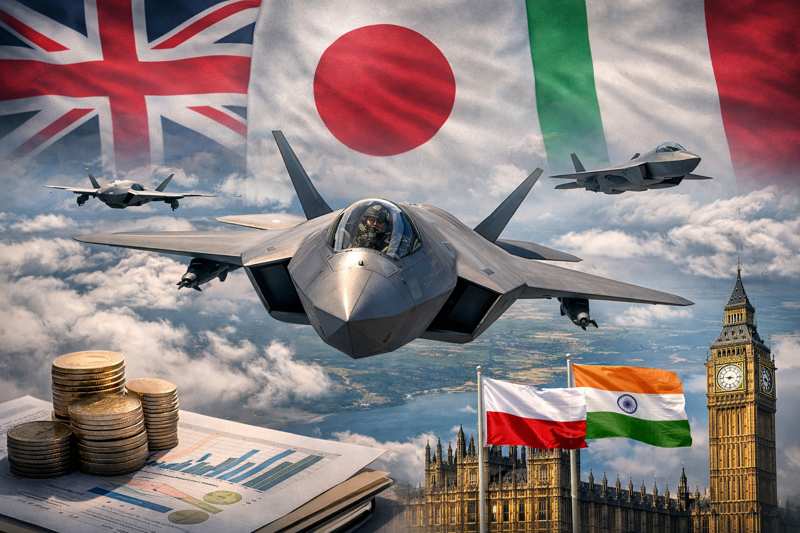
LONDON — The Global Combat Air Programme (GCAP), a flagship multinational effort to develop a sixth-generation fighter jet, is facing growing uncertainty as delays in defense funding commitments from the United Kingdom threaten to slow progress and strain coordination among partner nations.
The program—jointly led by the United Kingdom, Japan, and Italy—aims to deliver a next-generation combat aircraft by 2035. Designed to operate alongside drones within a highly networked combat system, GCAP has attracted global attention for both its technological ambition and strategic importance.
Funding Delays Stall Critical Progress
At the center of the current uncertainty is a delay in British defense budget approvals, which has held up a key contract necessary to advance full-scale design and engineering work. Without this agreement in place, progress on the program has slowed at a crucial phase.
According to a report by Eurasian Times, engineering work continues under existing national funding arrangements. However, industry sources caution that the absence of a unified financial commitment among partner nations could undermine the program’s timeline and increase the risk of missed milestones.
The delay highlights the challenges of coordinating large-scale international defense projects, particularly when domestic budget processes disrupt collective planning.
Japan Raises Alarm Over Timeline Risks
Concerns have been most pronounced in Japan, where officials view GCAP as essential to maintaining future air defense capabilities. With regional competitors rapidly advancing their own next-generation fighter programs, any delay is seen as a potential strategic risk.
Japanese officials have warned that setbacks could create capability gaps in the mid-2030s, precisely when sixth-generation aircraft are expected to become operational globally. Reports that other nations are already testing prototype systems have added urgency to Tokyo’s position.
Japan continues to push for strict adherence to the 2035 delivery target, emphasizing the need for a fully operational aircraft within that timeframe. Other partners, however, appear more flexible, focusing on long-term technological integration rather than rigid deadlines.
Diplomatic Reassurances Fall Short
Efforts have been made through diplomatic channels to reassure Japan of continued commitment to the program. However, without confirmed funding decisions from the United Kingdom, those reassurances have had limited impact.
The lack of financial clarity has made it difficult to maintain confidence among stakeholders, raising questions about governance and decision-making within the partnership. Analysts note that sustained uncertainty could erode trust and complicate future collaboration.
New Partners Show Interest Amid Uncertainty
Despite current challenges, GCAP continues to attract interest from additional countries. Poland has initiated discussions about potential participation, signaling growing European interest in the program.
At the same time, India is exploring the possibility of joining GCAP or pursuing similar collaborative efforts. Indian officials have indicated that international partnerships are increasingly important to remain competitive in advanced aerospace development.
The potential inclusion of new partners could bring added funding and technical expertise, helping to offset rising development costs that have increased significantly since the program began.
Expansion Brings Opportunities and Challenges
While expanding the partnership could strengthen the program financially and technologically, it also introduces new complexities. Issues such as technology sharing, intellectual property protection, and strategic alignment will need to be carefully managed.
Adding more participants could also slow decision-making processes, potentially exacerbating existing delays. Current members must weigh the benefits of broader collaboration against the risks of increased complexity.
A Critical Moment for GCAP’s Future
The GCAP initiative represents a major effort to consolidate national fighter programs into a unified development framework, positioning its members to compete with other global sixth-generation projects.
For now, the program remains active, but its trajectory will depend heavily on near-term funding decisions in London. Without timely financial commitments, the initiative risks falling behind both its schedule and competing international programs.
As the 2035 deadline approaches, the coming months are likely to prove निर्ण—determining whether GCAP can maintain its ambitious goals or will need to adjust its timeline in response to financial and geopolitical pressures.
