


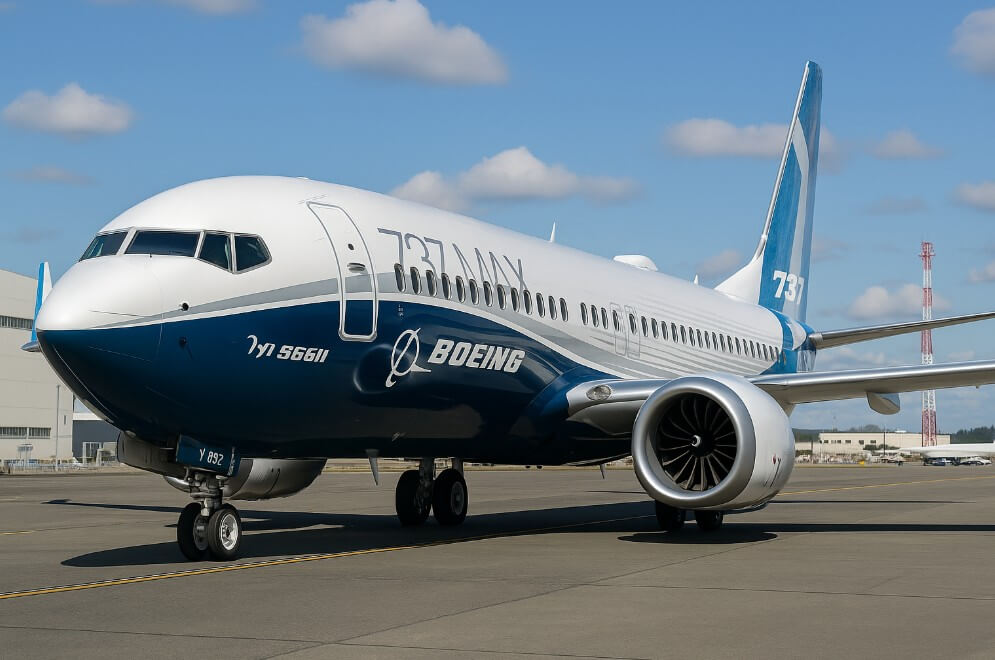
SEATTLE — Boeing has received long-awaited approval from the Federal Aviation Administration (FAA) to increase production of its 737 MAX aircraft, a move seen as a pivotal step in the planemaker’s effort to restore stability and meet surging airline demand.
The FAA’s decision authorizes Boeing to gradually raise monthly production of its 737 MAX from 38 to 42 jets, marking the first increase since regulators imposed strict output limits nearly two years ago. The change follows extensive inspections and audits across Boeing’s manufacturing sites to verify safety and quality standards.
The production cap was introduced in January 2024, after a high-profile incident in which an Alaska Airlines 737 MAX 9 suffered a door plug failure shortly after takeoff from Portland International Airport. The mishap prompted intense scrutiny from regulators and renewed questions about Boeing’s quality control systems.
Regulatory Confidence Returns
In announcing its decision, the FAA said inspectors had reviewed every phase of Boeing’s assembly process before granting approval, underscoring that oversight would continue as output ramps up. The regulator’s message was clear: while the company can build more jets, safety compliance remains paramount.
Boeing welcomed the decision, emphasizing its renewed focus on operational discipline. The manufacturer said it will continue working closely with its global supplier network to meet the higher production target while maintaining safety and quality as its “top priorities.”
For Boeing, the approval represents more than a logistical shift—it’s a financial lifeline. Aircraft makers receive the bulk of customer payments upon delivery, making production volume a direct driver of cash flow and profitability.
CEO Kelly Ortberg, who assumed leadership to stabilize Boeing after years of turbulence, previously outlined plans to raise production further to 47 aircraft per month once supply chain conditions improve.
Gradual Recovery After a Turbulent Period
The FAA’s move also reflects renewed confidence in Boeing’s internal compliance systems. Just last month, regulators restored limited authority for the company to self-certify certain aircraft components, a responsibility that had been removed after the 737 MAX’s earlier grounding.
The 737 MAX program has faced extraordinary challenges over the past several years. Two fatal crashes in 2018 and 2019 led to a worldwide grounding that lasted nearly two years, severely damaging Boeing’s reputation and finances. Production setbacks continued through the COVID-19 pandemic, global supply shortages, and a major labor strike at its Seattle-area plants.
Boeing has not posted an annual profit since 2018 but has shown steady improvement in deliveries. The company expects its 2025 output to reach the highest level since before the grounding, signaling what analysts describe as “cautious optimism” across the aerospace sector.
Boeing is scheduled to release its quarterly earnings on October 29, when investors will be watching closely for signs of how the production rate increase affects its balance sheet.
FAA Oversight: The Backbone of U.S. Aviation Safety
The Federal Aviation Administration, part of the U.S. Department of Transportation, regulates nearly every aspect of American civil aviation—from aircraft certification to air traffic control operations. Based in Washington, D.C., the agency’s mission extends far beyond compliance enforcement; it ensures the integrity, safety, and efficiency of the national airspace system.
Working with international partners such as the European Union Aviation Safety Agency, the FAA sets global benchmarks for aviation safety. Its responsibilities include regulating aircraft manufacturing and maintenance, certifying airmen and airports, and managing air traffic across one of the world’s busiest skies. The agency also plays a growing role in regulating commercial space transportation and advancing air navigation technologies.
Boeing’s Role in Global Aerospace
Headquartered in Arlington, Virginia, Boeing is one of the world’s largest aerospace companies and the United States’ leading exporter. Employing more than 170,000 people worldwide, the company designs, manufactures, and services commercial jetliners, defense systems, and space technologies for customers in over 150 countries.
Its business structure includes three core divisions—Commercial Airplanes, Defense, Space & Security, and Global Services—supported by cross-functional teams dedicated to safety, engineering, and technology development.
Boeing’s commercial lineup features the 737, 767, 777, and 787 Dreamliner families, as well as the Boeing Business Jet series. The company also dominates the cargo market, with about 90% of global air freight transported aboard Boeing-built aircraft.
The manufacturer’s defense and space segment supplies advanced systems like the KC-46 Pegasus tanker, AH-64 Apache helicopter, and CST-100 Starliner spacecraft, while its services arm supports airlines and governments with maintenance, digital analytics, and pilot training programs.
Looking Ahead
The FAA’s approval marks a notable turning point for Boeing as it seeks to restore its standing with regulators, airlines, and the public. With demand for narrowbody aircraft rising worldwide, the 737 MAX remains central to the company’s recovery.
As Boeing works to meet production goals and rebuild trust, the coming months will test whether its renewed emphasis on quality can sustain both safety and profitability in one of the most closely watched industrial turnarounds in U.S. aviation history.
