


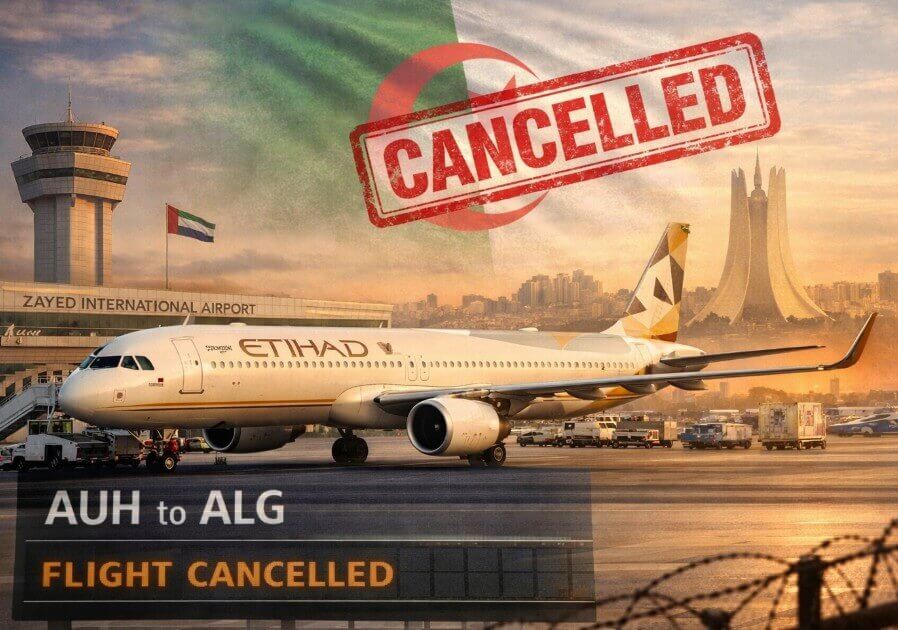
Etihad Airways has quietly withdrawn plans to launch scheduled passenger flights to Algeria, ending what would have been the carrier’s first direct entry into the North African market. The decision removes a proposed long-haul connection between Abu Dhabi and Algiers before a single commercial flight was operated, highlighting the impact of regulatory constraints on international airline expansion.
The Abu Dhabi-based airline had planned to connect Zayed International Airport (AUH) with Houari Boumediene Airport (ALG), positioning the route as part of a broader strategy to expand its presence across North Africa. Instead, the service has been dropped without a public announcement, and the route has disappeared entirely from Etihad’s booking systems.
Route Announced, Then Repeatedly Delayed
Etihad first disclosed its intention to serve Algiers in November 2024, announcing four weekly flights using the Airbus A321LR. The narrowbody aircraft, configured for long-range operations, was expected to allow the airline to efficiently serve thinner long-haul markets while maintaining connectivity through its Abu Dhabi hub.
The Algiers route was scheduled to launch on November 7, shortly after Etihad successfully introduced flights to Tunis. That launch fueled expectations that Algiers would follow, signaling a wider push into underserved North African markets.
Those expectations soon faded. Within weeks, Etihad informed partners that the start date would be pushed back to early February, citing factors outside the airline’s control. The delay immediately raised concerns among industry observers, particularly around regulatory approvals and bilateral air service agreements.
Quiet Removal Signals Full Cancellation
By early 2025, it became clear that the postponement was not temporary. Etihad quietly removed the Algiers service from its reservation system, effectively confirming that the airline had abandoned the route altogether. No formal statement accompanied the move, and the carrier has not publicly commented on whether it plans to revisit the market.
The absence of an announcement reflects a cautious approach as airlines increasingly manage route changes quietly, especially when driven by regulatory rather than commercial factors.
Traffic Rights Emerge as Key Obstacle
Industry sources point to Algeria’s restrictive air service policy as the primary reason behind Etihad’s withdrawal. The country allocates international traffic rights on a strict 50/50 basis between domestic and foreign carriers, leaving little flexibility for additional operators.
On the UAE–Algeria market, those rights are already fully utilized. Emirates and Air Algérie each operate seven weekly flights, exhausting the available capacity under current bilateral agreements. Without either a renegotiation between governments or a reduction in existing services, no additional carrier can enter the market.
Despite Etihad’s plan to operate fewer weekly flights and deploy a smaller aircraft, regulatory approval reportedly remained unattainable. Without guaranteed traffic rights, the airline was unable to finalize schedules, allocate crews, or make long-term commercial commitments.
Lost Capacity and Connectivity
Etihad’s decision has direct consequences for Algeria’s international air connectivity. The planned A321LR service would have added approximately 640 seats per week in each direction, increasing capacity and competition on the UAE–Algeria corridor.
Beyond point-to-point traffic, the route was expected to provide Algerian travelers with improved one-stop access to Asia-Pacific destinations via Abu Dhabi. That connectivity would have diversified travel options beyond traditional European transfer hubs.
Its cancellation instead reinforces Algeria’s reputation as a challenging market for foreign airlines, particularly those seeking incremental capacity growth under rigid regulatory frameworks.
Strategic Discipline for Etihad
For Etihad, the withdrawal underscores a disciplined approach to capacity management. Rather than engaging in prolonged negotiations over traffic rights with uncertain outcomes, the airline appears to have redirected aircraft and resources to markets with clearer regulatory pathways and faster returns.
As global airlines continue to fine-tune networks amid rising costs and capacity constraints, regulatory certainty has become as critical as passenger demand in shaping route decisions.
Bottom Line
Etihad’s abandoned Algiers launch illustrates how government policy and bilateral agreements can be decisive factors in international aviation. Despite clear commercial intent, structural limits on traffic rights ultimately halted the airline’s plans.
For now, Algeria remains absent from Etihad’s network map, with no indication that talks to revive the route will resume in the near future.
