


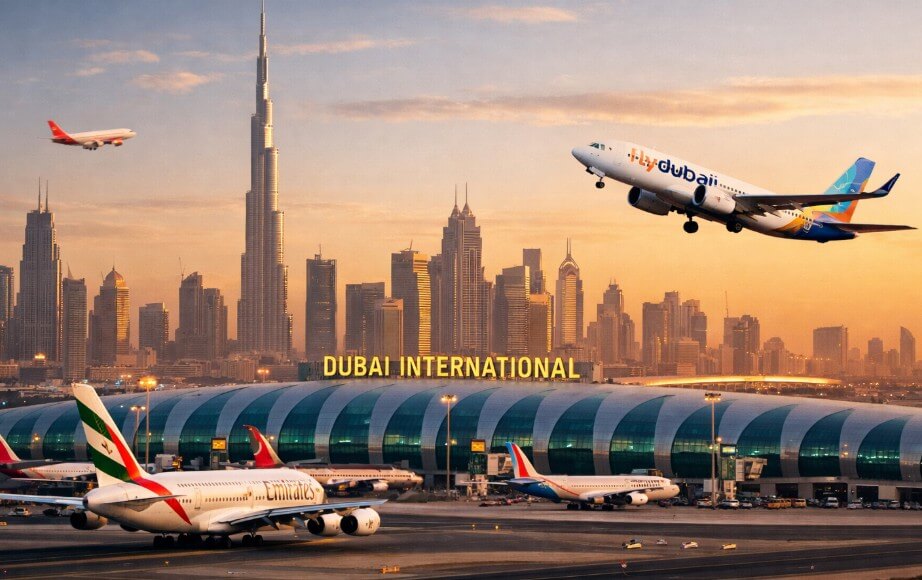
Dubai International Airport (DXB), the world’s busiest airport for international travel, is closing in on a landmark few aviation hubs have ever approached: 100 million passengers handled in a single year. Airport officials project the milestone could be reached in late 2026 or 2027, underscoring both sustained growth and a structural transformation in the way travelers use the airport.
For years, DXB’s dominance was built on its role as a global connector, efficiently linking East and West through long-haul transfer traffic. Today, the airport’s growth story is increasingly defined by travelers who start or end their journeys in Dubai—an evolution that reflects broader changes in the emirate’s economy and global appeal.
From Transit Hub to Global Destination
Historically, DXB’s passenger volumes were driven by connecting travelers, many flying long-haul routes on Emirates Airline, which has operated from the airport for four decades. In 2019, just before the COVID-19 pandemic disrupted global travel, origin-and-destination (O&D) traffic accounted for about 40% of all passengers at DXB.
Recent figures show a marked reversal. O&D traffic now represents approximately 55% of passenger movements, meaning the majority of travelers are visiting or departing Dubai rather than merely passing through. This shift points to Dubai’s growing stature as a destination for tourism, commerce, and long-term residence.
Robert Whitehouse, vice-president of research at Dubai Airports, attributes the change to multiple factors, including strong inbound tourism, increased outbound travel by residents, and the steady growth of expatriate communities choosing Dubai as a home base. He notes that the resulting passenger profile creates a “balanced mix” that reduces the airport’s dependence on connecting flows and strengthens its resilience against global disruptions.
Tourism, Business, and Long-Stay Appeal
Dubai’s strategic investment in attractions and infrastructure has been central to the rise in destination traffic. The city continues to add hotels, restaurants, and entertainment venues at a rapid pace, giving travelers more reasons to stay longer.
Iconic landmarks play a major role in that appeal. The Burj Khalifa, the world’s tallest building at over half a mile high, draws millions of visitors annually for observation decks, dining experiences, and events. Alongside major shopping districts, beaches, and convention facilities, such attractions help position Dubai as both a leisure hotspot and a global business center.
This diversified demand supports steady year-round travel, reinforcing DXB’s growth even as global travel patterns fluctuate.
Airline Expansion Supports Origin Traffic
Airlines are responding to the rise in O&D demand by adding capacity aimed at travelers whose journeys begin or end in Dubai. This winter, British Airways and Virgin Atlantic are increasing seat capacity from London Heathrow, reflecting strong point-to-point demand between the UK and Dubai.
In continental Europe, Austrian Airlines is relaunching its service from Vienna International Airport, restoring a key connection for Central European travelers. New routes from Asia and surrounding regions are also coming online, further expanding DXB’s reach.
FlyArystan will introduce twice-weekly flights from Aktau International Airport in Kazakhstan, while Iran’s Varesh Airlines plans similar service from Sari Airport. Pakistan’s Fly Jinnah is set to launch twice-weekly flights from Lahore’s Allama Iqbal International Airport. Together, these routes tap emerging regional markets and add to the steady flow of origin-and-destination passengers.
Regional Demand and Competitive Landscape
Saudi Arabia remains one of DXB’s largest source markets, with traffic projected to reach eight million passengers by year-end—about 22,000 travelers per day. Eased travel conditions and deepening economic ties between the UAE and Saudi Arabia continue to fuel demand.
Regionally, DXB faces competition from other major hubs with different traffic profiles. Doha’s Hamad International Airport remains heavily transfer-focused, with roughly 75% of passengers connecting, largely via Qatar Airways. Abu Dhabi International Airport has seen connecting traffic fall to about 50% as more travelers visit the emirate directly, supported by new cultural developments such as the Zayed National Museum and a Guggenheim museum planned for 2026.
A Milestone in Sight
With two parallel runways, expansive terminals, and a proven ability to scale operations, DXB is structurally prepared to handle continued growth. Its anticipated approach to 100 million passengers marks more than a numerical achievement—it reflects Dubai’s successful transition from a transit crossroads to a destination leader in global aviation.
As the airport moves toward that milestone, its evolving passenger mix may prove just as significant as the record itself, signaling a more sustainable and diversified future for one of the world’s most important aviation hubs.
