


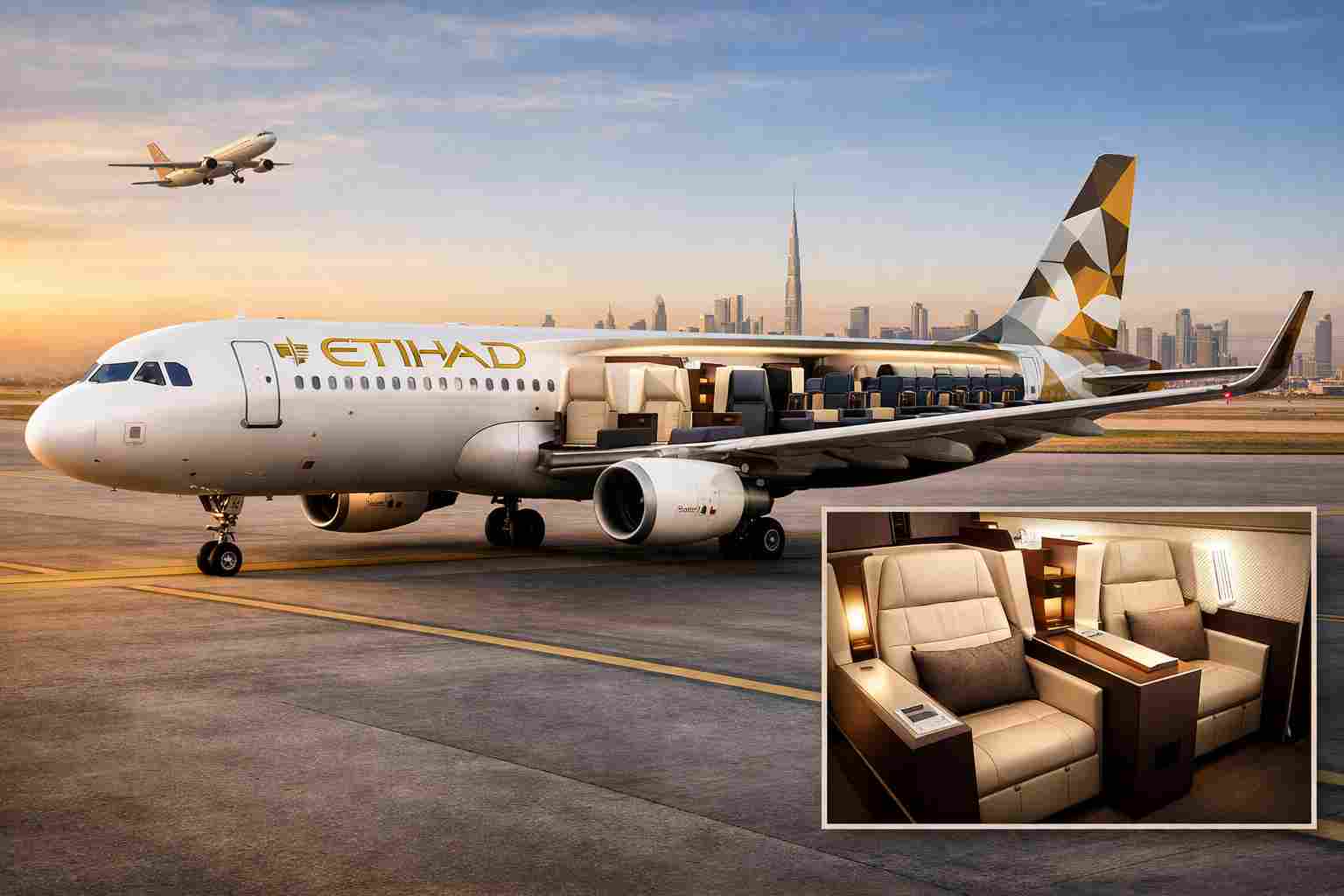
Airline Bets on High-Density Narrow-Body Strategy Without Dropping Premium Branding
ABU DHABI — Etihad Airways is reshaping its narrow-body strategy with a high-density Airbus A321LR configuration that still retains a three-cabin layout, including first class—an uncommon move in the segment. The redesign signals a calculated shift toward maximizing seat capacity while preserving elements of its premium brand identity.
The Abu Dhabi-based carrier plans to deploy the aircraft initially on routes linking Abu Dhabi to Delhi and Mumbai, two of its most competitive and high-demand corridors. By blending increased capacity with a reduced premium footprint, Etihad is aiming to balance revenue efficiency with customer experience.
Seating Overhaul Reflects Revenue Priorities
Etihad’s updated A321LR configuration increases total seating from 160 to 194 passengers. The layout will include just two first class seats, six business class seats, and 186 economy seats.
This represents a significant shift in cabin allocation. The airline has removed eight business class seats while adding 42 economy seats, underscoring a strategic pivot toward volume-driven revenue. The move aligns with broader industry trends where airlines are optimizing narrow-body aircraft for dense, high-frequency regional routes.
The configuration, first reported by OMAAT, is expected to enter service in early 2027.
Premium Cabins Remain a Differentiator
Despite the reduced number of premium seats, Etihad is maintaining a three-cabin structure—still rare among narrow-body operators. Both first and business class cabins will feature reverse herringbone seating, a design more commonly associated with long-haul wide-body aircraft.
This seating configuration provides direct aisle access and increased privacy, offering a competitive edge over rivals that typically use recliner-style or standard herringbone seats on similar aircraft.
The first class cabin will consist of only two seats located at the bulkhead. While the hard product is closer to an enhanced business class seat than a traditional first class suite, Etihad is relying on soft product elements—such as service, dining, and ground experience—to justify the premium positioning.
Efficiency Trade-Off Raises Operational Questions
The reconfiguration also highlights the stark contrast in space allocation between cabin classes. Removing eight business class seats to accommodate 42 additional economy seats suggests that a single business class seat occupies the equivalent space of more than five economy seats.
This raises questions about how Etihad is optimizing cabin space, including potential adjustments in galley areas or seat pitch. However, the airline has not disclosed detailed specifications.
Premium Demand Risks on India Routes
The decision to shrink business class capacity to just six seats may present challenges, particularly on routes between the UAE and India, where premium demand is consistently strong.
Potential risks include limited availability for high-yield passengers, faster sell-outs of business class inventory, and the possibility of premium travelers shifting to competitors. Additionally, constrained premium seating could impact connecting traffic and broader network revenue.
Even a single corporate booking or family group could fill the entire business class cabin, limiting availability well in advance.
First Class on Narrow-Body Aircraft Stands Out
Introducing first class on a high-density narrow-body aircraft is an unusual approach, but Etihad appears to be executing it efficiently. Rather than expanding the cabin footprint, the airline is incorporating first class within existing space constraints.
Pricing for the product is expected to be lower than first class offerings on wide-body aircraft, reflecting differences in seat size and overall experience. This allows Etihad to maintain a premium tier without significantly impacting aircraft economics.
Flexible Strategy Across Fleet Types
One notable aspect of Etihad’s approach is the contrast between aircraft types. While the A321LR will feature first class, some larger aircraft in its fleet—such as certain Airbus A350-1000 jets—do not.
This highlights a flexible, route-specific strategy in which cabin configurations are tailored to demand rather than standardized by aircraft size. The airline has also indicated a long-term interest in expanding first class across additional aircraft, including its Airbus A380 and select Boeing 787-9 jets.
A Calculated Shift in Narrow-Body Travel
Etihad Airways is redefining narrow-body travel by combining high-density seating with a three-cabin structure. The 194-seat Airbus A321LR reflects a deliberate trade-off between premium capacity and operational efficiency.
As competition intensifies on regional routes, particularly in markets like India, the strategy positions Etihad to capture higher passenger volumes while maintaining a differentiated premium offering.
The success of this approach will ultimately depend on whether reduced premium capacity can meet demand without eroding customer loyalty or revenue potential.
