


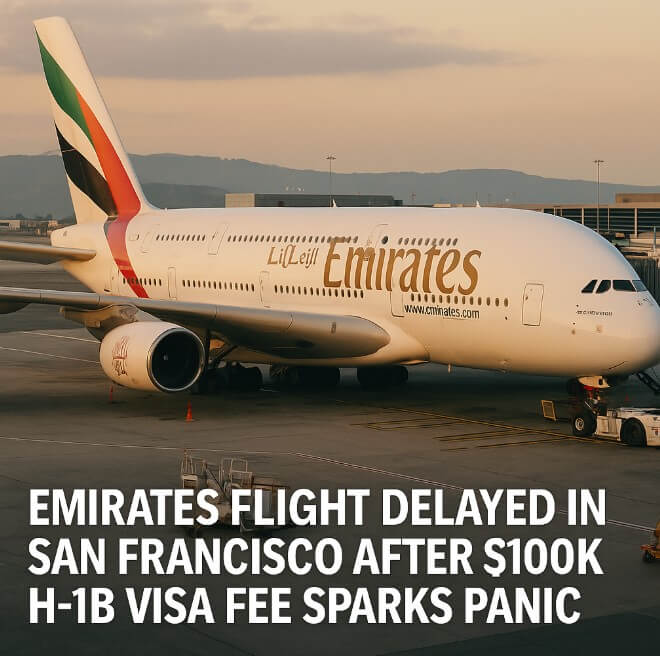
SAN FRANCISCO — An Emirates Airlines Airbus A380 flight bound for Dubai was delayed for more than three hours on September 19 after reports of a new $100,000 H-1B visa fee triggered panic among passengers at San Francisco International Airport (SFO).
The disruption occurred aboard flight EK226, scheduled to depart at 5:05 p.m. local time, when news of an executive order signed by President Trump began circulating among travelers. The fee, aimed at tightening restrictions on foreign workers in the United States, led many passengers—particularly Indian nationals, who make up a majority of H-1B visa holders—to demand to leave the aircraft before departure.
Confusion Before Takeoff
Just prior to pushback, unverified details about the rule spread through the cabin, according to reports from PYOK. Rumors suggested the new $100,000 fee would apply not only to new applicants but also to current visa holders returning to the U.S. from overseas trips.
The speculation created immediate alarm. Emirates’ captain addressed the matter directly, informing passengers that those who no longer wished to travel would be permitted to disembark.
Passengers’ primary concern was that leaving the United States might bar their ability to reenter under the new visa requirements. “Passengers worried that the $100,000 visa requirement would block their return to the United States, prompting many to request immediate offloading,” according to reports.
Managing a Mass Offload
Cabin crew and ground staff scrambled to manage dozens of passengers seeking to leave the plane. The process of offloading luggage and rebalancing the aircraft extended the delay to more than three hours.
The flight ultimately departed at 8:45 p.m. instead of its scheduled 5:05 p.m., leaving those who remained onboard to face an already long 15-hour journey stretched into an ordeal of more than 18 hours.
While the disruption gave those who stayed behind extra space in the cabin, the incident underscored the fragility of travel confidence when sudden government policy changes are introduced.
White House Defends Visa Fee
The $100,000 H-1B visa fee marks one of the sharpest escalations in the Trump administration’s efforts to curb foreign work programs. President Trump justified the move by accusing U.S. companies of exploiting the H-1B program to displace American workers.
“President Trump defended the $100,000 H-1B visa fee, arguing that U.S. companies were abusing the system to replace American employees with cheaper foreign labor,” the release noted.
The White House later clarified that the new cost would apply only to new applicants and would not be assessed annually or retroactively to current visa holders, as some early rumors suggested. Nonetheless, the confusion at SFO demonstrated how misinformation can ripple rapidly across global travel corridors.
Impact on Indian Nationals and Tech Industry
Indian nationals are expected to be disproportionately affected by the new fee. They account for more than 70% of current H-1B visa holders, many of whom work in the technology sector.
“For many, the fee represents a prohibitive barrier, effectively shutting down the H-1B pathway,” the release said.
Technology companies have already signaled concern. Microsoft, among others, has reportedly advised employees to avoid unnecessary international travel amid the uncertainty.
Analysts warn that the development could reshape how Silicon Valley and other tech hubs manage their workforce. U.S. firms have long relied on H-1B visas to fill critical roles in engineering and information technology. With the new cost structure, companies may need to rethink recruitment strategies, expand domestic training pipelines, or accelerate global outsourcing plans.
Broader Business Implications
The Emirates incident highlights a broader theme for global businesses: how quickly changes in U.S. immigration policy can disrupt not just labor markets but also international travel patterns. A single policy announcement led to widespread confusion, flight disruption, and heightened anxiety among one of the most mobile and globally connected professional communities.
As the administration pushes forward with its immigration agenda, executives across industries are bracing for potential ripple effects. “This development could reshape workforce strategies in Silicon Valley and beyond, as firms reconsider how to fill critical roles,” the release concluded.
For Emirates, the episode serves as a reminder that airlines remain on the front line of global policy shifts—often tasked with managing the immediate fallout before clarity arrives from Washington.
