


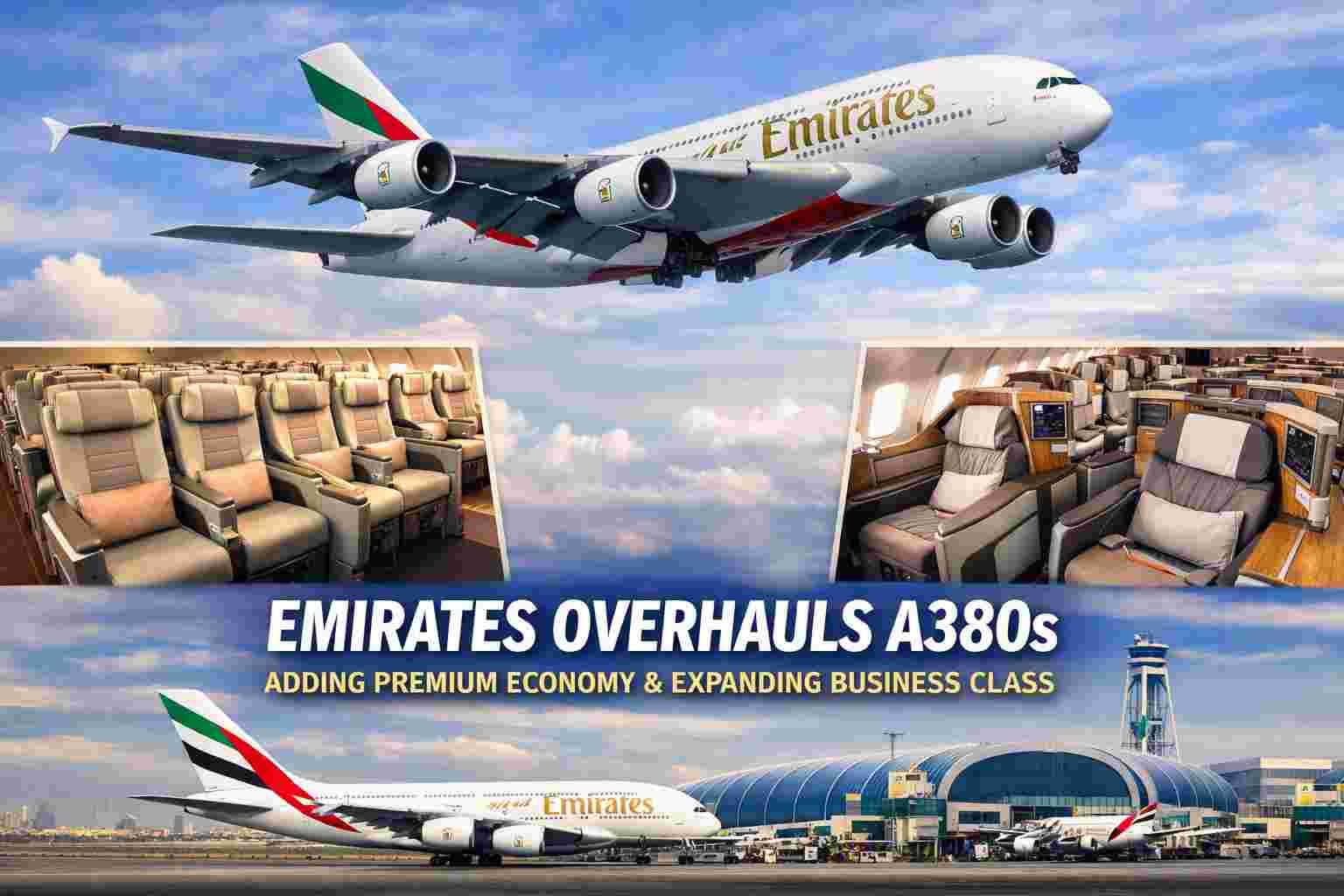
DUBAI — Emirates is overhauling its highest-capacity passenger aircraft in a strategic shift toward higher-yield premium travel, reducing seating on its densest Airbus A380 jets while introducing a new premium economy cabin and expanding business class.
The Dubai-based carrier said it will reconfigure its 615-seat Airbus A380 aircraft to accommodate 569 passengers, an 8% reduction in total capacity. The retrofit is scheduled to begin in the coming months, with the first aircraft expected to return to service this spring from its hub at Dubai International Airport.
The move marks a significant change for the world’s largest passenger jet and signals Emirates’ continued investment in premium travel segments as demand patterns evolve.
Premium Economy Debuts on High-Density Jets
The most notable addition is a new 56-seat premium economy cabin, which will occupy the front section of the A380’s upper deck. This space was previously configured differently on the airline’s high-density aircraft, which do not include first-class suites.
Premium economy seating will follow a 2-3-2 layout and offer a quieter, more exclusive environment compared with the main economy cabin located on the lower deck. The change brings these aircraft in line with Emirates’ broader strategy to expand its premium economy footprint across its global fleet.
At the same time, Emirates will increase business class capacity from 58 seats to 76 seats. These seats will be positioned in the middle and rear sections of the upper deck, matching the configuration found on the airline’s four-class A380 aircraft that include first class.
Economy class will see the largest reduction, falling from 557 seats to 437 seats. The lower deck will remain dedicated entirely to economy seating after the retrofit, while the upper deck will become exclusively premium.
Aligning the Fleet for Operational Efficiency
The aircraft being reconfigured are part of a 15-plane subfleet designed for maximum passenger volume. These jets were originally deployed on routes with lower demand for premium cabins but strong overall traffic.
By standardizing business class at 76 seats across all A380 aircraft, Emirates aims to simplify scheduling, improve operational flexibility, and deliver a more consistent onboard experience.
Previously, business class capacity varied depending on whether an aircraft included first class. The retrofit eliminates those differences, creating uniformity across the fleet.
This consistency also allows Emirates to more easily assign aircraft to different routes without sacrificing premium seat availability.
Responding to Shifts in Travel Demand
The overhaul reflects broader trends in global aviation, where airlines are reducing dense economy configurations in favor of higher-margin premium seating.
Premium economy, in particular, has emerged as one of the fastest-growing cabin segments. Positioned between economy and business class, it appeals to travelers seeking additional comfort without the higher price of business class.
The high-density A380 aircraft were originally optimized for maximum economy capacity, but Emirates is now adapting them to capture stronger premium demand.
Reducing economy seats while expanding premium options is expected to increase revenue per flight, even with fewer total passengers.
According to OMAAT, this standardizes the fleet and reflects evolved travel patterns.
End of the Highest-Capacity Passenger Configuration
The retrofit will also mark the end of 600-plus-seat commercial passenger aircraft in Emirates’ fleet. The 615-seat configuration had been the highest-capacity commercial passenger layout in service globally.
Emirates operates more than 100 A380 aircraft, making it the world’s largest operator of the double-deck jet. Most of those aircraft include first class, business class, premium economy, and economy cabins.
The 15 high-density aircraft stood out as an exception, focusing almost entirely on economy seating to maximize volume.
Once reconfigured, those jets will more closely resemble the airline’s standard premium-focused layout.
Strategic Investment in the Flagship Aircraft
The A380 remains central to Emirates’ long-haul strategy, particularly on high-traffic routes connecting Dubai with major global cities.
The retrofit underscores the airline’s confidence in the aircraft’s long-term role and its commitment to premium product offerings.
By reallocating space from economy to premium cabins, Emirates is positioning its flagship aircraft to generate stronger returns while aligning with changing customer expectations.
The first refurbished aircraft is expected to enter service this spring, with additional retrofits continuing across the 15-plane subfleet.
The changes represent not only a physical transformation of the aircraft but also a strategic shift in how Emirates balances capacity, revenue, and customer experience in the post-pandemic travel market.
