


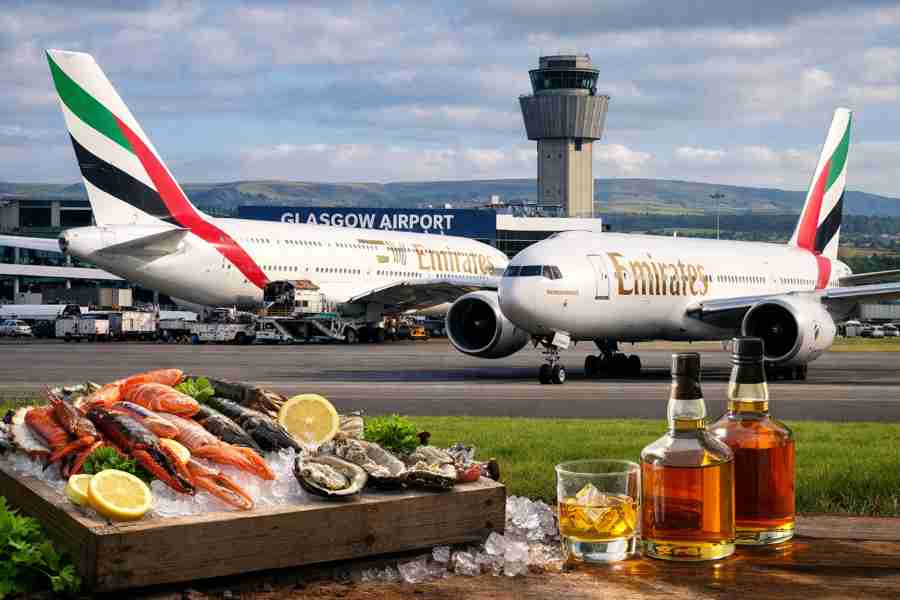
Emirates Airline is in discussions to restore a second daily flight between Glasgow Airport and Dubai International Airport, a move that would reflect sustained growth in both passenger traffic and high-value cargo exports from Scotland. The potential expansion marks a significant development for Glasgow’s long-haul connectivity and underscores the strategic importance of the Dubai hub for trade and travel.
The proposed second daily service would reverse a previous reduction in capacity and could be introduced as early as the next airline scheduling cycle, though timing remains uncertain as Emirates balances aircraft deployment across its global network.
Glasgow Included in Emirates Expansion Plans
AGS Airports, the operator of Glasgow Airport, confirmed that discussions with Emirates are ongoing. Kam Jandu, chief executive of AGS Airports, told The Herald that the airline has Glasgow on its future growth roadmap, even though no formal launch date has been announced.
Demand on the route has remained resilient. Glasgow previously supported a double-daily Emirates operation, and airport officials believe market conditions once again justify additional capacity. The second flight could arrive in the next scheduling season, but it may also be delayed until the following year as Emirates manages fleet availability and competing priorities worldwide.
Currently, Emirates operates one daily Glasgow–Dubai service using the Airbus A380, its largest passenger aircraft. That flight is expected to remain in place even if a second frequency is added.
Aircraft Choice Reflects Cargo Priorities
While passenger volumes remain strong, cargo demand has become a central factor in planning the additional service. The proposed second daily flight would likely be operated by a Boeing 777, an aircraft valued for its cargo capability and operational flexibility.
Although the Boeing 777 offers fewer passenger seats than the Airbus A380, it provides superior freight performance, making it well suited for routes with significant export volumes. This consideration has taken on added importance as Scottish exporters seek faster and more reliable access to global markets via Dubai.
Seafood and Whisky Exports Fuel Growth
Scottish seafood exports—particularly fresh fish and live shellfish—are a major driver behind the push for more cargo space. Limited capacity on the current daily service often forces exporters to route shipments through other UK airports, including Manchester, increasing transit times and logistical complexity.
To support a potential second Emirates flight, Glasgow Airport is planning investments in expanded refrigeration and cold-chain infrastructure at its cargo handling center. These upgrades would allow perishable goods to be processed more quickly, enabling same-day departures to international destinations through Dubai.
Whisky exports also play a significant role in sustaining cargo demand. As one of Scotland’s most valuable export commodities, whisky shipments benefit from the global reach and frequency of Emirates’ network, further strengthening the commercial case for additional flights.
Passenger Demand Remains Strong
Despite the growing importance of freight, passenger traffic continues to underpin the route’s performance. Glasgow maintains a solid base of inbound and outbound travelers, both for leisure and business purposes, and compares favorably with nearby markets.
The continuation of the daily Airbus A380 service ensures that high-capacity passenger demand remains well served, even as Emirates evaluates adding a complementary second flight.
Premium Economy and Competitive Landscape
Emirates is also considering the introduction of its Premium Economy cabin on the Glasgow route as part of an ongoing fleet refurbishment program. If aircraft refit schedules align, the upgraded cabin could be available on Glasgow services within the next year, offering an enhanced option for travelers seeking greater comfort at a mid-range price point.
Regionally, competition remains measured. Edinburgh Airport currently hosts a daily Emirates service to Dubai operated by the Airbus A350, providing an alternative gateway for Scottish travelers while highlighting the airline’s broader commitment to the market.
Ownership Changes Support Expansion Strategy
The potential Emirates expansion comes as AGS Airports adjusts to new ownership. In early 2025, Canada-based PSP Investments acquired AGS Airports through AviAlliance in a £1.53 billion transaction. New leadership has since emphasized network growth and infrastructure investment across the group’s airports, including Glasgow.
For Glasgow Airport, the return of double-daily Emirates flights would represent a strategic win, reinforcing its role as a key international gateway for both travelers and exporters in Scotland.
