


Regional Conflict Weighs on Air Travel Demand
DUBAI — Long-haul flights operated by major Gulf airlines are departing with unusually low passenger numbers as geopolitical tensions across the Middle East disrupt travel patterns and reduce demand for flights through the region’s major hubs.
Flights operated by Emirates between Frankfurt Airport (FRA) and Dubai International Airport (DXB) are among those affected, with passengers reporting that some aircraft are operating far below normal capacity levels. Similar situations have been reported on Qatar Airways flights connecting through Hamad International Airport (DOH) in Doha.
The decline in passenger traffic comes amid ongoing hostilities involving Iran, Israel, and the United States, which have created uncertainty for airlines operating across Middle Eastern airspace. Security concerns and potential airspace restrictions have prompted many travelers to reconsider itineraries that transit through Gulf hubs.
As a result, airlines are operating fewer flights overall, and those that continue to run are sometimes carrying far fewer passengers than usual.
Travelers Avoiding Transit Through Gulf Hubs
Travel demand into and through the Gulf region has fallen significantly as travelers respond to the evolving geopolitical situation.
Some passengers remain stranded in parts of the Middle East due to schedule changes and disruptions, while others are deliberately avoiding connections through cities such as Dubai and Doha because of safety concerns.
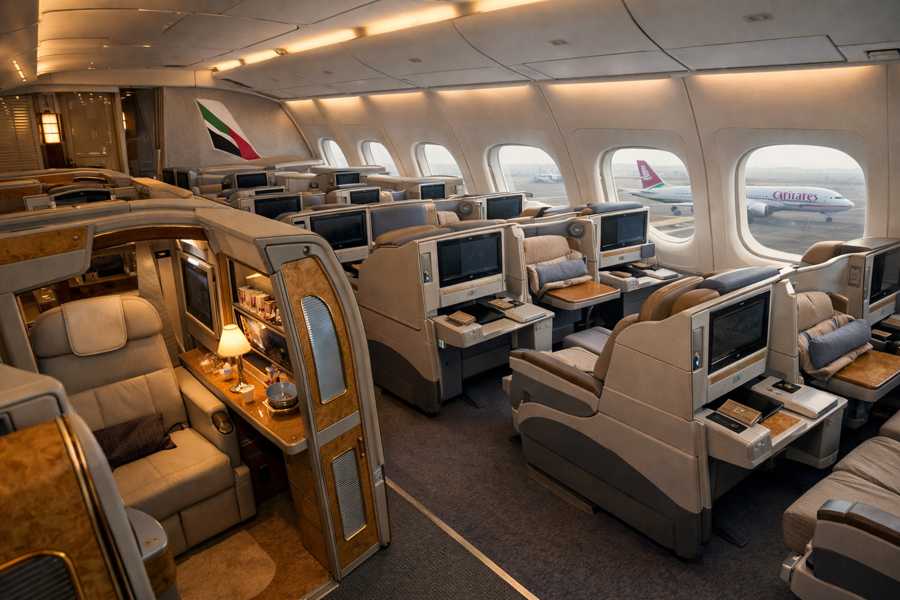
The shift in travel behavior has produced an unusual effect: premium cabins on certain long-haul flights are largely empty. Travelers on several flights have reported that first-class and business-class sections — typically among the most sought-after seats on international routes — are operating with very few passengers.
In some cases, passengers say they have had entire premium sections to themselves, a rare occurrence in normal market conditions.
Emirates A380 Flights Operating With Minimal Loads
One widely discussed example involves an Emirates flight from Frankfurt Airport (FRA) to Dubai International Airport (DXB) operated using an Airbus A380, the largest passenger aircraft currently in commercial service.
The aircraft typically carries up to 468 passengers depending on configuration. However, passengers on the flight reported that only about 50 travelers were onboard, suggesting the aircraft departed roughly 90 percent empty.
The Emirates A380 is known for its high-end premium cabin offerings, particularly its first-class suites. The aircraft features private enclosed suites as well as two onboard shower spas available exclusively to first-class passengers.
On most flights, passengers must reserve time slots to use the shower facilities because of high demand. On this particular flight, that system reportedly was not necessary because the entire first-class cabin was empty.
Business-class cabins on some services have also remained largely unoccupied due to the sharp drop in travel demand.
Qatar Airways Seeing Similar Passenger Patterns
Reports from passengers traveling with Qatar Airways through Hamad International Airport in Doha suggest similar conditions on certain flights.
Videos shared by travelers show business-class cabins on long-haul routes with only a handful of passengers. In some cases, travelers appear to have had an entire section of the cabin to themselves.
However, some claims circulating on social media about these flights have proven inaccurate. Suggestions that aircraft are being operated with only one pilot or a single flight attendant are false.
International aviation regulations require airlines to maintain minimum crew levels based on aircraft type and passenger capacity, and those requirements cannot be reduced below mandated safety standards.
Rare Experience for Long-Haul Passengers
Flights operating with extremely low passenger loads are unusual but not unprecedented in the aviation industry.
Similar situations have occurred during periods of major disruption, including security scares, technical concerns, or global travel crises. For example, during the Y2K transition in January 2000, fears of computer system failures led many travelers to avoid flying, leaving some flights with only a handful of passengers.
Other instances have occurred when significant delays or schedule changes cause large numbers of passengers to rebook onto different flights.
While aviation enthusiasts occasionally encounter lightly filled premium cabins, having an entire first-class or business-class section essentially to oneself is extremely rare during normal travel conditions.
Disruptions Highlight Sensitivity of Airline Demand
The current situation highlights how quickly geopolitical tensions can influence global airline demand.
Carriers such as Emirates and Qatar Airways operate some of the world’s largest long-haul networks, connecting passengers between Europe, Asia, Africa, and the Americas through their Gulf hubs.
When uncertainty affects the region, even temporarily, travel patterns can shift rapidly, leaving airlines operating flights with significantly fewer passengers than planned.
For now, the small number of travelers who are still flying through the region are experiencing unusually quiet flights — and a rare level of space in premium cabins that are normally fully booked.
Industry observers expect passenger demand to gradually return as regional conditions stabilize and traveler confidence improves.
