


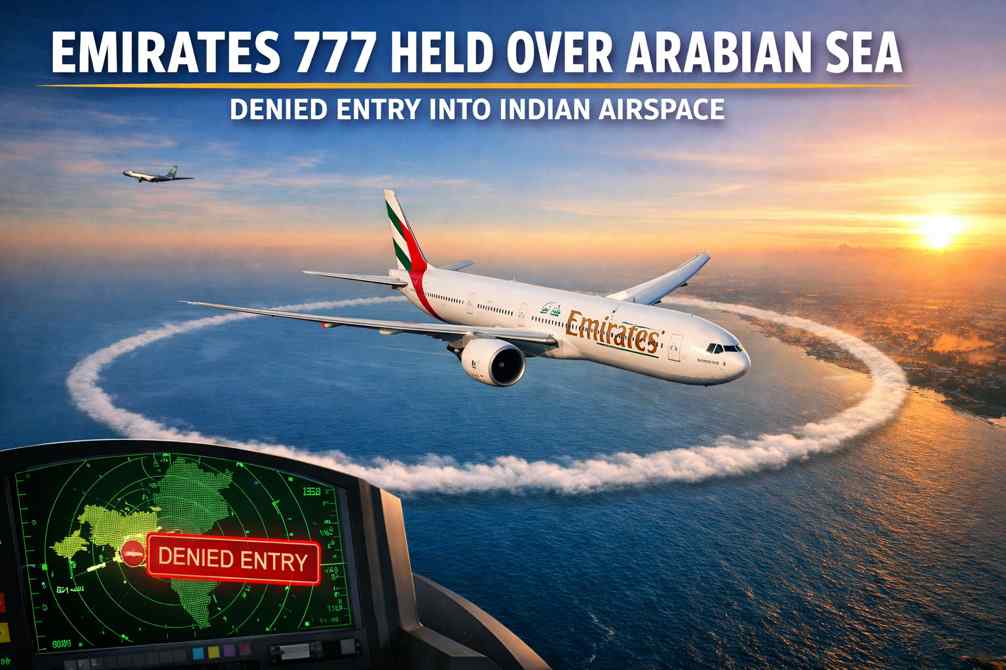
Emirates Boeing 777 Held Over Arabian Sea Following Airspace Clearance Confusion
An Emirates Airline Boeing 777 operating from Ras Al Khaimah to Singapore was briefly denied entry into Indian airspace after a flight plan filing error incorrectly classified the service as a non-scheduled operation, triggering regulatory concerns and a temporary holding pattern over the Arabian Sea.
The incident occurred on April 5, 2025, involving Emirates flight EK 9314, which departed from Ras Al Khaimah International Airport bound for Singapore. According to a report by TOI, the aircraft was approaching Indian airspace at approximately 6:25 a.m. IST when air traffic controllers in Mumbai flagged the flight over discrepancies in its filed operational status.
Indian controllers determined that the flight had been submitted in aviation systems as a non-scheduled service rather than a scheduled commercial operation. Under Indian aviation regulations, non-scheduled flights require prior approval from the Directorate General of Civil Aviation (DGCA) and must carry a valid authorization document known as a YA number.
Documentation Error Prompted Temporary Airspace Denial
Because no YA number had been issued for EK 9314, and no approval could be located in DGCA records, Mumbai ATC denied the aircraft immediate entry into Indian airspace and instructed the Boeing 777 to hold while authorities worked to verify the flight’s status.
The aircraft subsequently turned around and remained in a holding pattern over the Arabian Sea as the issue was investigated.
The matter was resolved after Emirates and the flight crew confirmed to Indian authorities that EK 9314 was in fact operating as a scheduled service and had been incorrectly categorized during the flight plan filing process. Once that clarification was made, controllers granted the aircraft permission to proceed through Indian airspace and continue to Singapore.
DGCA Approval Process Underpins Non-Scheduled Operations
India’s Directorate General of Civil Aviation maintains a strict framework for approving charter, ferry, and other non-scheduled flights operating to, from, or through Indian airspace.
Each approved non-scheduled operation must receive a DGCA-issued YA number, which serves as documentary proof of authorization. Scheduled airline services, by contrast, typically operate under standing approvals linked to airline route authorities, published schedules, and carrier designator codes.
Because air traffic control decisions are based on the information contained in a filed flight plan, the absence of a YA number for a flight categorized as non-scheduled represented sufficient grounds for controllers to deny entry until the discrepancy was resolved.
The episode underscores how even minor documentation or classification errors can create operational disruptions for long-haul international flights.
Incident Echoes Earlier IndiGo Airspace Disruption
The Emirates incident follows another notable airspace-related disruption involving Indian carrier IndiGo roughly one month earlier.
IndiGo flight 6E 033, operating from Delhi to Manchester, was forced to return to Delhi after more than seven hours airborne when a discrepancy involving aircraft registration and operator documentation triggered concerns from Eritrean air traffic control.
That flight was operated using a Boeing 787-9 Dreamliner wet-leased from Norse Atlantic Airways. Although IndiGo had obtained overflight permissions, Eritrean authorities reportedly questioned why the aircraft registration corresponded to Norse Atlantic while the flight paperwork had been filed under IndiGo’s name.
The resulting confusion led to a turnaround, forcing passengers to endure a roughly 14-hour round trip that ended back at the departure airport.
Operational Complexity Rising Amid Airspace Restrictions
The IndiGo case also reflects broader operational challenges facing carriers as geopolitical tensions reshape global flight routing.
Because the European Union Aviation Safety Agency has restricted aircraft registered under its jurisdiction from using certain Middle Eastern airspace, including routes over Saudi Arabia, Norse Atlantic-operated aircraft flying for IndiGo have been routed through Africa on Europe-bound services.
That longer routing has added complexity to overflight planning, requiring airlines and regulators to coordinate approvals across multiple jurisdictions.
While the Emirates overflight disruption was resolved quickly and had limited operational impact, both incidents highlight the aviation industry’s growing dependence on precise regulatory filings and accurate cross-border coordination as airspace management becomes increasingly complex.
