


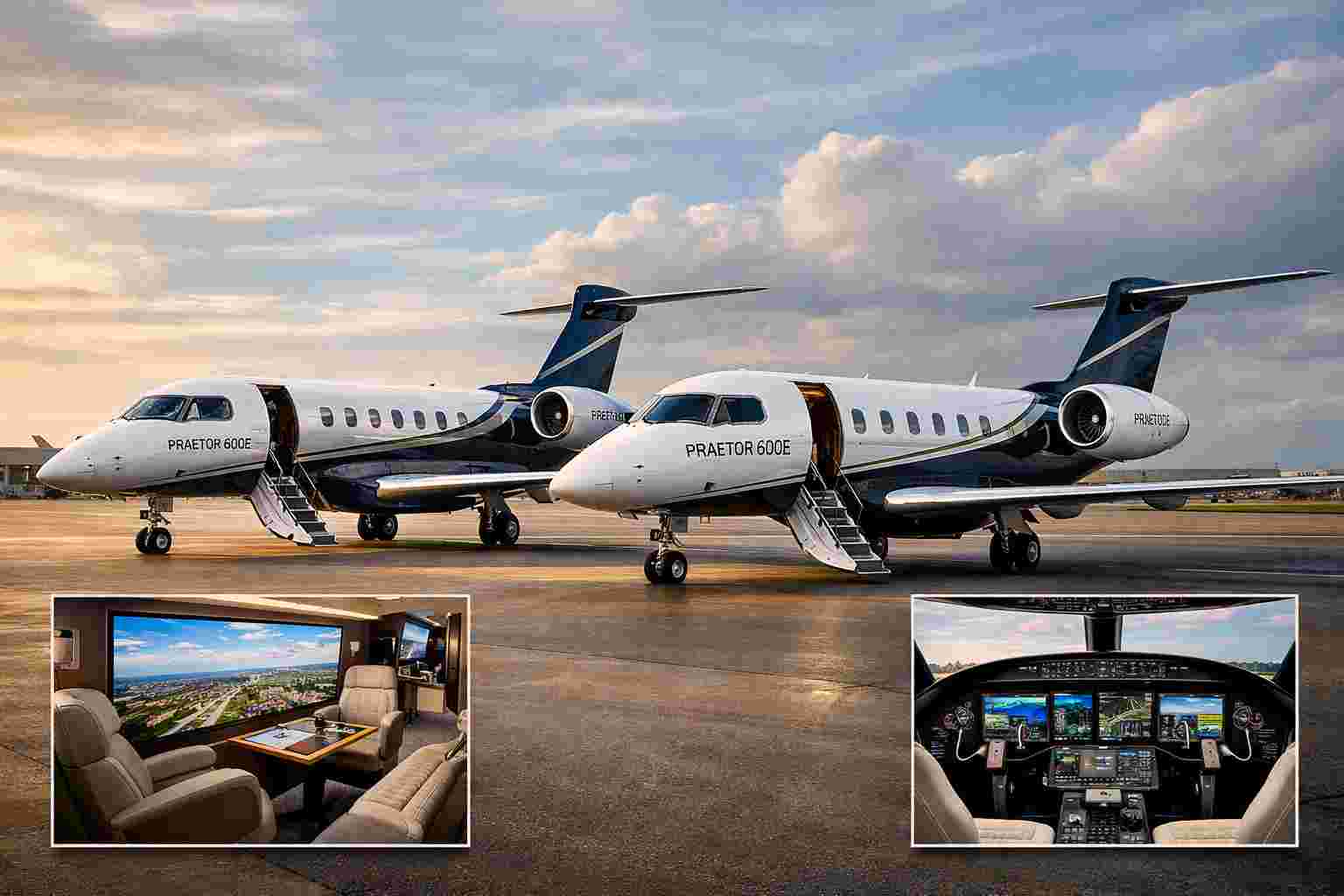
Embraer is expanding its presence in the midsize and super-midsize business jet market with the launch of two updated aircraft variants, the Praetor 600E and Praetor 500E, the first major evolution of the company’s Praetor family since its introduction.
The new jets focus heavily on cabin technology, connectivity, and passenger comfort while maintaining the performance characteristics that have helped position the Praetor series among the leading aircraft in its category. The upgrades include redesigned interiors, improved cabin management systems, and enhanced avionics intended to support longer missions and more productive inflight environments.
Cabin redesign targets productivity and connectivity
The most prominent feature debuting in the updated lineup is the optional 42-inch 4K OLED Smart Window™ available on the Praetor 600E. The system integrates multiple functions—including video conferencing, high-resolution streaming, and live external camera views—through three cameras mounted on the aircraft’s fuselage.
When paired with an optional divan seating configuration, the Smart Window™ effectively turns the second cabin zone into a multipurpose meeting or entertainment area. Passengers can use the space to conduct business discussions, stream media, or relax during extended flights.
Both aircraft also introduce a redesigned Cabin Management System intended to give passengers greater control over the onboard environment. The system allows users to manage temperature, lighting, airflow, entertainment, and audio through multiple interfaces, including a dedicated mobile application.
Additional optional features include voice-command functionality, Bluetooth audio connectivity, wireless charging, and customizable RGB mood lighting designed to adjust the cabin atmosphere during different phases of flight.
To accommodate the added technology, Embraer redesigned the cabin’s upper valance area, integrating new technology panels and improving the ambient air distribution system. The redesign aims to enhance both the aesthetics and overall functionality of the passenger cabin.
Seating upgrades designed for long-range comfort
Seating across both models has also undergone a complete redesign and is now manufactured in-house by Embraer. The new seats incorporate configurable cushion firmness, dual lumbar support, forward-tracking headrests, and increased legroom.
Electric-assist seat movement allows passengers to adjust seating positions more easily, while a redesigned berthing system enables faster conversion of the cabin for rest during longer flights. A dedicated lounge position is also available to improve comfort during extended missions.
The Praetor 600E includes a redesigned galley with expanded storage capacity, increased waste disposal space, and a larger ice drawer to better support long international trips. Meanwhile, the Praetor 500E features an upgraded refreshment center with additional stowage.
Despite the changes, both aircraft retain key features that have been central to the Praetor line. These include a six-foot-tall flat-floor cabin, stone flooring, a vacuum service lavatory, and what Embraer describes as the largest baggage compartment in their respective classes. Each aircraft also continues to offer a full vanity in the rear private lavatory as standard equipment.
Flight technology and operational performance
From a flight operations standpoint, the Praetor 600E and Praetor 500E maintain the company’s full fly-by-wire flight control system with active turbulence reduction, a feature that remains unique in their class. The technology helps reduce pilot workload while improving passenger comfort during turbulent conditions.
Both aircraft are also equipped with Embraer’s Runway Overrun Awareness and Alerting System, which provides additional situational awareness during landing operations.
Power for both jets comes from twin HTF7500E engines produced by Honeywell, providing strong runway performance and operational flexibility. The Praetor 600E, for example, is capable of operating from demanding airports such as Santa Monica and Ocean Reef.
With four passengers and NBAA IFR reserves, the Praetor 600E offers a range of 4,018 nautical miles (7,441 kilometers), enabling nonstop routes such as London to New York or São Paulo to Miami. The Praetor 500E delivers a range of 3,340 nautical miles (6,186 kilometers), allowing routes such as Miami to Seattle and Los Angeles to New York.
Both aircraft maintain a cabin altitude of 5,800 feet and low cabin noise levels designed to reduce fatigue on long missions.
Expanding Embraer’s executive aviation portfolio
The introduction of the new Praetor variants reinforces Embraer’s broader strategy in the executive aviation market, where the company competes in the light, midsize, and super-midsize segments.
In addition to the Praetor lineup, Embraer’s executive jet portfolio includes the Phenom 100EX and the Phenom 300E, the latter of which has led the light-jet market for 14 consecutive years.
With more than five decades of aerospace experience, the company continues to emphasize performance, operational efficiency, and customer support as it expands its global fleet of business aircraft.
