


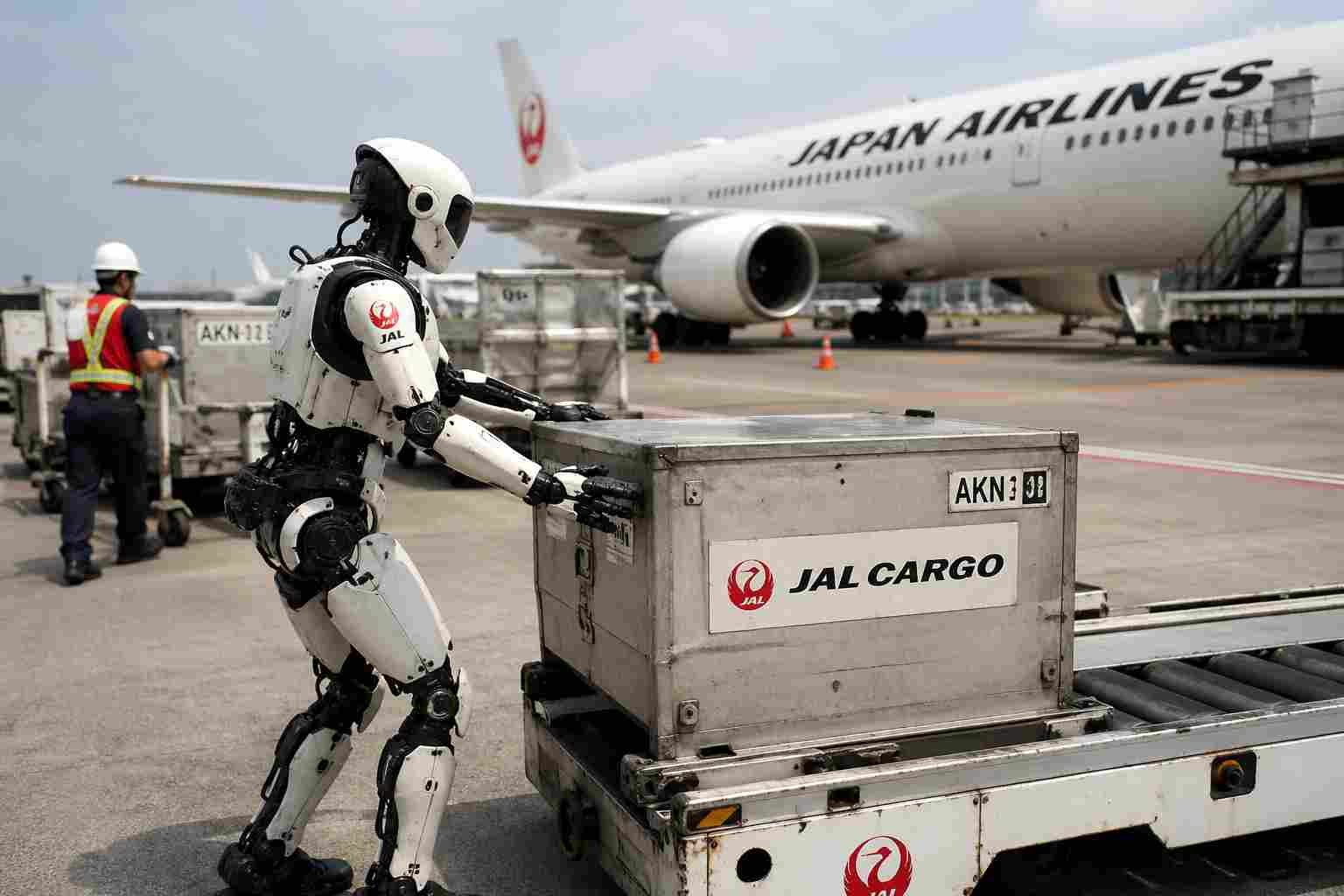
JAL partners with GMO to test robots for cargo handling as labor shortages intensify
TOKYO — Japan Airlines is moving forward with an ambitious plan to integrate humanoid robots into airport operations, launching a first-of-its-kind trial at Tokyo Haneda Airport aimed at easing labor shortages and improving efficiency in ground handling.
The initiative, developed in collaboration with subsidiaries of GMO Internet Group, will begin in May 2026 and marks Japan’s first deployment of human-shaped robots in an airport ground services environment. The multi-year demonstration underscores mounting pressure across the aviation sector to maintain operational performance amid a shrinking workforce.
A Three-Year Trial Focused on Automation
The project will be led by JAL Ground Service Co., Ltd., working alongside GMO AI & Robotics Trading Co., Ltd., combining aviation operational expertise with advanced robotics engineering.
The trial is expected to run for approximately three years, during which the companies will conduct phased evaluations and real-world operational testing. In its initial stage, two humanoid robots will be introduced to perform basic but physically demanding tasks.
These early functions will include transporting cargo containers and operating the mechanical levers used to secure them—jobs that traditionally require significant manual effort and precision.
Over time, the companies plan to enhance the robots’ capabilities through artificial intelligence, allowing them to adapt to more complex airport workflows. Future development phases will focus on increasing autonomy, enabling the machines to operate with minimal human intervention.
Addressing Japan’s Labor Constraints
Japan’s aviation industry is grappling with a growing labor shortage, driven by a combination of increasing travel demand and a declining working-age population. Ground handling roles have been particularly difficult to fill, given their physically intensive nature and often challenging working conditions.
JAL currently employs around 4,000 ground handling staff, many of whom operate in confined spaces and under strict time constraints. The introduction of humanoid robots is intended to alleviate some of this burden while maintaining high standards of safety and efficiency.
Unlike traditional automation systems, which often require purpose-built infrastructure, humanoid robots are designed to replicate human movement. This allows them to function within existing airport environments without significant modifications to facilities or equipment—a key advantage in complex, space-constrained settings like airports.
Expanding Use Cases Beyond Cargo
While the initial trial will focus on cargo handling, the long-term vision for the project extends far beyond that scope. Developers aim to eventually deploy humanoid robots across a wide range of airport operations.
Potential applications include baggage loading, aircraft cabin cleaning, and handling ground support equipment. These tasks, which are repetitive and labor-intensive, are seen as strong candidates for automation.
Before any broader rollout, however, the companies plan to conduct detailed analyses of airport workflows to identify safe and practical use cases. Both simulated and real-world testing will be used to ensure that the robots meet strict aviation safety and reliability standards.
Strategic Push Toward AI and Robotics
The collaboration is also part of a larger strategic push by GMO Internet Group to accelerate the adoption of artificial intelligence and robotics technologies. The company has identified 2026 as a milestone year for humanoid robot development, signaling its intention to scale innovations across multiple industries.
For Japan Airlines, the initiative represents a forward-looking investment in operational resilience. If successful, the program could establish a new model for airport ground operations—one that blends human expertise with robotic efficiency.
Industry analysts say such hybrid workforce models may become increasingly common, particularly in regions facing demographic challenges similar to Japan’s. Airports worldwide are under pressure to handle rising passenger volumes while controlling costs and maintaining service standards.
A Potential Blueprint for Global Aviation
The Haneda trial could ultimately serve as a blueprint for other airlines and airport operators seeking to modernize their ground operations. By demonstrating that humanoid robots can safely and effectively perform essential tasks, JAL and its partners may help accelerate adoption across the global aviation sector.
If the technology proves viable at scale, it could reshape how airports approach staffing, training, and infrastructure planning in the years ahead—potentially transforming one of the most labor-intensive segments of the industry.
For now, all eyes are on Tokyo as the trial prepares to begin, offering a glimpse into what the future of airport operations might look like.
