


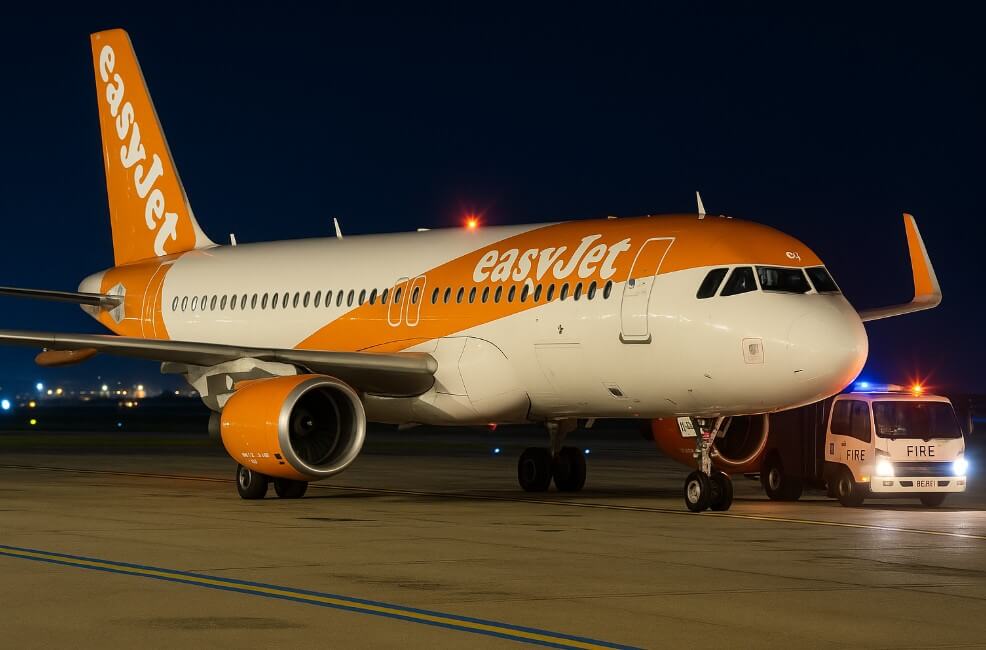
An easyJet flight traveling from Copenhagen to Manchester made an emergency landing in Newcastle on the night of October 27, 2025, after the crew declared an in-flight emergency related to a passenger medical issue.
Flight U22238, operated by an Airbus A320-200 registered G-EZPB, was cruising over the North Sea as it approached the east coast of England when the incident occurred. The crew transmitted the emergency transponder code 7700, signaling an urgent situation, and diverted the aircraft directly to Newcastle Airport.
The aircraft, part of the airline’s regular Copenhagen–Manchester service, had departed Copenhagen Airport (CPH) at 10:23 p.m. local time. According to publicly available flight tracking data, the jet had climbed to a cruising altitude of 38,000 feet (FL380) before the crew initiated the emergency procedure at approximately 8:28 p.m. UTC.
Emergency Declared Over North Sea
Flight tracking sources show that after declaring the emergency, the A320 altered course westward toward Newcastle. The landing was executed safely at 10:45 p.m. local time. Emergency services were standing by upon arrival, as is standard procedure for such events.
According to the aviation monitoring outlet Flight Emergency, the reason for the unscheduled landing was a medical situation involving a passenger on board. No further details about the passenger’s condition were released.
Following a brief stopover in Newcastle, during which the medical emergency was addressed, the aircraft continued its journey to Manchester. The flight departed again at 12:02 a.m. local time on October 28 and landed at its original destination without further incident.
Routine Response and Continuation of Service
easyJet, one of Europe’s largest low-cost carriers, operates hundreds of short-haul flights daily across its network. Diversions of this nature, while rare, are handled in accordance with strict safety and medical protocols.
The Airbus A320 involved in the incident is a 9.7-year-old aircraft delivered new to easyJet in February 2016. The narrow-body jet remains a workhorse of the airline’s fleet, known for its reliability and efficiency on routes across Europe.
Although the carrier has not yet issued an official statement, flight data confirm that the aircraft resumed normal service shortly after the incident. Industry observers note that medical diversions, while disruptive to schedules, are among the more common causes of in-flight emergencies and are managed with well-established procedures.
Context and Operational Data
Flight U22238 is a regularly scheduled evening service between Copenhagen and Manchester, connecting two major European business and leisure hubs. Under normal conditions, the route spans approximately 1 hour and 45 minutes.
On this occasion, the flight’s diversion added roughly 90 minutes to its journey time. The aircraft’s flight path—available from live-tracking platforms—shows a smooth descent into Newcastle following the emergency declaration.
Aviation analysts highlight that transponder code 7700 is universally recognized as a distress signal indicating a general emergency, prompting air traffic control to prioritize assistance. When such a code is transmitted, controllers immediately clear surrounding airspace and coordinate a direct approach to the nearest suitable airport.
A Safe Resolution
Despite the unexpected diversion, operations resumed quickly, and the aircraft departed Newcastle shortly after midnight. Passengers ultimately arrived at Manchester Airport early on October 28.
Such events underline the aviation industry’s focus on safety and preparedness. From onboard medical training for crew members to coordination with ground-based emergency services, airlines maintain protocols designed to respond swiftly and effectively to any in-flight emergencies.
The smooth handling of flight U22238’s diversion demonstrated those procedures in action — ensuring both the safety of passengers and the continuation of service with minimal disruption.
