


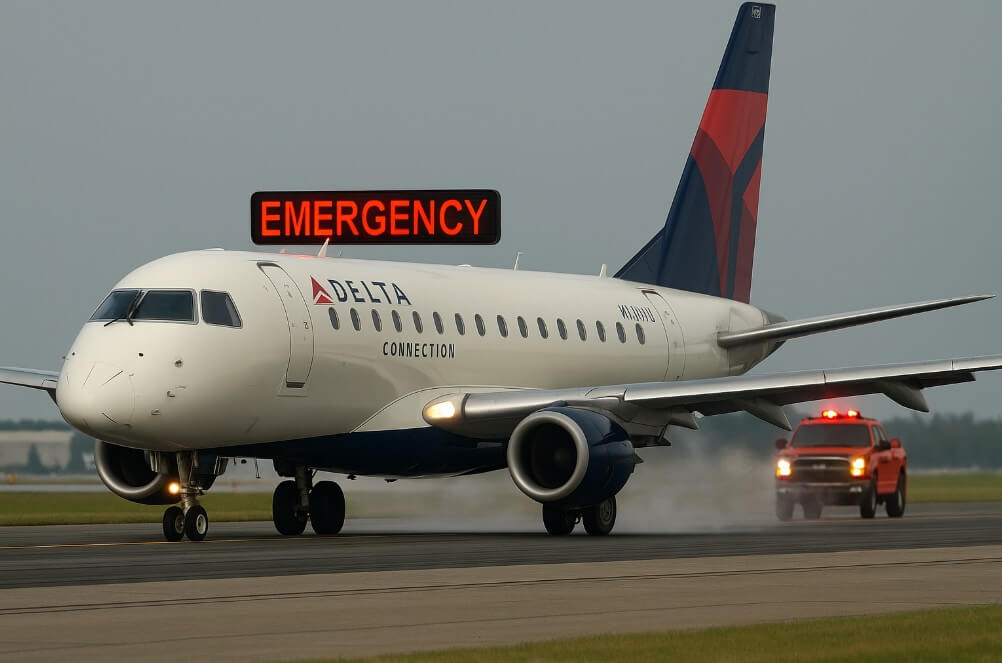
Raleigh, N.C. — A Delta Connection flight en route from Orlando to Raleigh-Durham declared an emergency on Sunday after the flight crew reported detecting the smell of smoke in the cockpit during final approach. The Embraer E175 landed safely at Raleigh-Durham International Airport without injuries, according to officials.
Flight DL5823, operated on behalf of Delta by Republic Airways, was on a scheduled morning service from Orlando International Airport (MCO) to Raleigh-Durham (RDU) on August 24, 2025. The regional jet, an Embraer ERJ-175 registered N211JQ, had departed Orlando on time at 11:57 a.m. and climbed to a cruising altitude of 33,000 feet for its northeastward journey.
Emergency Declared on Approach
The flight proceeded normally until its descent into North Carolina. As the aircraft descended through 4,000 feet on final approach to runway 05R, the crew reported the smell of smoke in the cockpit. In response, the pilots declared an emergency and squawked transponder code 7700, the international signal for aircraft in distress.
Despite the emergency, the flight crew continued the approach and landed the aircraft safely on runway 05R. After vacating the runway, the crew brought the aircraft to a stop while emergency response teams converged on the jet.
Ground Response and Inspection
Airport fire and rescue services carried out an immediate inspection of the aircraft while it remained on a taxiway. The inspection did not reveal any immediate hazards, and the jet was subsequently cleared to taxi under its own power to a hardstand area of the apron for further checks.
Delta confirmed that the aircraft landed without further incident. The airline has not reported any injuries among the passengers or crew.
Aircraft Background
The Embraer E175 involved in Sunday’s incident is a 16.7-year-old aircraft delivered new in December 2008. It has been operated in Delta Connection service since its delivery, flying regional routes on behalf of Delta Air Lines under Republic Airways management. The twin-engine regional jet is a common workhorse for U.S. regional carriers, typically carrying 76 passengers in a dual-class configuration.
While the precise cause of the smoke smell has not yet been disclosed, post-landing inspections are part of standard safety protocols. Mechanical or electrical systems can sometimes generate unusual odors without resulting in visible smoke or fire, prompting flight crews to act out of caution.
Standard Safety Measures
Declaring an emergency in cases of smoke or fire indication is consistent with established aviation safety procedures. Pilots are trained to treat any potential fire hazard as an immediate threat, even when the situation does not escalate. Squawking 7700 alerts air traffic control and airport responders, ensuring that firefighting and rescue resources are on standby when the aircraft arrives.
Flight tracking data showed the service departed Orlando as scheduled and conducted its cruise and descent normally until the emergency declaration. The flight crew’s decision to proceed with a normal landing while declaring the emergency allowed responders to prepare without disrupting the safe continuation of the approach.
Broader Context
Although rare, in-flight smoke or odor incidents are taken seriously in commercial aviation. The Federal Aviation Administration (FAA) requires airlines to follow strict reporting and inspection processes whenever crews encounter such conditions.
Delta and Republic Airways have not indicated whether the aircraft will undergo additional maintenance before returning to service. Safety investigators typically review maintenance records, aircraft systems, and crew reports following such events.
Passenger Impact
Delta did not immediately comment on whether passengers would face delays or re-accommodations as a result of the incident. Typically, in cases where a jet is taken out of service for inspection, airlines arrange alternate aircraft to maintain scheduled operations.
The swift resolution of the emergency highlights the layered safety systems in place for U.S. commercial aviation. Though unnerving for passengers, events such as Sunday’s precautionary emergency declarations remain rare and are designed to err on the side of caution.
