


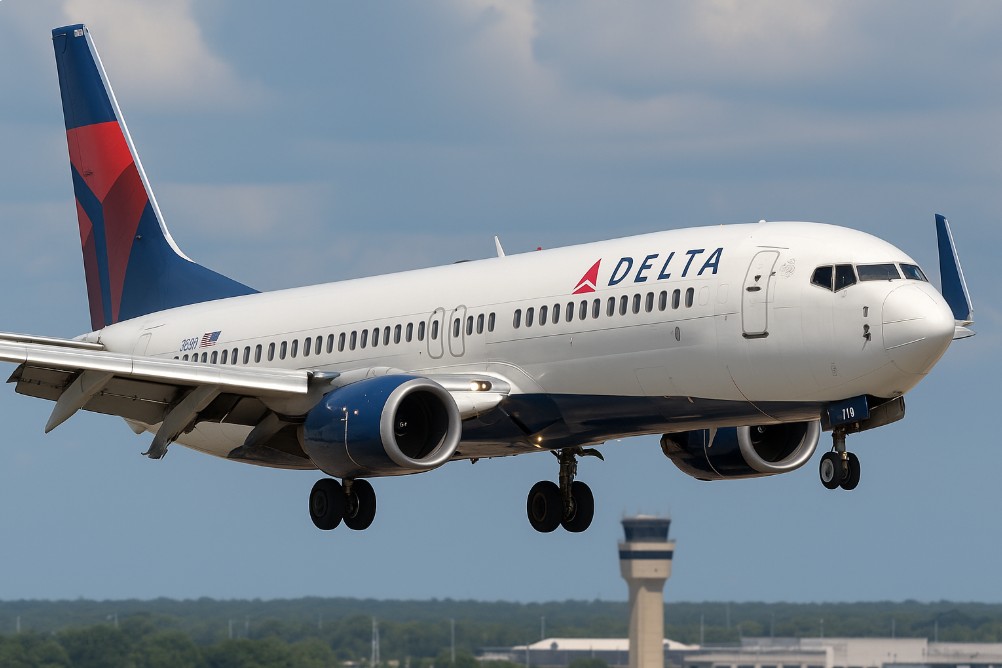
Delta Air Lines confirmed that one of its Boeing 737-800 aircraft sustained damage to a wing flap assembly during an approach to Austin Bergstrom International Airport on August 19, 2025. Despite the in-flight issue, the aircraft landed safely without incident, according to federal aviation officials.
Incident Details
The aircraft, operating as Delta Air Lines flight DL1893, was on a scheduled service from Orlando International Airport (MCO) to Austin, Texas. The flight departed Orlando at 1:11 p.m. local time and proceeded normally, cruising at flight level FL400 before beginning its descent into Austin.
According to The Aviation Herald, passengers on board noticed visible damage to the outboard left-hand flap assembly as the aircraft descended toward runway 18R. The flap, which plays a critical role in controlling lift during landing, appeared to have suffered a partial fracture and had dislodged from its proper position.
Despite the issue, flight crew continued with the approach, and the aircraft touched down safely at Austin Bergstrom International Airport. No injuries were reported among the passengers or crew.
FAA Findings
A Federal Aviation Administration (FAA) report later confirmed the damage. “Aircraft landed and post flight inspection revealed the trailing edge of the left-wing flap was bent upward,” the FAA stated in its initial findings.
Delta Air Lines has not publicly commented on whether the incident will prompt a wider inspection of its Boeing 737-800 fleet, one of the most widely used aircraft in its domestic operations.
Aircraft Background
The aircraft involved in the incident was a Boeing 737-800, registered N3740C. Records show the plane has been in service with Delta Air Lines since December 2000, making it nearly 25 years old at the time of the incident. While aging, the 737-800 remains a workhorse of Delta’s fleet, used primarily for medium-haul domestic routes such as Orlando to Austin.
At 24.7 years of service, the aircraft represents one of the older units still in operation across major U.S. carriers. Delta, like its competitors, routinely invests in maintenance and upgrades to extend the service life of its aircraft.
Passenger Accounts
Reports suggest passengers could see the extent of the damage from cabin windows during descent. While no official passenger statements have been released, observers noted that the damaged flap was visibly bent upward and not in its expected position. Such issues can create concern among those on board, but the crew followed protocol to ensure a stable landing.
Operational Context
Flight data reviewed after the incident confirmed that all other stages of the flight operated normally. The descent phase was when the flap damage became apparent. Because flaps are deployed during approach to increase lift and reduce landing speed, any structural compromise carries significant risk. Aviation analysts note that the safe landing demonstrates both the crew’s training and the aircraft’s ability to withstand partial component failures.
Industry experts point out that incidents of flap damage, while not common, are not unprecedented in aging fleets. Inspections, stress fatigue, and environmental factors are all considered in evaluating the lifespan of such parts.
Broader Implications
The FAA will likely conduct a full investigation into the incident, which could lead to maintenance directives for similar aircraft models across U.S. airlines. Safety regulators typically issue airworthiness directives if systemic risks are identified, requiring airlines to perform specific inspections or repairs.
Delta, meanwhile, continues to operate one of the largest fleets of Boeing 737-800s in the world. The carrier has also been modernizing its fleet with next-generation narrow-body jets such as the Airbus A321neo and Boeing 737 MAX, though many older models remain active across its domestic network.
While the airline has not announced whether flight DL1893’s aircraft will be returned to service following repairs, industry observers say the event underscores the ongoing challenges of balancing fleet modernization with the continued operation of aging aircraft.
Conclusion
Though unsettling, the flap damage aboard Delta Air Lines flight DL1893 highlights the aviation industry’s emphasis on layered safety systems and rigorous training. The aircraft landed safely, and no passengers were harmed, but the FAA’s findings will inform whether further precautions are required.
For travelers, the incident serves as a reminder of both the reliability of commercial aviation and the importance of regulatory oversight in ensuring that even unexpected equipment failures do not compromise passenger safety.
