


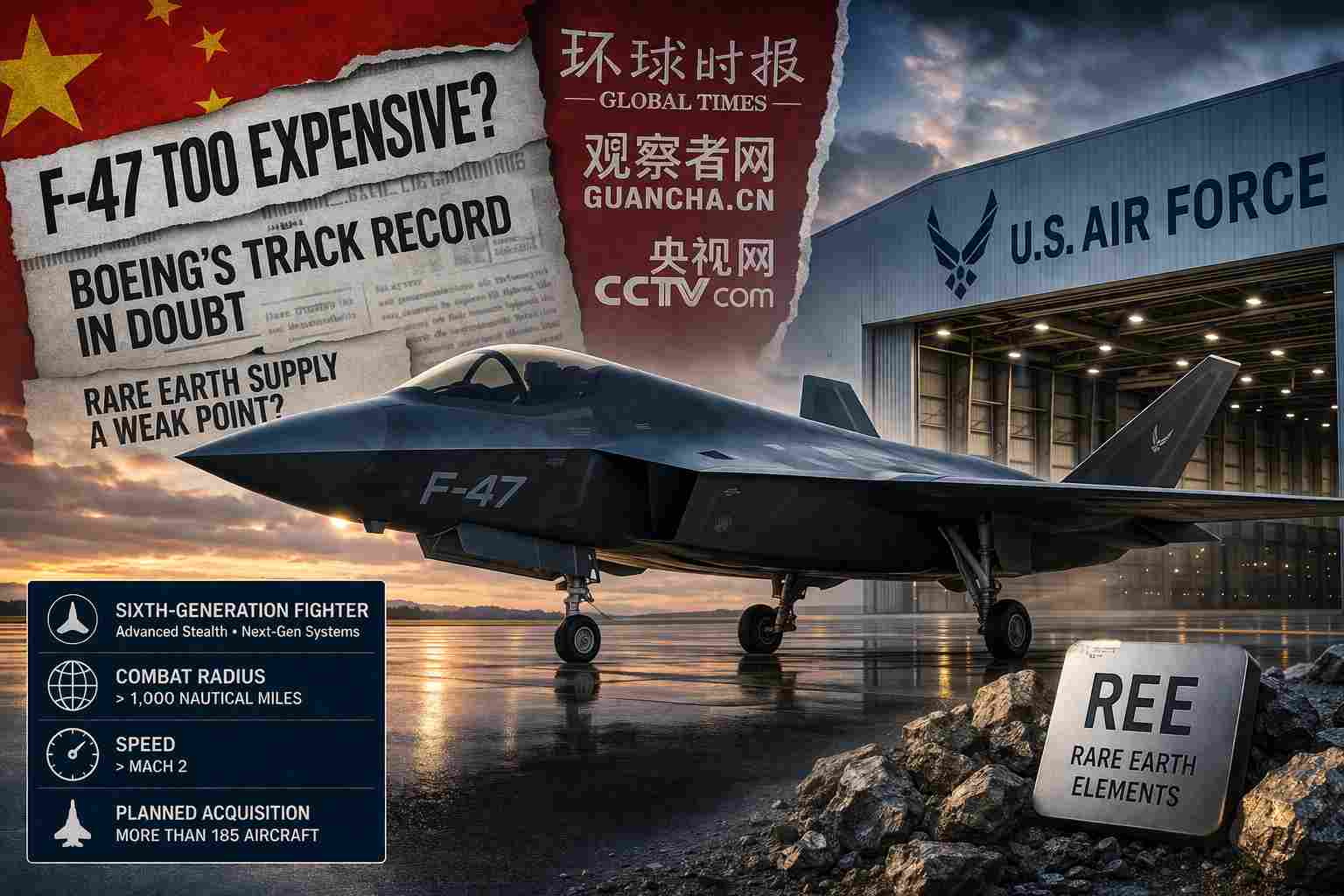
State Media Narratives Target Cost, Industry, and Supply Chains
WASHINGTON, D.C. — Chinese state media outlets are actively shaping a narrative aimed at undermining confidence in the U.S. Air Force’s next-generation F-47 fighter jet program, according to a new report. The coverage emphasizes concerns over program costs, criticizes contractor performance, and highlights potential vulnerabilities tied to rare earth mineral supply chains.
The findings come from an April 13 report released by the China Aerospace Studies Institute (CASI), which analyzed early Chinese media reactions to the sixth-generation fighter initiative. The report, prepared by analysts at BluePath Labs, suggests the messaging follows a familiar strategic pattern designed to influence multiple audiences.
How Chinese Messaging Is Structured
According to the report, Chinese state media coverage centers on three recurring themes: the projected cost of the F-47 program, criticism of prime contractor Boeing, and warnings about dependence on rare earth materials.
U.S. defense analysts say these narratives are not случайные but deliberately calibrated. Retired Navy Cmdr. J. Michael Dahm, a senior fellow at the Mitchell Institute for Aerospace Studies, noted that Chinese reporting typically targets three distinct groups: domestic audiences, regional allies, and U.S. policymakers.
For domestic viewers, the messaging reinforces confidence in China’s ability to compete technologically. For regional partners, it seeks to discourage closer alignment with Washington. For American officials, the goal is to introduce doubt about the viability and sustainability of major defense programs.
Cost Concerns and Boeing Under Scrutiny
A significant portion of Chinese coverage portrays the F-47 as financially unsustainable. Military commentators, including analyst Zhang Xuefeng, have suggested the aircraft could become the most expensive in history, arguing that rising costs and U.S. budget pressures may ultimately derail the program.
Chinese outlets have also focused heavily on Boeing’s recent performance, pointing to issues such as cost overruns in the KC-46 tanker program, delayed deliveries, and broader financial challenges. These reports question whether the company can execute the F-47 program on schedule.
U.S. officials have pushed back strongly against those claims. At the Air & Space Forces Association’s Warfare Symposium in February, U.S. Air Force Gen. Dale White stated that the program remains on track, with a first flight expected by 2028—just three years after program initiation.
That timeline compares favorably with earlier platforms. The F-22 required six years from contract award to first production flight, while the F-35 took five years.
Retired U.S. Air Force Col. John Venable, also with the Mitchell Institute, attributed recent delays across the defense sector to pandemic-era supply chain disruptions rather than systemic issues within Boeing. He added that improvements are already underway across major contractors.
Debate Over Technological Superiority
Chinese analysts have also attempted to downplay the F-47’s technological significance. Commentator Jin Yinan argued that the program reflects U.S. concerns about losing its technological edge, likening the situation to a modern-day “Sputnik moment.”
U.S. experts reject that characterization. Venable pointed to continued operational success of existing platforms like the F-35, which, despite being developed more than two decades ago, continues to demonstrate superiority over competing systems.
He cited recent missions where the F-35 operated effectively against Chinese- and Russian-made defenses, including advanced air defense systems. These examples, he argued, underscore the enduring technological advantage held by the United States.
Venable said the F-47 is expected to extend that advantage further, describing it as a potential “paradigm shift” in air combat capability.
Rare Earth Supply as a Strategic Flashpoint
Another focal point in Chinese media coverage is the F-47 program’s reliance on rare earth minerals—materials critical to advanced electronics and defense systems. Chinese analysts have highlighted Beijing’s dominant position in global rare earth production, framing it as a potential leverage point.
While acknowledging China’s current advantage in this area, U.S. experts argue that the risk is manageable. Venable noted that efforts are already underway to diversify supply chains, including expanding processing capacity in the United States and Canada.
He also emphasized that the total volume of rare earth materials required for the F-47 program is relatively small, making it feasible to source through alternative channels without significant disruption.
Strategic Messaging Battle Continues
The CASI report concludes that Chinese state media coverage of the F-47 is less about technical assessment and more about strategic influence. By focusing on cost, industrial performance, and supply chain vulnerabilities, the messaging aims to shape perceptions both inside and outside the United States.
As development of the F-47 progresses, analysts expect this information campaign to continue evolving alongside the program itself—highlighting the growing importance of narrative competition in modern defense strategy.
