


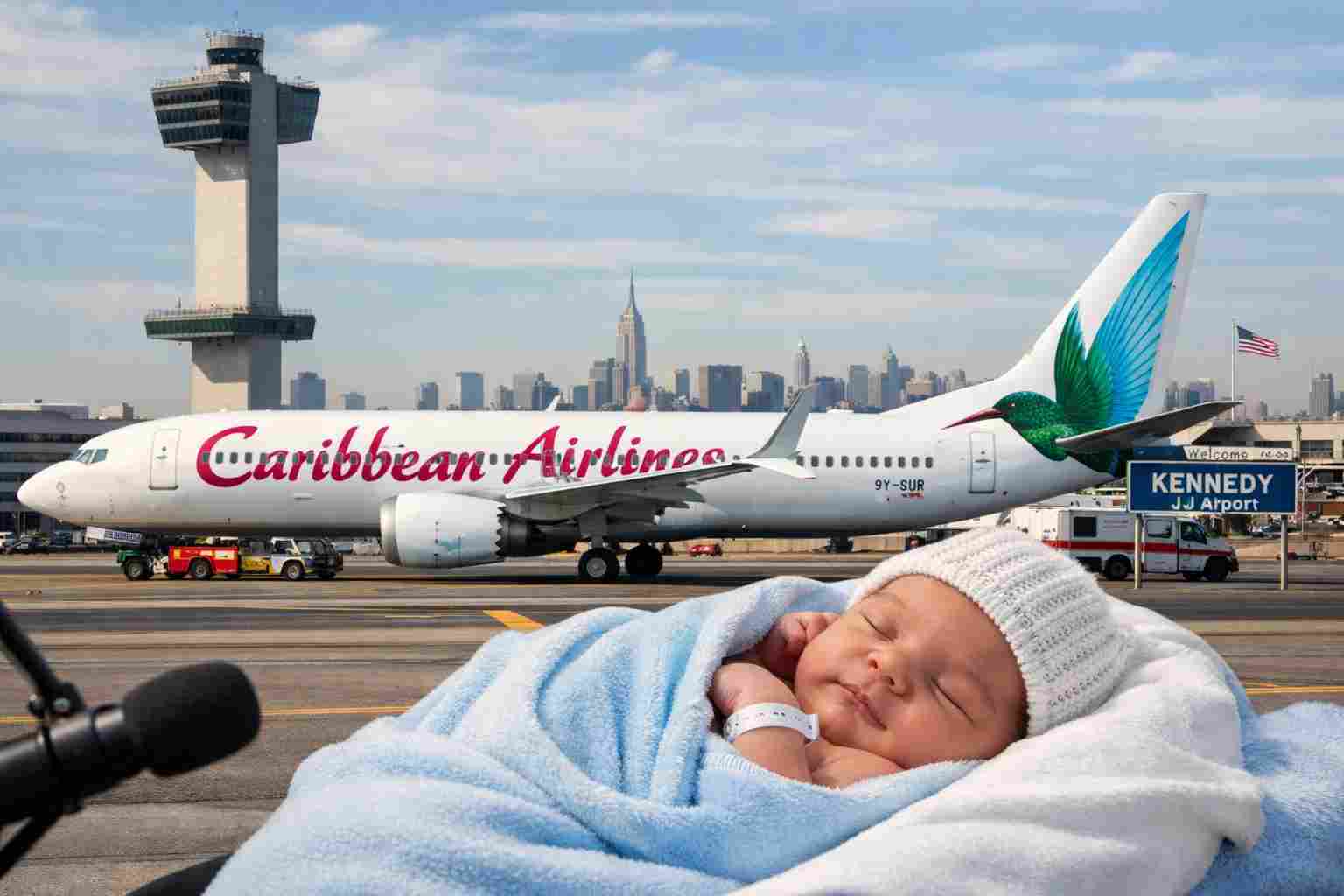
Mid-Air Birth Prompts Priority Landing at John F. Kennedy International Airport
NEW YORK — A routine international flight turned extraordinary when a passenger gave birth aboard a Caribbean Airlines aircraft moments before landing at New York’s John F. Kennedy International Airport, prompting swift coordination from air traffic control and a viral moment of levity from the cockpit.
The incident occurred on April 4, 2026, as Caribbean Airlines Flight BW 005 made its final descent into JFK. According to flight communications, a passenger went into labor shortly before landing, prompting the crew to alert air traffic control and request priority handling.
Controllers responded quickly, granting the aircraft a more direct route and expediting its descent. The plane was cleared “direct ZETAL” and stepped down from 3,000 feet to 2,000 feet, ensuring a faster and smoother approach. It was then given priority clearance to land on Runway 04R, with medical personnel standing by at the gate.
Coordinated Response Without Emergency Declaration
Despite the urgency of the situation, the flight crew did not declare a formal emergency. Instead, they followed standard aviation protocols by notifying controllers of the onboard medical event and requesting operational priority.
This approach is commonly used when conditions are stable but require expedited handling. Air traffic control coordinated seamlessly across approach, tower, and ground operations to ensure the aircraft reached the gate as quickly as possible.
The child was delivered before the aircraft reached its parking position, marking a rare inflight birth during a commercial flight’s final moments.
In post-landing communication, a ground controller asked whether the baby had been delivered and then humorously suggested naming the newborn “Kennedy,” a reference to the airport. The lighthearted remark quickly gained attention online, reflecting what observers described as both professionalism and humanity in aviation communication.
According to aviation publication View from the Wing, the exchange highlighted how operational efficiency can coexist with a personal touch, even in high-pressure situations.
Aircraft and Flight Details
The aircraft involved in the incident was a Boeing 737 MAX 9, registered as 9Y-SUR. The jet landed just before noon local time and is part of a fleet commonly used for regional and international routes.
While commercial aircraft are equipped with standard onboard medical kits, childbirth scenarios rely heavily on the response of trained crew members and, in many cases, assistance from passengers with medical experience.
Rare but Not Unprecedented
Inflight births remain exceedingly rare in commercial aviation, with fewer than 100 documented cases worldwide. A similar incident occurred in July 2005 involving BWIA West Indies Airways, a predecessor to Caribbean Airlines, when a passenger delivered a baby approximately 10 minutes before landing at JFK.
Globally, such cases have included mid-air deliveries, emergency diversions, and, in some instances, airline-issued benefits for the newborn, such as frequent flyer miles or lifetime travel privileges.
Citizenship Questions and Legal Context
The birth also raises questions about citizenship, a topic governed in the United States by the Fourteenth Amendment to the United States Constitution. Under current legal interpretation, individuals born within U.S. jurisdiction are generally granted citizenship.
This includes births occurring in U.S. airspace over land or within territorial waters extending 12 nautical miles from the coastline. While legal interpretations have been debated in recent years, existing guidance continues to recognize such births as qualifying under current law.
Airline Policies on Pregnancy Travel
Airlines maintain specific guidelines to manage the risks associated with late-stage pregnancy. Most carriers allow travel up to 36 weeks, though medical certificates are often required after 28 weeks due to the increased likelihood of spontaneous labor beyond 37 weeks.
Caribbean Airlines permits expectant mothers to travel without medical clearance up to approximately 32 weeks. However, as this incident demonstrates, unexpected early labor remains a possibility even within approved travel windows.
Bottom Line
The mid-air birth aboard Caribbean Airlines Flight BW 005 underscores both the unpredictability of air travel and the aviation industry’s capacity to respond effectively to medical events.
From expedited routing to coordinated ground support, the incident highlights the systems in place to manage in-flight emergencies—while also delivering a uniquely human moment that has resonated far beyond the runway.
For the newborn, the story begins not just with a place of birth, but with a connection to one of the world’s busiest aviation hubs—an origin story unlikely to be forgotten.
