


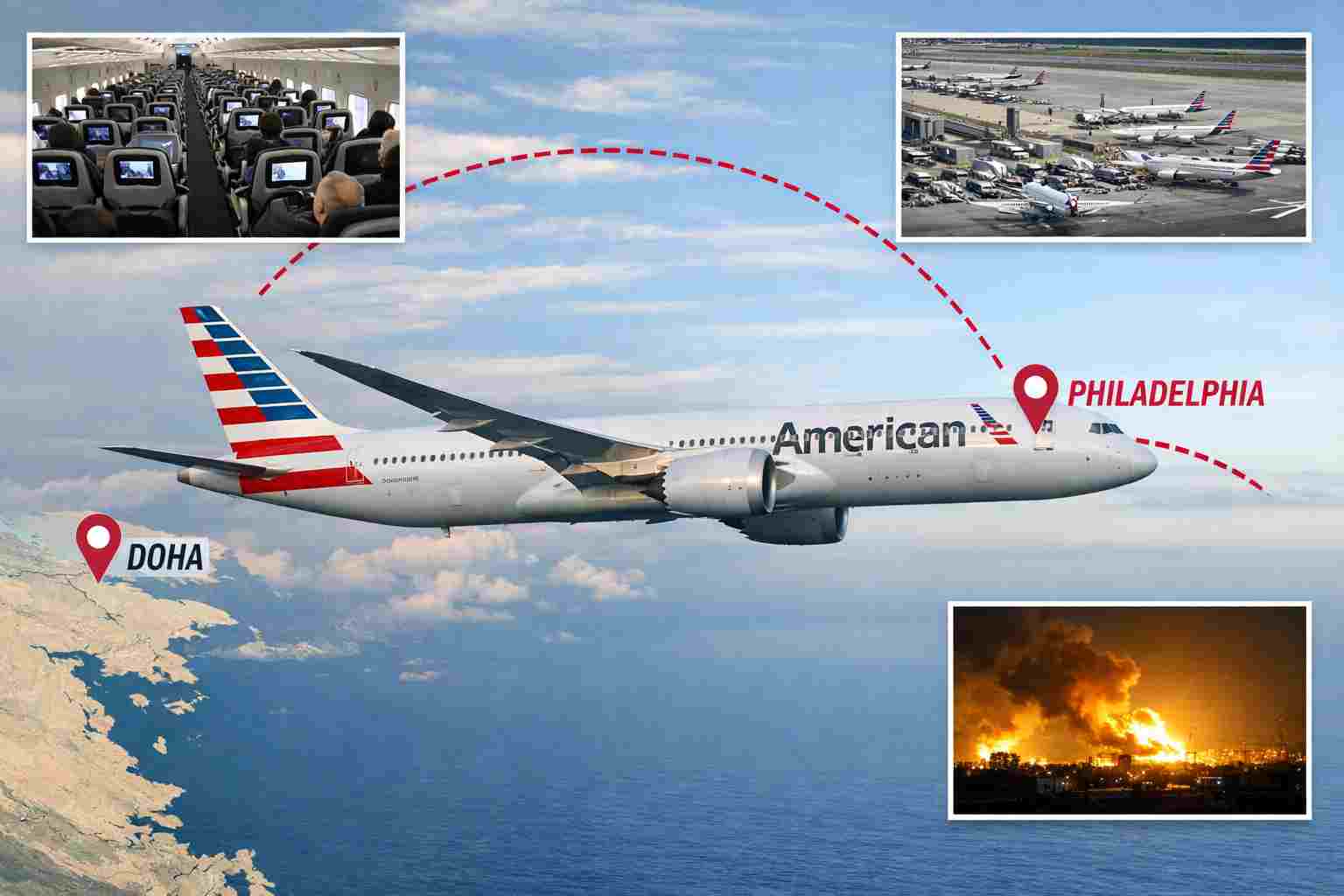
Passengers aboard an American Airlines long-haul flight to Qatar endured a rare 16-hour journey that ended where it began, after escalating military conflict in the Middle East forced the aircraft to reverse course mid-flight and return to Philadelphia.
American Airlines flight AA120 departed Philadelphia International Airport at 7:38 p.m. EST Friday, bound for Hamad International Airport in Doha. The route, launched in 2022, is scheduled to take about 12 hours and serves as a key link between the United States and South Asia through the airline’s partnership with Qatar Airways.
But the flight never reached its destination.
Crisis Unfolds Mid-Flight
The aircraft, a Boeing 787-9 Dreamliner manufactured by Boeing, was cruising at 38,000 feet over the Mediterranean Sea after passing Spain when it abruptly reversed course. The decision came at approximately 2:30 a.m. EST, coinciding with Israel’s confirmation of air strikes on Iranian military targets.
The Middle East immediately braced for retaliation, with subsequent developments including waves of Iranian missiles and kamikaze drones targeting Doha. Unconfirmed reports suggested the attacks may have hit Hamad International Airport. In response, authorities effectively shuttered Qatari airspace, eliminating the possibility of continuing the flight safely.
According to PYOK, the decision to return directly to Philadelphia reflected expectations that airspace restrictions would not be lifted quickly and that diversion options in the region were becoming increasingly constrained.
Why the Airline Returned to Philadelphia
Airlines faced limited alternatives once Qatari airspace closed. American Airlines had the option to divert to Madrid, where its oneworld alliance partner Iberia provides ground support. However, that option presented significant logistical challenges.
Some passengers on board may not have met Schengen visa requirements to formally enter Spain. A diversion to Madrid could have left travelers stranded inside the airport transit area for an extended period, potentially up to a full day, with limited onward options.
Instead, American Airlines opted to return the aircraft to its origin. The Boeing 787-9’s long-range capability allowed the jet to make the journey back to Philadelphia without refueling, though the airline pushed crew duty time limitations close to regulatory limits to complete the operation safely.
The aircraft landed back in Philadelphia at approximately 11:41 a.m. EST Saturday after just over 16 hours in the air. Strong westbound headwinds extended the return journey beyond the original scheduled flight duration.
The incident ranks among the longest modern commercial “flights to nowhere,” though it does not hold the record.
Strategic Route Highlights Airline Partnership
The Philadelphia-Doha route reflects a broader strategic partnership between American Airlines and Qatar Airways, established after the two carriers resolved a long-running dispute over alleged government subsidies.
The agreement resulted in one of the airline industry’s largest codeshare partnerships and expanded connectivity between North America and South Asia. Doha serves as a major hub, connecting passengers onward to cities including Lahore, Dhaka, Kathmandu and Islamabad.
The disruption underscores how geopolitical instability can affect even routine long-haul operations, particularly those that rely on access to politically sensitive airspace.
Not the Longest, but Among the Most Significant
While unusual, the American Airlines incident is not without precedent. On Feb. 16, 2023, Air New Zealand operated a nearly 17-hour return flight after departing Auckland for New York’s JFK airport. Midway across the Pacific, the crew learned that a fire at JFK Terminal 1 had caused a major power outage.
With no spare arrival capacity at JFK and diversion options declined by airline management, air traffic control instructed the aircraft to return to Auckland, resulting in nearly 17 hours of total flight time.
While AA120 fell short of that duration, its 16-hour return highlights the operational and financial challenges airlines face when geopolitical events disrupt carefully planned intercontinental routes.
For passengers and airlines alike, the incident serves as a reminder that even modern ultra-long-range aircraft remain vulnerable to rapidly changing global events far beyond their control.
