


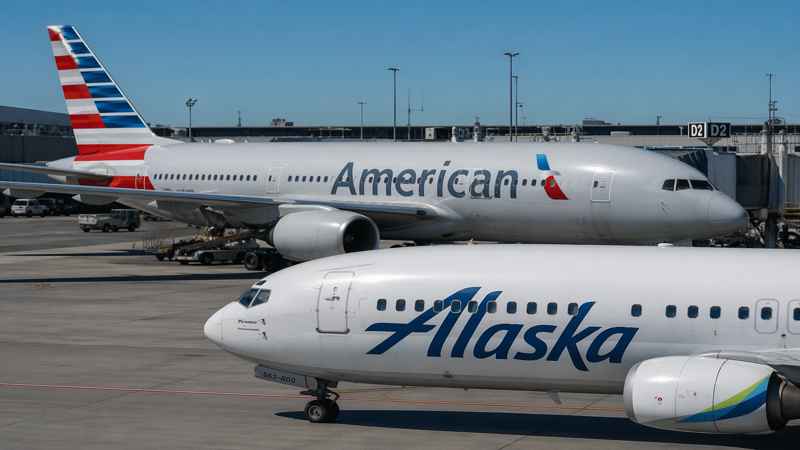
Shift From Merger Ambitions to Strategic Partnership Signals New Industry Approach
WASHINGTON — American Airlines and Alaska Airlines have stepped back from early-stage merger discussions and are instead pursuing a deeper commercial partnership centered on revenue sharing, according to industry developments. The move reflects a broader strategic recalibration as U.S. airlines navigate heightened regulatory scrutiny over consolidation and alliances.
While initial talks reportedly explored the possibility of a full merger, those discussions failed to progress beyond preliminary stages. Instead, both carriers are now focusing on expanding their existing collaboration, signaling a preference for flexibility over structural integration.
The shift comes in the wake of regulatory challenges faced by airline partnerships, most notably American’s unsuccessful alliance with JetBlue Airways, which was dismantled following a court ruling. That experience appears to have shaped American’s current approach to partnerships in a tightly regulated environment.
Early Merger Talks Give Way to Revenue-Sharing Strategy
Initial merger discussions between American and Alaska had the potential to significantly reshape the U.S. airline landscape, combining two major players with complementary networks. However, the talks stalled amid concerns over regulatory complexity and strategic alignment.
Rather than pursuing a full corporate merger, the airlines are now working toward a revenue-sharing agreement that would allow for closer coordination on routes, pricing, and scheduling. Such agreements enable airlines to deepen cooperation without triggering the same level of antitrust scrutiny typically associated with mergers.
American Airlines has not publicly confirmed that merger negotiations took place. However, the pivot toward a revenue-sharing model suggests a more cautious and calculated strategy, particularly as regulators continue to closely examine competitive dynamics within the aviation sector.
Strengthening the West Coast Alliance
American and Alaska already maintain a robust partnership through the oneworld alliance, complemented by their “West Coast Alliance.” This collaboration includes codesharing arrangements, reciprocal frequent-flyer benefits, and coordinated customer offerings such as seat upgrades and premium lounge access.
The partnership leverages the strengths of both carriers across key U.S. markets. American maintains a major hub at Dallas/Fort Worth International Airport, while Alaska has a strong presence at Seattle–Tacoma International Airport. Together, these networks create opportunities for expanded connectivity without the need for full integration.
For American, the partnership enhances its reach in Northern California and the Pacific Northwest—regions where its standalone presence is comparatively limited. Alaska, meanwhile, benefits from access to American’s extensive international network, strengthening its global footprint.
Industry analysts note that such partnerships are increasingly valuable not only for route expansion but also for driving engagement in loyalty programs and boosting co-branded credit card revenues—both critical profit centers for U.S. airlines.
Regulatory Landscape Shapes Strategic Decisions
The evolving regulatory environment has played a central role in shaping the airlines’ decision to abandon merger talks in favor of a less formal partnership structure. U.S. authorities have taken a more aggressive stance on airline consolidation and cooperation, particularly where consumer competition may be affected.
A revenue-sharing agreement between American and Alaska would still likely undergo regulatory review. However, it may face fewer obstacles than a merger, especially if the airlines can demonstrate limited market overlap and minimal impact on competition.
Recent court rulings have suggested that certain cooperative agreements can meet antitrust standards, particularly when they do not significantly reduce consumer choice or create dominant market positions. The relative absence of slot constraints in overlapping markets could further ease regulatory concerns.
Even so, any agreement involving pricing coordination or schedule alignment will require careful structuring to ensure compliance with antitrust laws.
Industry Signals a Broader Trend
The shift by American and Alaska underscores a broader trend in the airline industry: a move away from large-scale mergers toward more targeted, flexible partnerships. As regulatory barriers rise, airlines are increasingly seeking ways to collaborate without triggering legal challenges.
For American Airlines and Alaska Airlines, the expanded partnership offers a path to growth that balances commercial opportunity with regulatory caution. Whether the revenue-sharing agreement ultimately materializes—and how regulators respond—will be closely watched across the industry.
Stay tuned with us. Further, follow us on social media for the latest updates.
