

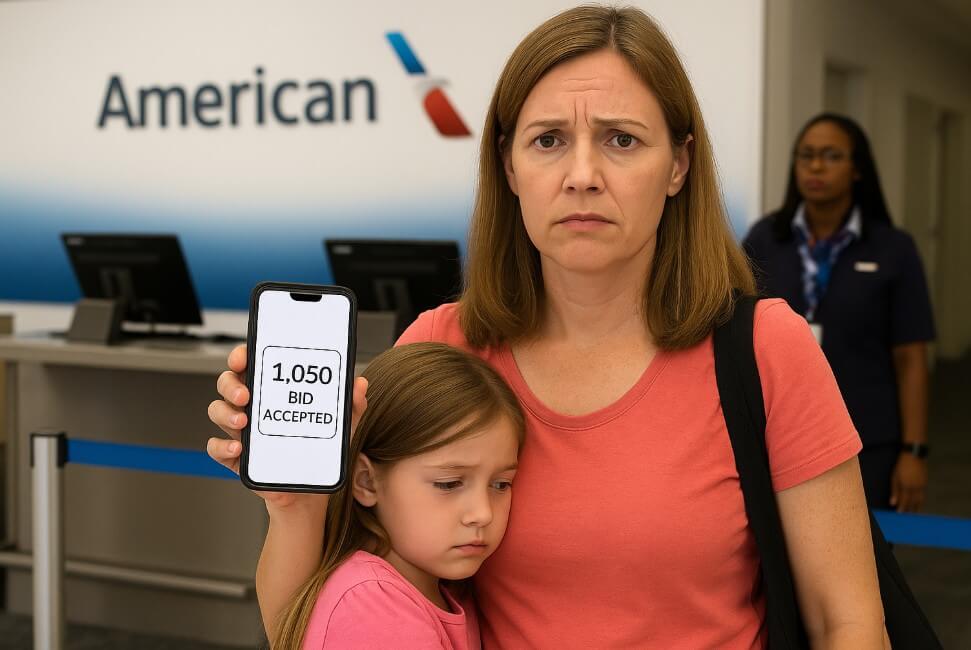
FORT WORTH, Texas — American Airlines is facing mounting criticism after a mother traveling with her child was denied boarding at Chicago O’Hare International Airport (ORD) despite receiving confirmation that her $1,050 bid to take a later flight had been accepted.
The incident, first reported by PYOK, has ignited renewed debate over the airline’s voluntary bidding compensation system — a process designed to reduce the need for involuntary passenger bumping when flights are oversold. Instead, the case has become a cautionary tale for travelers relying on digital confirmations to secure compensation agreements.
A Bid Accepted — Then Rejected
According to the passenger, she placed a $525 bid per seat to voluntarily take a later flight, for a total of $1,050. After receiving confirmation messages that the bids were accepted, she arrived at the gate expecting to be rebooked and compensated as agreed. Instead, she and her child were told by gate agents that their accepted offer was not valid and that their seats had been reassigned to other passengers.
Despite presenting proof of her accepted bids, the traveler was informed that American Airlines would not honor the compensation. The mother later described feeling “defeated and ignored,” citing poor communication and a lack of accountability throughout the ordeal.
A System Under Scrutiny
American Airlines routinely overbooks flights, a legal yet controversial practice across the airline industry aimed at ensuring full planes and maximizing revenue. When this happens, airlines request volunteers to give up their seats in exchange for vouchers or cash compensation. In theory, AA’s online bidding system allows passengers to proactively offer how much compensation they’d accept, streamlining what was once an in-person negotiation.
But as this case demonstrates, execution doesn’t always match intention. Passengers have reported receiving mixed results — sometimes being reassigned to different seats on the same flight instead of being rebooked altogether. For some, that confusion negates the purpose of volunteering in the first place.
After repeated attempts to contact customer service, the passenger eventually received acknowledgment from American Airlines’ customer relations department that her compensation claim had been mishandled. Still, she said the drawn-out process left her feeling the system “is designed to make you give up.”
Industry Concerns and Expert Warnings
Travel experts say the case highlights a growing disconnect between airlines’ automated systems and real-world enforcement at the gate. Voluntary bid systems were introduced to make the process more transparent and efficient, but inconsistent implementation continues to erode customer trust.
“While these programs can theoretically reduce involuntary bumps, they’re only as reliable as the people and systems enforcing them,” said one industry analyst. “When passengers get confirmation messages that aren’t honored, that’s a serious breakdown in trust.”
According to the U.S. Department of Transportation (DOT), American Airlines ranked second-worst among major U.S. carriers for involuntary passenger bumping between April and June 2025, with 4,257 passengers affected. Only Frontier Airlines performed worse in that category. In comparison, Delta Air Lines reported zero involuntary bumps during the same period, while United Airlines reported just 62.
Those numbers underscore the ongoing risks for travelers when overbooking practices collide with unclear compensation procedures.
Lessons for Travelers
Consumer advocates urge passengers to treat airline bidding systems cautiously. Travelers should always verify accepted bids in person at the gate and request written confirmation of compensation before relinquishing their seats. Maintaining documentation — including screenshots or email confirmations — can provide critical leverage if disputes arise.
“Digital systems make the process appear seamless,” one frequent flyer noted, “but unless there’s a human gate agent who acknowledges your acceptance in real time, it’s not guaranteed.”
While American Airlines has not issued a public statement addressing this particular case, the incident reinforces broader concerns about how major carriers manage overbooked flights in an era of automation. As airlines continue to rely on technology to streamline operations, the human cost of errors — especially for families and vulnerable travelers — remains significant.
For now, this mother’s experience serves as a reminder that even in the age of digital confirmation, passengers are safest when they double-check their compensation agreements face-to-face.
