


Family Claims Removal From Flight Violated Passenger Rights
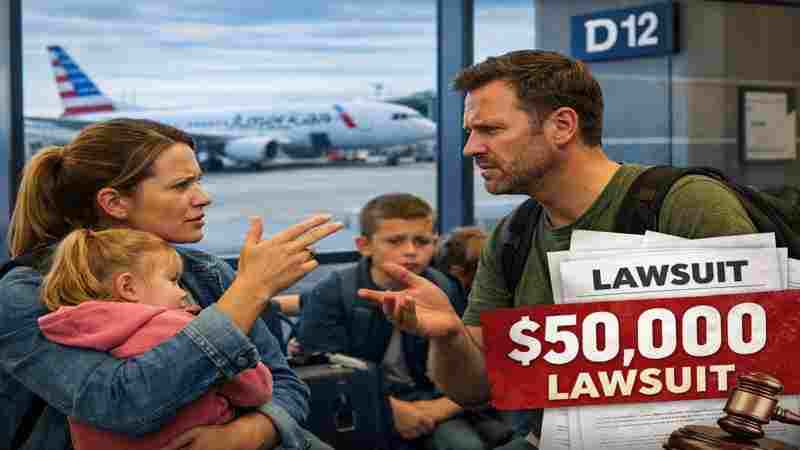
FORT WORTH — American Airlines is facing a $50,000 lawsuit filed by a Louisiana family who allege disability discrimination following their removal from a March 1, 2025 flight, according to court filings and initial reporting.
The case centers on a disputed overbooking incident that disrupted what the family described as a “once in a lifetime” trip to Walt Disney World and has raised broader questions about airline discretion, accessibility obligations, and passenger protections.
Coby and Emily Stewart, traveling with their four children, claim airline staff unfairly singled them out after they disclosed that Emily is deaf and communicates using American Sign Language, and that Coby is a military veteran. The airline has not publicly explained its actions, and attempts to obtain comment have been unsuccessful.
Disputed Overbooking Decision at Center of Complaint
According to the lawsuit, the family purchased six round-trip tickets totaling $5,187.58 for travel from Lake Charles, Louisiana, to Orlando, Florida. They arrived at the airport nearly two hours before departure and completed check-in early, expecting a routine boarding process.
Despite this, airline personnel allegedly informed them that the flight was oversold and that one passenger would need to be removed. The family claims they were the only passengers selected, even though other travelers had not yet checked in.
The complaint argues that the decision came shortly after the family disclosed Emily’s disability and Coby’s veteran status, forming the basis of their discrimination claim.
Tensions escalated when airline staff reportedly chose the family’s four-year-old son, Archer, for removal from the flight. The parents objected, stating that separating the family was not feasible given Emily’s reliance on assistance while managing four young children.
Coby Stewart then volunteered to give up his own seat and arranged alternate travel through an airport roughly 90 minutes away in Texas. He was initially offered a $1,200 travel voucher as compensation. However, the family alleges that this offer was later rescinded after staff stated the flight was not actually oversold — a contradiction that has become central to the legal dispute.
Travel Disruptions and Financial Impact
The lawsuit outlines significant logistical complications stemming from the incident. Coby and one child attempted to reroute through another state, while Emily and the remaining children continued on the original itinerary.
Airline staff reportedly indicated that the family would reunite at Dallas Fort Worth International Airport. However, that did not occur as planned. Instead, the family arrived separately in Orlando later that day.
Court filings describe the father as arriving “frazzled,” underscoring the stress and confusion caused by the separation. The family maintains that the outcome directly conflicted with their request to remain together due to accessibility needs.
In addition to emotional distress, the complaint cites financial losses, including additional travel expenses, diminished ticket value, and the revoked compensation voucher. The family argues that standard denied-boarding compensation frameworks do not adequately address situations involving alleged discrimination or failure to accommodate disabilities.
Under U.S. regulations, compensation for involuntary denied boarding can reach up to $1,075 for shorter delays and up to $2,150 for longer disruptions, though such guidelines do not explicitly account for accessibility-related claims.
Legal Claims Focus on Accessibility Obligations
The lawsuit alleges violations of the Americans with Disabilities Act, asserting that the airline failed to provide reasonable accommodation for a deaf passenger traveling with dependent children. It also contends that the airline’s actions unnecessarily disrupted the family unit.
Initially filed in Louisiana state court in February 2025, the case was later moved to federal court in March. The plaintiffs are seeking damages exceeding $50,000, citing emotional distress, anxiety, and financial harm.
The legal action emerges against a backdrop of increased regulatory scrutiny. The U.S. Department of Transportation previously imposed a $50 million penalty on American Airlines for disability-related violations between 2019 and 2023, placing additional attention on how carriers implement accessibility policies.
Broader Implications for Airline Industry
The case highlights ongoing tensions between airline operational practices — particularly overbooking — and passenger rights, especially for those requiring accommodations.
While airlines retain authority over boarding decisions, those decisions must comply with federal accessibility requirements. The lawsuit also raises concerns about internal communication, consistency in handling overbooked flights, and how frontline employees manage passengers with special needs.
Industry analysts note that cases like this underscore the legal and operational risks airlines face when accessibility considerations are not fully integrated into decision-making processes.
The outcome of the case could influence how airlines refine policies related to disability accommodations and overbooking procedures, particularly as regulatory oversight continues to intensify.
