


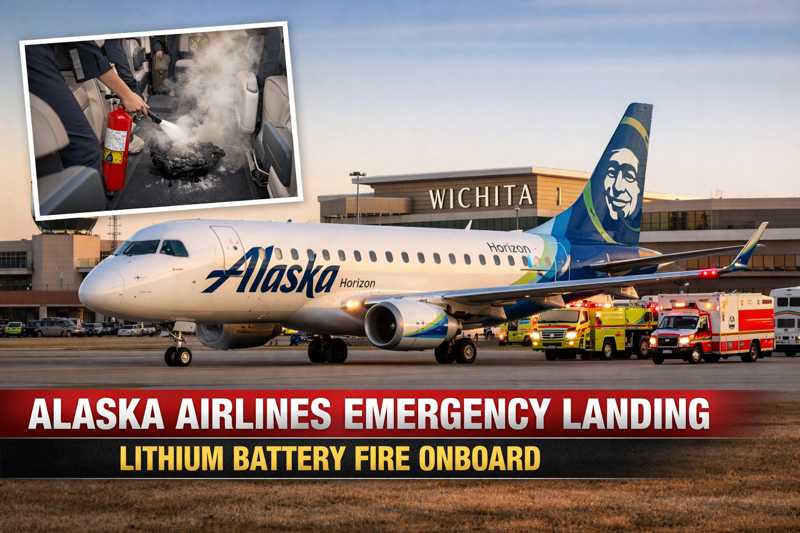
WICHITA, Kan., Feb. 22, 2026 — An Alaska Airlines regional flight bound for Seattle was forced to declare an emergency and return to Wichita shortly after takeoff Sunday when a passenger’s portable power bank caught fire in the cabin, injuring one traveler and delaying the flight by more than seven hours.
Alaska Airlines Flight AS2117, operated by Horizon Air, departed Wichita Eisenhower National Airport at approximately 1:52 p.m. local time en route to Seattle-Tacoma International Airport. Minutes after departure, the Embraer 175 aircraft issued squawk code 7700, signaling a general emergency and requesting immediate assistance from air traffic control.
Emergency Diversion After Cabin Fire
The flight crew acted quickly after smoke emerged from a portable battery pack inside the cabin. According to reports, the device overheated and ignited while resting on a passenger’s lap, without being actively used.
Pilots decided to return to Wichita as a precautionary measure. The aircraft landed safely about 56 minutes after departure, where emergency services met the flight on arrival.
There were 76 passengers onboard at the time of the incident. One passenger sustained minor burns and received medical attention at a local hospital, while no other injuries were reported among travelers or crew.
Cabin crew members reportedly extinguished the smoking device in the aisle using onboard firefighting equipment. Their prompt response prevented further damage and ensured passenger safety during the diversion.
Lithium Battery Risks Under Scrutiny
Portable power banks use lithium-ion batteries, which aviation regulators classify as hazardous materials due to their fire risk. When damaged, overheated, or defective, these batteries can experience “thermal runaway,” a chain reaction that causes rapid self-heating and potential explosion.
Airlines strictly regulate how passengers carry lithium batteries onboard. Most carriers require spare batteries to remain in carry-on baggage rather than checked luggage, allowing cabin crew to respond quickly if overheating occurs.
Several airlines worldwide have tightened rules around portable chargers. Japan’s transport ministry is preparing to introduce new restrictions that will limit the use of power banks during flights and cap the number and capacity of devices allowed per passenger.
Under the expected rules, passengers traveling on domestic Japanese routes may be restricted to two portable chargers each, with a maximum rating of 160Wh per device.
Industry experts continue to stress passenger awareness about lithium battery safety. While such events remain rare, regulators and airlines treat them seriously due to the confined environment of an aircraft cabin.
Replacement Aircraft and Extended Delay
Following inspections and safety checks, Alaska Airlines arranged a replacement aircraft to complete the journey to Seattle. The rescheduled service departed Wichita at 9:16 p.m. local time, reported The Independent.
The flight eventually arrived in Seattle more than seven hours behind its original schedule. Despite the extended delay, airline officials confirmed that no additional injuries occurred during the continuation of the journey.
Alaska Air Group has been contacted for further comment regarding the incident and any potential review of onboard battery policies. The event adds to a growing number of aviation incidents involving portable electronic devices.
As global air travel increases, airlines are expected to maintain strict enforcement of battery carriage rules to minimize in-flight fire risks and ensure operational safety.
