


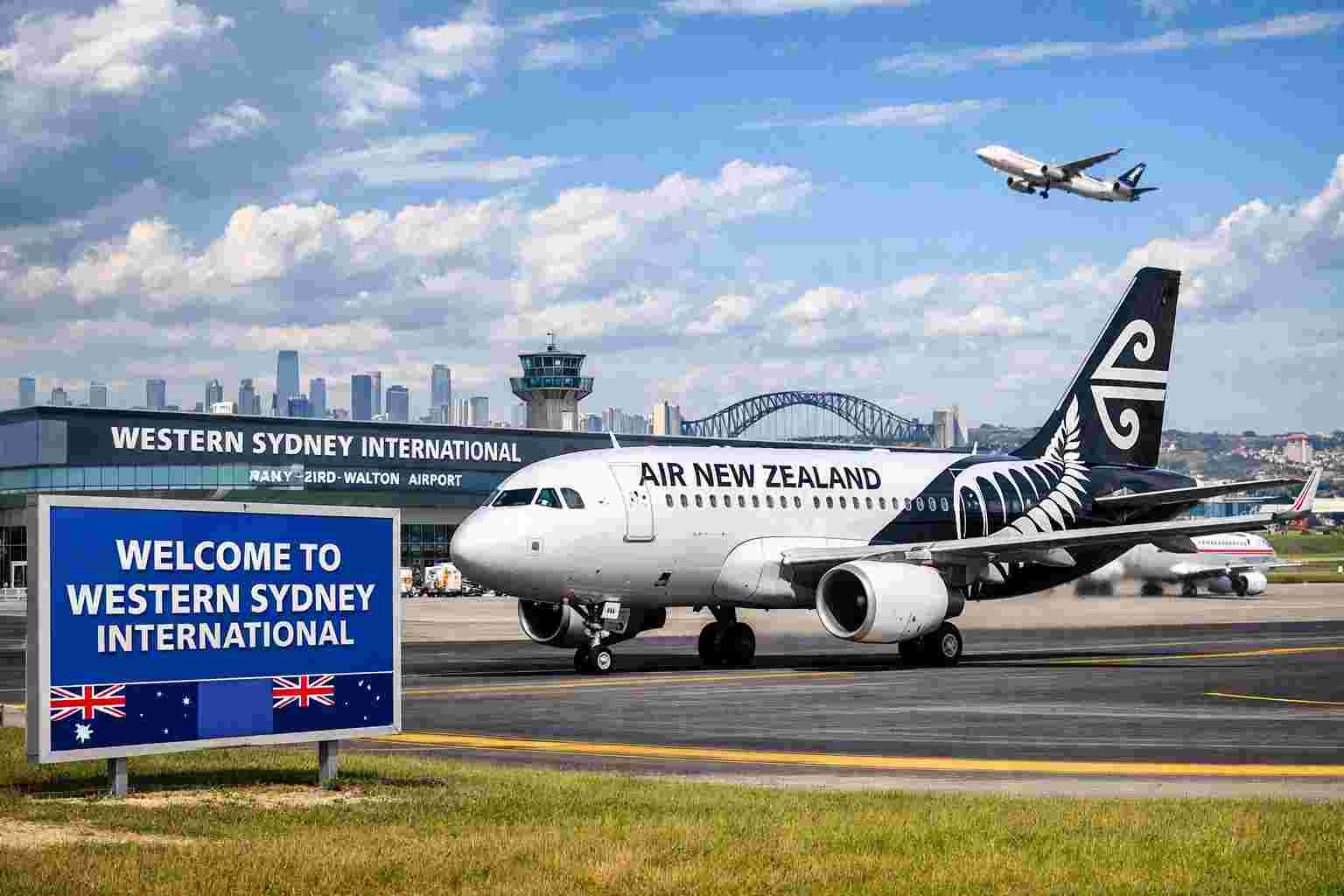
New Trans-Tasman Route Marks Major Milestone for Western Sydney International
SYDNEY — Air New Zealand will begin operating international flights to Western Sydney International Airport, marking a significant step in the development of Sydney’s second major aviation hub. The airline announced that tickets are now on sale for its inaugural service connecting Western Sydney with Auckland Airport, with flights scheduled to commence on October 26, 2026.
The new route positions Western Sydney International Airport (WSI) as a growing international gateway, designed to serve a catchment area of more than 2.5 million residents while easing congestion at Sydney Kingsford Smith Airport.
Flight Schedule and Service Details
Air New Zealand will operate three weekly return services between Auckland and Western Sydney on Mondays, Wednesdays, and Fridays. Flights departing Auckland at 6:05 a.m. are scheduled to arrive in Western Sydney at 7:50 a.m., while return services will leave WSI at 9:00 a.m. and land in Auckland at 2:15 p.m.
The airline will deploy its narrowbody fleet on the route, including Airbus A320 and A321 aircraft. The A320s will offer configurations of 165 or 241 economy seats, while the A321 aircraft will provide 214 economy seats.
Introductory fares for the inaugural flights start at AUD 361 one-way, excluding checked baggage, targeting both budget-conscious leisure travelers and business passengers seeking efficient trans-Tasman connections.
Lucy Hall, Air New Zealand’s General Manager of Short Haul and Domestic, emphasized the strategic importance of the new route:
“This route opens a new gateway to Sydney, supporting stronger business, tourism, and visiting friends and family links between our nations.”
Expanding Connectivity and Regional Access
The addition of Western Sydney services complements Air New Zealand’s existing operations into Sydney, offering travelers greater flexibility and access to a rapidly growing region. The new airport’s location is expected to reduce travel times for residents and businesses in Western Sydney, a region that has historically relied on Kingsford Smith Airport.
The launch also reflects broader demand for diversified airport infrastructure in major metropolitan areas, particularly as international travel continues to rebound and evolve post-pandemic.
Economic and Tourism Impact
Government officials and industry stakeholders have welcomed the announcement, citing its potential to strengthen economic ties between Australia and New Zealand.
Federal Minister Catherine King noted that the service would enhance bilateral connectivity, while NSW Minister for Jobs and Tourism Steve Kamper highlighted the broader economic benefits tied to the route’s launch.
The Western Sydney International Take-Off Fund, a joint initiative between the New South Wales government and WSI, played a key role in securing the service. Backed by AUD 16 million in funding, the program is projected to generate more than 162,000 international visitors and contribute approximately AUD 530 million in visitor expenditure.
The new route is also expected to support local employment and stimulate demand across hospitality, retail, and tourism sectors. Businesses in Western Sydney are preparing for increased activity from both leisure travelers and corporate visitors.
A New Era for Sydney Aviation
Western Sydney International Airport, also known as Nancy-Bird Walton Airport, is designed to operate around the clock, addressing long-standing curfew restrictions at Kingsford Smith Airport. Its modern terminal infrastructure and passenger-focused design aim to attract both airlines and travelers seeking a more seamless airport experience.
Industry observers note that additional carriers are already planning to establish operations at WSI. According to The Canberra Times, airlines including Singapore Airlines and Qantas have committed to launching services from the airport, further expanding its global connectivity.
Strategic Outlook
The introduction of Air New Zealand’s trans-Tasman service represents a pivotal moment for Western Sydney International Airport and the broader aviation landscape in Australia.
As airlines seek to optimize routes and passengers demand greater convenience, WSI is positioning itself as a competitive alternative for both regional and long-haul travel. Its ability to operate without curfew constraints, combined with strong government backing and growing airline interest, underscores its long-term potential.
With its first international route now confirmed, Western Sydney International Airport is set to play an increasingly central role in connecting Australia to key global markets while supporting economic growth across the region.
