


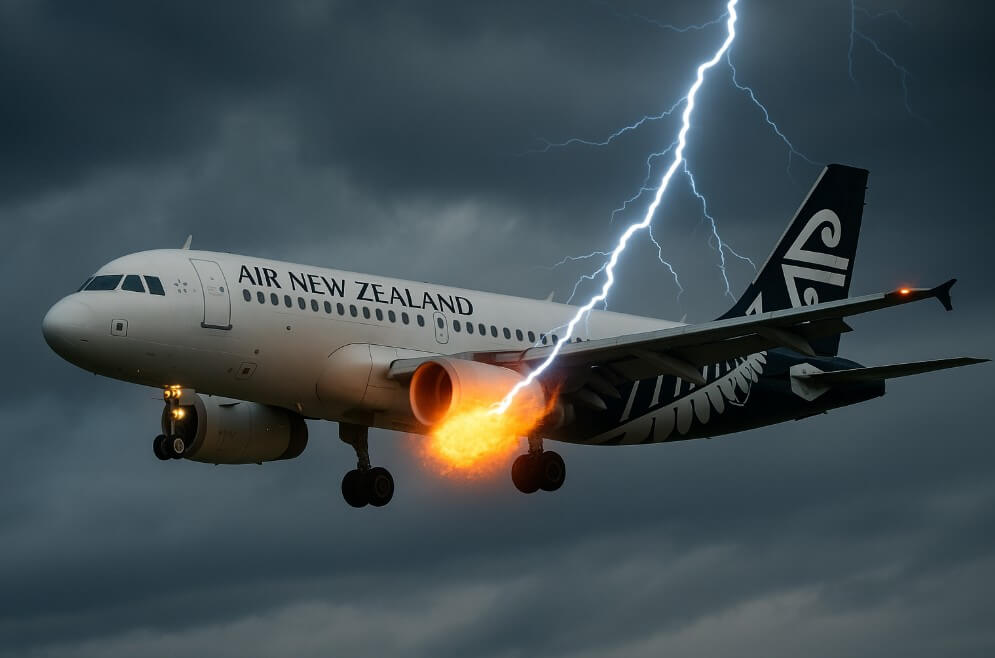
AUCKLAND, New Zealand — Passengers aboard an Air New Zealand flight faced a terrifying ordeal Tuesday morning when lightning struck their aircraft shortly after takeoff from Auckland, producing what several described as a “fireball” near one of the wings.
The incident occurred around 7 a.m. as severe thunderstorms swept across the upper North Island. Flight NZ676, bound for Dunedin, was diverted to Christchurch as a precaution after the strike. No injuries were reported.
A Flash and a Bang Midair
Meteorologists reported nearly 500 lightning strikes across the region between 4 a.m. and 7 a.m., part of a strong frontal system moving over Auckland and Northland. Conditions were turbulent even before takeoff, according to passengers.
Quincy Sio, 35, one of those aboard, described the event as the most frightening experience of his life. Speaking to Newstalk ZB, Sio said the plane “had already been turbulent from the moment it left Auckland Airport” and that rough air “buffeted the aircraft continuously” before the sudden strike.
He recalled a “deafening bang” reverberating through the cabin just ten minutes into the flight. As the sound echoed, Sio saw what he described as a large orange “fireball” flash from the left wing.
“Panic spread immediately, with passengers screaming and bracing for impact,” he said, adding that the explosion left his ears ringing for hours and caused a headache. Despite the intense noise and visible flash, Sio said no immediate announcement came from the flight crew, leaving passengers anxious as the aircraft continued on toward Christchurch instead of returning to Auckland.
Storms Hammer Northern New Zealand
According to New Zealand’s MetService, 482 lightning strikes were detected across northern regions in the early hours of Tuesday. The storm system also brought heavy rainfall, turbulent winds, and frequent thunder, prompting an upgraded thunderstorm risk alert for Auckland and Northland.
The weather event coincided almost exactly with NZ676’s departure time, heightening passenger concerns about flying amid active electrical storms.
By midmorning, the MetService warned that the same weather front could continue moving south, potentially disrupting additional flights and ferry services.
Air New Zealand Confirms Lightning Strike
Air New Zealand Chief Operations Officer Alex Marren confirmed that flight NZ676 was struck by lightning and diverted to Christchurch as a safety precaution.
“The aircraft is now undergoing standard engineering checks. As a result, NZ676 Dunedin–Auckland was cancelled. We are reaccommodating customers on alternate services and have added an additional flight from Christchurch to Dunedin to ensure all passengers reach their destination,” Marren said.
The airline emphasized that lightning strikes on aircraft, while dramatic, are not uncommon. Commercial aircraft are designed to safely conduct electrical charges through the fuselage and dissipate them without endangering passengers or flight systems. Pilots also receive specific training to handle such events calmly and professionally.
Despite the unnerving circumstances, the plane landed safely in Christchurch at about 8:30 a.m., where engineers began a comprehensive inspection of the airframe and electrical systems.
Routine Checks and Passenger Support
Following standard safety procedures, the aircraft remains grounded for a full engineering assessment. Lightning strikes typically require checks on potential entry and exit points—usually wing tips, tail sections, or nose cones—along with examinations of navigation and communication equipment.
Air New Zealand said all affected passengers were either rebooked on later flights or provided compensation and accommodation as needed.
“We are reaccommodating customers on alternate services,” Marren noted, underscoring that customer safety remains the airline’s top priority.
Context: Lightning Strikes in Aviation
Globally, commercial aircraft are hit by lightning on average once or twice per year. Advances in materials and design—especially aluminum and composite fuselages with conductive meshes—mean modern jets can withstand such encounters without serious damage.
In most cases, passengers experience only a loud bang or brief flash as the current travels along the exterior of the plane. Still, the phenomenon can be deeply unsettling, particularly when paired with turbulence or low visibility, as in Tuesday’s flight.
Looking Ahead
Air New Zealand engineers in Christchurch are expected to complete inspections before the plane re-enters service later this week. Meanwhile, meteorologists warn that unstable weather may persist over parts of the South Island, though lightning risk should decrease by Wednesday.
For passengers like Quincy Sio, however, the memory of that “fireball” remains vivid. “It’s something you never forget,” he said.
The airline reiterated that all safety measures functioned as designed and that there were no injuries among passengers or crew.
Air New Zealand continues to coordinate rebookings and monitor weather systems across the country as it works to restore full service amid the storm disruptions.
