


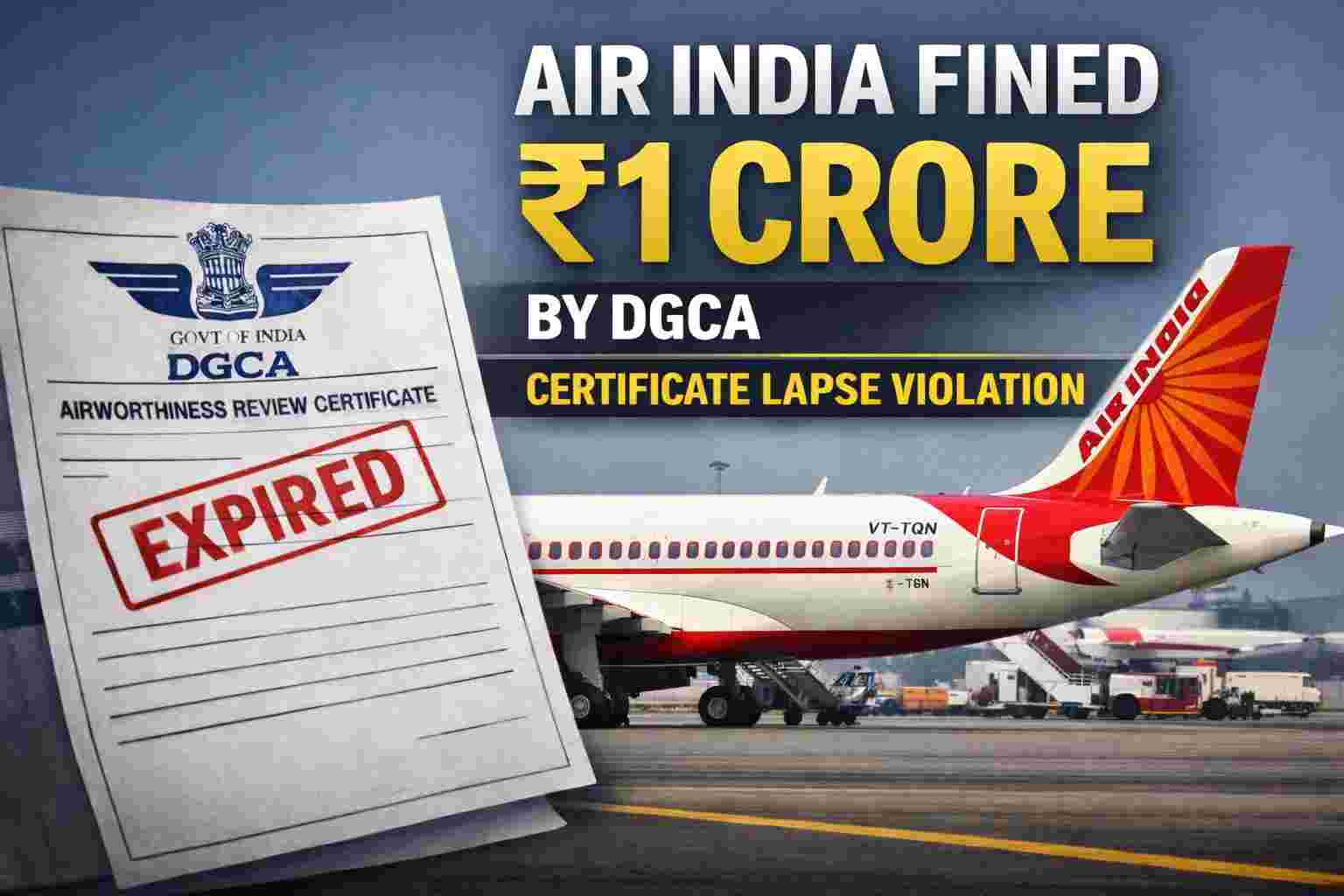
India’s aviation safety regulator has imposed a financial penalty on Air India after determining that one of the carrier’s aircraft operated multiple commercial flights without a valid airworthiness clearance, underscoring heightened regulatory scrutiny during a period of rapid fleet integration.
DGCA Imposes ₹1 Crore Penalty
The Directorate General of Civil Aviation (DGCA) has fined Air India ₹1 crore following an investigation that found the airline flew an aircraft without a valid Airworthiness Review Certificate (ARC). The lapse involved revenue flights connected to New Delhi operations and was confirmed after a probe launched in late 2025.
According to the regulator, the aircraft conducted commercial operations despite the absence of a current ARC, a document that certifies an aircraft’s continued airworthiness based on maintenance records, inspections, and regulatory compliance.
The DGCA concluded that the lapse weakened public confidence and negatively affected the airline’s safety compliance record. Responsibility for the oversight was attributed to the airline’s accountable manager.
The penalty order was issued after authorities completed their review of the incident and assessed corrective actions taken by the airline.
Aircraft Operated With Expired Certificate
Under delegated authority, Air India is permitted to issue Airworthiness Review Certificates for aircraft in its fleet. These certificates must be renewed annually following a detailed examination of maintenance documentation, aircraft condition, and adherence to aviation regulations.
The issue arose during the post-merger fleet transition following Vistara’s integration into Air India. During that transition phase, the DGCA handled the first ARC renewal process for aircraft previously operated by Vistara.
Regulatory findings show that ARC renewals were completed for 69 aircraft. However, one Airbus A320, registered VT-TQN, did not receive certification and was grounded for an engine replacement. After the engine was changed, the aircraft was returned to service without the ARC being renewed.
On November 26, 2025, Air India informed the DGCA that the aircraft had operated eight revenue flights with an expired certificate.
Airline Response and Voluntary Disclosure
Air India acknowledged receipt of the regulator’s order and stated that the incident had been voluntarily reported earlier. The airline said corrective measures were implemented and shared with authorities.
The airline described the lapse as regrettable and unacceptable. It reported the issue promptly after discovery and suspended personnel linked to the decision pending review.
In addition, Air India initiated a comprehensive internal investigation and reiterated its commitment to operational safety and regulatory compliance.
Authorities confirmed that corrective steps were reviewed before concluding the probe.
Organizational Changes Ordered
Beyond the financial penalty, the DGCA directed the airline to remove certain engineering post holders involved in operational oversight as part of corrective measures stemming from the investigation.
The regulator also instructed Air India to conduct further internal reviews and strengthen compliance systems to prevent similar lapses in the future. The DGCA emphasized that airlines must ensure strict verification before aircraft are released for commercial service.
The enforcement action signals the regulator’s intent to maintain rigorous oversight as Indian carriers expand fleets and integrate operations.
Broader Implications for Fleet Integration
The incident highlights operational challenges that can emerge during large-scale fleet mergers and transitions. Aviation experts note that the ARC plays a critical role in validating an aircraft’s Certificate of Airworthiness, which confirms that it meets safety standards required for commercial operations.
During periods of organizational restructuring or integration, oversight mechanisms can face strain, particularly when aircraft records, maintenance systems, and administrative responsibilities are being consolidated.
India’s aviation sector has been undergoing significant transformation, with airlines expanding capacity and integrating fleets amid strong passenger demand growth. Regulators have responded by tightening compliance monitoring and reinforcing safety accountability frameworks.
The DGCA’s action reinforces the importance of strict adherence to certification requirements and internal checks before aircraft are cleared for revenue service.
Regulatory Oversight Intensifies
The penalty serves as a reminder that even procedural lapses — particularly those involving mandatory safety documentation — can result in substantial financial and organizational consequences.
By imposing both a monetary fine and structural corrective measures, the DGCA has signaled that compliance failures will be met with enforcement action, regardless of voluntary disclosure.
For Air India, the episode adds another layer of scrutiny as the carrier continues its integration process and fleet modernization efforts. The airline has indicated that strengthened compliance mechanisms are now in place.
As India’s aviation market grows, regulators and carriers alike face mounting pressure to ensure that operational expansion does not compromise safety standards.
