


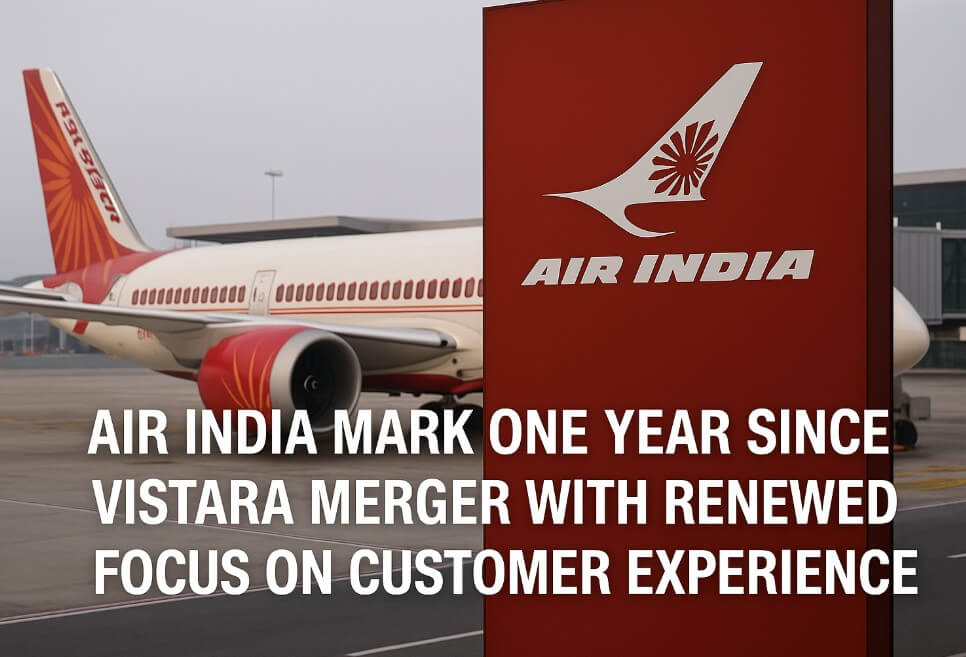
NEW DELHI — One year after completing its merger with Vistara, Air India is solidifying its position as a customer-centric carrier under the Tata Group’s aviation portfolio. Since the merger’s completion on November 12, the airline has emphasized consistency in service delivery, improved passenger communication, and a unified corporate culture.
The merger, which integrated Vistara’s operations into Air India’s expanding global network, marked a pivotal moment in the ongoing transformation of India’s oldest airline. Despite a turbulent year that included challenges such as the Ahmedabad air crash and disruptions linked to Pakistan’s airspace closure, Air India’s management says the merger has laid the groundwork for a stronger, more cohesive airline.
“Since the completion of the merger on November 12, Air India has emphasized consistency in service and improved communication with passengers,” the airline said in a statement.
Operational Streamlining and Fleet Optimization
Over the past year, Air India has undertaken a significant operational realignment. The carrier reduced its weekly flights from 5,600 to 4,700, citing aircraft retrofits, lease returns, and route transfers to its low-cost subsidiary, Air India Express. The current fleet now totals 187 aircraft serving 82 destinations worldwide.
As part of its broader modernization strategy, Air India continues to refine its premium economy product. While pricing has remained competitive, bookings in this segment have not met expectations, leading to frequent upgrades from economy. To improve uptake, the airline is working with corporate clients and government agencies to include premium economy in official travel policies, according to The Hindu BusinessLine.
Air India also confirmed that the number of aircraft equipped with premium economy cabins has risen sharply—from 25 to 108—largely due to the inclusion of former Vistara planes.
Elevating In-Flight Experience
Central to the airline’s customer-focused transformation is a renewed emphasis on in-flight service quality. Air India has implemented standardized crew interaction protocols and uniform announcements designed to provide passengers with a consistent experience across all routes. The company says proactive communication during flight disruptions has also contributed to higher satisfaction levels.
A refreshed bar menu, tailored to specific routes and passenger demographics, is currently in development. The airline is also refining differentiation between first and business class products to strengthen perceived value among premium travelers.
Crew feedback has pointed to continuing efforts to modernize cabin interiors and entertainment systems, viewed internally as essential to sustaining premium service standards. According to company data, Air India’s Net Promoter Score in the domestic market has reached an all-time high—surpassing pre-merger metrics recorded by Vistara.
Building a Unified Corporate Culture
Beyond operations, Air India has been focused on integrating personnel and creating a unified organizational identity. The airline’s workforce now includes legacy Air India employees, former Vistara staff, and new hires brought on since privatization. To facilitate this transition, management conducted a company-wide employee survey aimed at defining shared values and improving collaboration.
A consolidated seniority list for pilots has been finalized, with one for cabin crew still in progress. While some employees have voiced concerns over roster management and scheduling practices, executives describe the company’s evolving workplace culture as more agile and egalitarian.
According to internal sources, Air India’s leadership style is shifting toward Vistara’s “first-name-based communication approach,” a move seen as a break from the traditional hierarchical structures that once defined the carrier’s corporate culture.
Looking Ahead
The merger’s first anniversary symbolizes a broader transformation under the Tata Group’s stewardship. Air India is simultaneously managing operational restructuring, brand integration, and a renewed emphasis on service excellence.
As the airline continues to invest in fleet modernization, digital systems, and staff training, industry analysts see Air India positioning itself to compete with global carriers across Asia and the Middle East. Executives within the company say the next phase will focus on enhancing punctuality, sustainability, and digital innovation to further align with international standards.
The airline’s leadership has framed the merger not merely as an operational consolidation, but as a strategic reset of Air India’s identity. By marrying Vistara’s reputation for service quality with Air India’s extensive international network, the Tata Group aims to reestablish the national carrier as a globally respected, customer-centric brand.
