


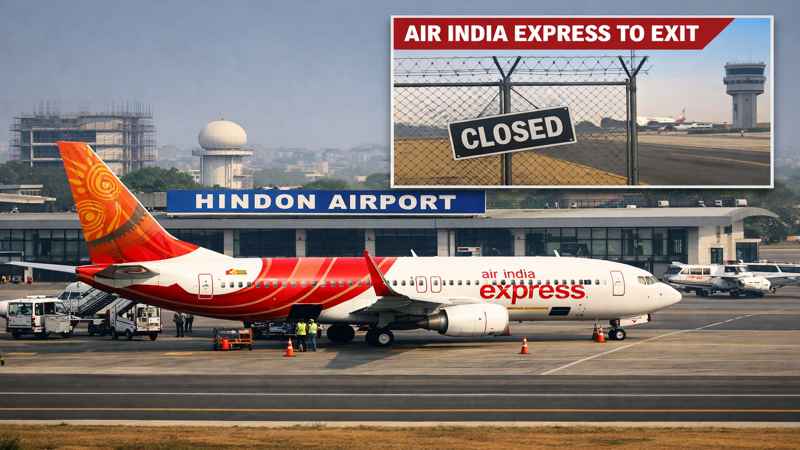
DELHI — Air India Express will discontinue its flight operations from Hindon Airport by the end of March 2026, marking the end of a short-lived presence at the National Capital Region’s secondary airport. The airline, which currently operates routes to Mumbai and Bengaluru, is no longer accepting bookings beyond March 27, 2026, in line with the conclusion of the winter flight schedule.
The move highlights shifting network strategies among Indian carriers as they respond to infrastructure constraints and prepare for upcoming changes in the region’s aviation landscape.
Short-Lived Expansion in NCR
Air India Express had launched its Hindon services less than a year ago, aiming to tap into growing regional connectivity demand within the Delhi NCR catchment area. The airport, located in Ghaziabad, was positioned as a convenient alternative to the congested Indira Gandhi International Airport.
However, despite steady passenger demand, the airline’s booking system now reflects a complete withdrawal from Hindon after March 27. The carrier has not issued an official statement regarding the decision.
Industry observers suggest the exit is part of broader network optimization efforts. Aircraft availability constraints, coupled with the need to deploy capacity more efficiently across higher-yield routes, likely played a role. Additionally, the upcoming launch of Noida International Airport is expected to significantly reshape airline strategies in the region.
Infrastructure Constraints Limit Growth
Hindon Airport has struggled with operational limitations that hinder its ability to support sustained airline expansion. The airport currently has only two aircraft parking bays and a relatively small terminal, leading to congestion during peak operating hours.
Aircraft frequently face delays of up to 20–25 minutes while waiting for parking availability. These delays increase turnaround times, reduce scheduling efficiency, and create challenges for airlines operating tight schedules—particularly low-cost carriers like Air India Express.
Such constraints can directly impact profitability and reliability, making it difficult for airlines to justify long-term commitments at the airport.
Broader Capacity Reductions Underway
The decline in Air India Express operations is part of a wider trend at Hindon. According to aviation analytics firm Cirium, overall scheduled capacity at the airport is expected to drop by around 35% in April 2026 compared to March.
Other carriers are also adjusting their operations. IndiGo is reducing select services, while Star Air continues to maintain its presence at the airport. The shifting capacity levels suggest airlines are reassessing the viability of operating from Hindon under current conditions.
Demand Remains Resilient
Despite operational challenges, passenger demand at Hindon Airport has remained strong. Data from the Airports Authority of India indicates that the airport handled approximately 960,000 passengers between April and January.
This sustained traffic underscores the potential of Hindon as a regional aviation hub, particularly for travelers seeking alternatives to larger, more congested airports in Delhi.
However, without corresponding infrastructure improvements, airlines may remain cautious about expanding or even maintaining services.
Expansion Plans in Progress
Authorities have initiated steps to address Hindon’s infrastructure constraints. The airport, owned by the Indian Air Force, operates a civil enclave managed by the Airports Authority of India (AAI).
AAI has proposed acquiring nearly 9 acres of land to expand the terminal and improve aircraft handling capacity. The Uttar Pradesh government has agreed in principle to facilitate the acquisition of approximately 6.5 acres.
As an interim measure, officials are expanding the existing terminal by 700 square meters. The upgrade is intended to reduce congestion, enhance passenger amenities, and improve operational efficiency.
Future Hinges on Execution
Hindon Airport began commercial operations in October 2019 under the government’s UDAN regional connectivity scheme, aimed at improving air access to underserved regions.
While expansion plans signal long-term potential, the pace of infrastructure development will be critical in determining the airport’s future. Airline participation is likely to depend on how quickly these improvements materialize and whether they can resolve existing operational bottlenecks.
For now, Air India Express’ exit underscores the challenges facing secondary airports in scaling operations—and the importance of aligning infrastructure growth with airline needs.
