


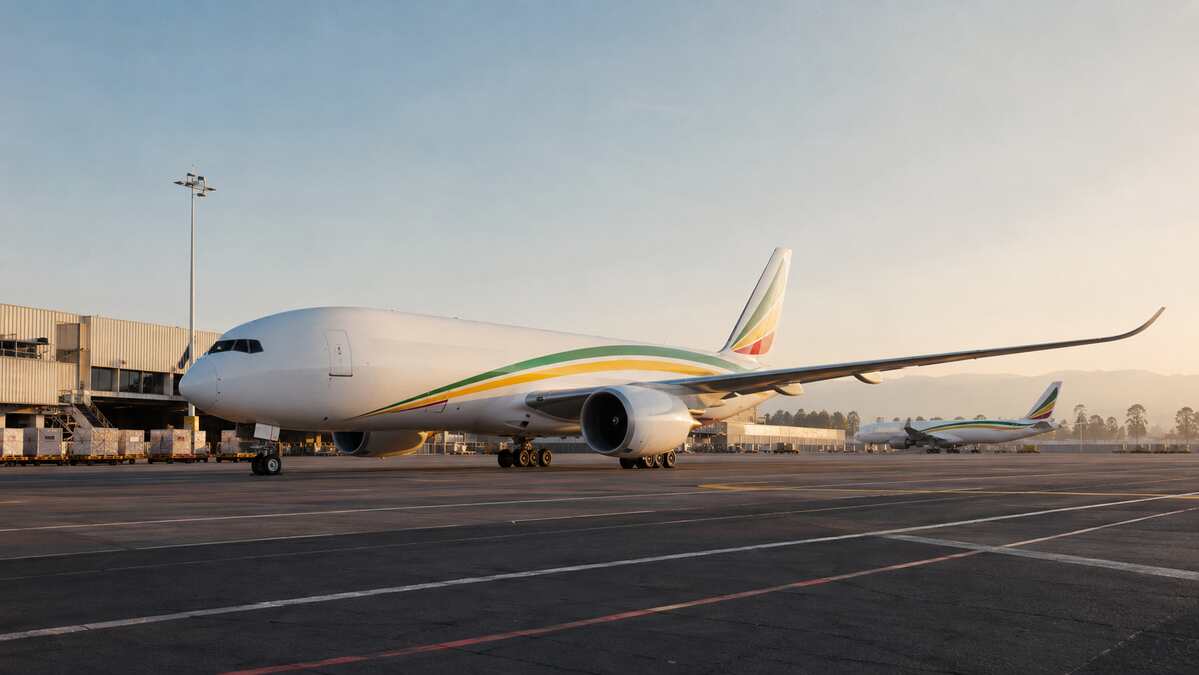
Ethiopian Airlines is reportedly moving closer to an agreement with Boeing for as many as 10 long-haul freighters, a potential investment that would expand Africa’s largest cargo airline as Ethiopia develops a major new aviation hub near Addis Ababa.
The prospective order could include two current-generation Boeing 777 Freighters, with the remaining aircraft potentially drawn from Boeing’s delayed 777-8F program. The final number and aircraft mix could still change as negotiations continue.
If completed, the transaction would strengthen Ethiopian Airlines’ freight operations through Addis Ababa Bole International Airport and support the country’s wider effort to become a major international aviation and logistics center.
Ethiopian Airlines Builds on Cargo Growth
Ethiopian Airlines transported approximately 897,000 metric tons of cargo during the 2025/26 fiscal year, an increase of 16% from the previous year. Cargo capacity rose 8% during the same period as the airline expanded its presence across African and international markets.
The carrier reported $9.1 billion in revenue for the fiscal year, highlighting the scale of its broader passenger and freight operations. Cargo remains a central component of Ethiopian’s growth strategy, connecting African producers and businesses with customers in Asia, Europe, the Middle East and the Americas.
Ethiopian already operates one of the continent’s largest dedicated freighter fleets. Its cargo aircraft include 12 Boeing 777Fs, along with Boeing 767 freighters and converted Boeing 737 cargo jets.
Adding eight to 10 widebody freighters would give the airline additional capacity for high-volume and long-distance routes. It would also help Ethiopian respond to rising demand for the transportation of pharmaceuticals, industrial products, agricultural exports, e-commerce shipments and other time-sensitive goods.
Boeing has declined to comment on speculation surrounding the possible deal, while Ethiopian Airlines had not immediately confirmed the prospective purchase.
New Aircraft Could Support Immediate and Long-Term Needs
A combination of 777Fs and 777-8Fs would allow Ethiopian to address capacity requirements across different time frames.
The current-generation 777F could provide additional near-term lift using an aircraft type already established in the airline’s fleet. That commonality could simplify pilot training, maintenance and operational planning.
The 777-8F, meanwhile, would give Ethiopian access to Boeing’s next-generation freighter platform as the airline plans for longer-term expansion. However, the new aircraft’s development has faced delays, making the timing of future deliveries an important consideration in any final agreement.
Bishoftu Airport Plans Create Room for Expansion
The possible aircraft purchase comes as Ethiopia advances plans for Bishoftu International Airport, a large passenger and cargo hub southeast of Addis Ababa.
The first phase of the airport is expected to begin operations around 2030. Once fully developed, the facility’s annual cargo capacity could reach approximately 3.7 million metric tons, providing substantial infrastructure for Ethiopian Airlines and other logistics operators.
Bishoftu is intended to ease capacity pressures at Addis Ababa Bole International Airport and help Ethiopia compete more directly with established Gulf aviation and freight centers.
Fleet growth and airport construction could progress in parallel. Additional freighters would allow Ethiopian Airlines to develop cargo traffic before Bishoftu reaches full-scale operations, while the new airport would provide space for further expansion once it opens.
Addis Ababa’s Connecting Role Gains Importance
Ethiopia’s geographic position gives Ethiopian Airlines access to trade flows linking Africa with Europe, Asia, the Middle East and the Americas. More widebody freighters could strengthen Addis Ababa’s role as a transfer point for goods moving between those regions.
The expansion could also support Ethiopian exports by increasing access to international markets, particularly for industries that depend on reliable and temperature-controlled air transportation.
Boeing Approaches a Major Freighter Transition
The potential deal comes during a significant transition for Boeing’s cargo aircraft business. International emissions requirements are expected to bring production of the current 777F to an end in 2027.
Boeing has asked the Federal Aviation Administration to permit certification of 35 additional 777Fs after January 1, 2028. The requested exemption would help the manufacturer maintain production continuity and meet customer demand before the 777-8F becomes available.
Interest in the 777-8F has continued to grow, with Boeing confirming more than 80 orders for the aircraft. MSC Air Cargo added five jets in July 2026, further expanding the new freighter’s customer base.
For Ethiopian Airlines, securing aircraft from both generations could bridge the gap between its immediate cargo requirements and the future capacity expected at Bishoftu. A completed order would reinforce the carrier’s position in global airfreight while aligning its fleet strategy with Ethiopia’s long-term aviation ambitions.
