


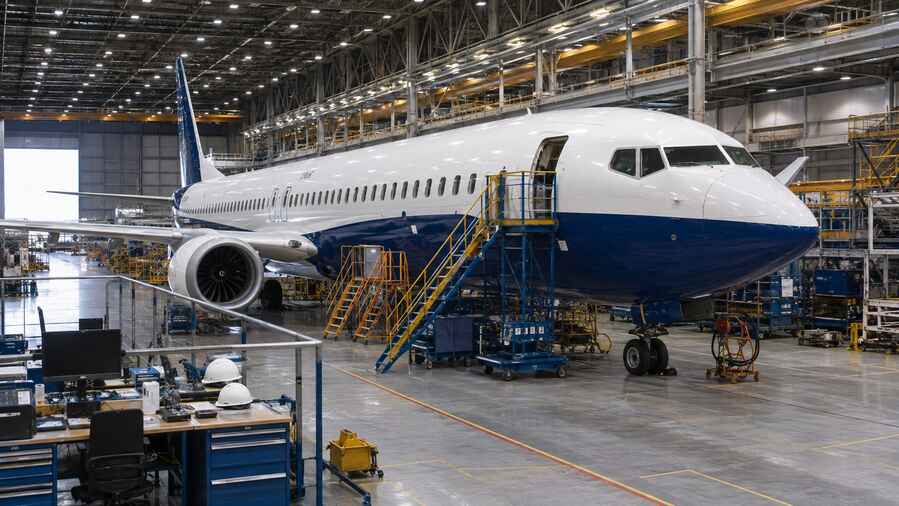
Boeing is accelerating production of its 737 aircraft and expanding manufacturing capacity in Washington state, but a growing labor dispute involving approximately 17,000 engineers and technical workers threatens to complicate the company’s recovery.
The aircraft manufacturer is transitioning toward a production rate of 47 Boeing 737s per month as it works through a record commercial backlog. At the same time, members of the Society of Professional Engineering Employees in Aerospace, or SPEEA, have authorized a potential strike ahead of an October contract deadline.
Boeing Advances Toward 47 Aircraft per Month
Boeing began moving toward a monthly production rate of 47 aircraft during the second quarter of 2026. In July, the company also activated low-rate initial production at its new 737 North Line in Everett, Washington.
The facility marks the first time in more than 50 years that Boeing has produced the 737 outside its traditional Renton plant. Boeing expects Renton to stabilize at Rate 47 before the Everett operation provides the additional capacity needed to reach Rate 52 and potentially higher levels.
Increasing output is critical because Boeing continues to face strong customer demand. Boeing Commercial Airplanes ended the second quarter with a backlog of more than 6,200 aircraft valued at a record $597 billion. The companywide backlog reached $715.3 billion.
Boeing delivered 171 commercial aircraft during the quarter, up 14% from 150 a year earlier. Deliveries of the 737 increased from 104 to 129 aircraft, while first-half 737 deliveries rose from 209 in 2025 to 243 in 2026.
Financial Results Improve, but Pressures Remain
Higher deliveries helped Boeing’s second-quarter revenue rise 8% year over year to $24.6 billion. Operating cash flow reached $1.36 billion, while free cash flow totaled approximately $600 million, compared with negative $200 million during the same quarter last year.
Despite the improvement, Boeing remained unprofitable. The company reported a GAAP net loss of $428 million and a non-GAAP core loss of $0.76 per share.
Boeing also finished the quarter with $45.9 billion in consolidated debt, compared with $20 billion in cash and marketable securities. The figures underscore the importance of converting the company’s backlog into completed aircraft and customer deliveries.
Everett Line Expands Boeing’s Manufacturing Capacity
The new Everett production line is central to Boeing’s longer-term output strategy. Work on the facility followed the company’s 2023 announcement that additional space would be needed to support future 737 MAX production.
The expansion comes after a period of regulatory restrictions. Following the January 2024 door-plug accident involving an Alaska Airlines 737-9 MAX, the Federal Aviation Administration limited Boeing to 38 aircraft per month.
The FAA subsequently allowed production to increase toward 42 aircraft per month before approving Boeing’s transition toward Rate 47 in 2026. Boeing must now demonstrate that it can raise output while maintaining safety, quality, regulatory compliance and manufacturing discipline.
SPEEA Members Authorize Potential Strike
Boeing’s production expansion is unfolding alongside a significant labor dispute. On August 21, SPEEA’s Professional Unit rejected the company’s proposed contract by 64.25%, while 71.87% of Technical Unit members voted against their offer.
Strike authorization received substantially stronger support. It was approved by 87.82% of Professional Unit voters and 89.71% of Technical Unit voters.
The existing labor agreements expire at midnight on October 6, making October 7 the earliest possible date for a strike.
SPEEA members do not assemble Boeing aircraft. That work is handled by machinists represented by a separate union. However, engineers and technical specialists play important roles in solving manufacturing problems, supporting aircraft deliveries and assisting with certification work.
A strike therefore might not immediately stop the assembly lines, but it could slow engineering decisions and other technical processes needed to maintain higher production rates.
Certification Programs Could Face Delays
The dispute also creates uncertainty around Boeing’s certification schedule. As of July, Boeing said flight testing had been completed for the 737-7 and 737-10. The company anticipated certification during 2026 and initial deliveries in 2027.
A work stoppage could reduce the engineering resources available for documentation, technical findings and certification requirements. Similar risks could affect the 777-9 program, which Boeing is also working to advance toward its first delivery in 2027.
Boeing has activated a strike contingency plan and posted contractor positions for engineering and technical roles. The company said its preparations are intended to preserve business continuity, safety and quality.
Negotiations Enter a Critical Period
Nearly 13,000 SPEEA members reportedly responded to a union survey following the contract rejection. Their leading priorities included larger guaranteed wage increases, stronger performance-based raises and better annual cost-of-living adjustments.
Boeing and SPEEA negotiators were scheduled to resume discussions on August 31. Both sides have indicated that they want to reach an agreement before the existing contracts expire.
The coming weeks will determine whether the dispute remains confined to negotiations or develops into an operational challenge. Boeing has rising deliveries, strong demand and new manufacturing capacity, but its recovery still depends on maintaining the engineering support required to produce and certify aircraft safely and consistently.
