


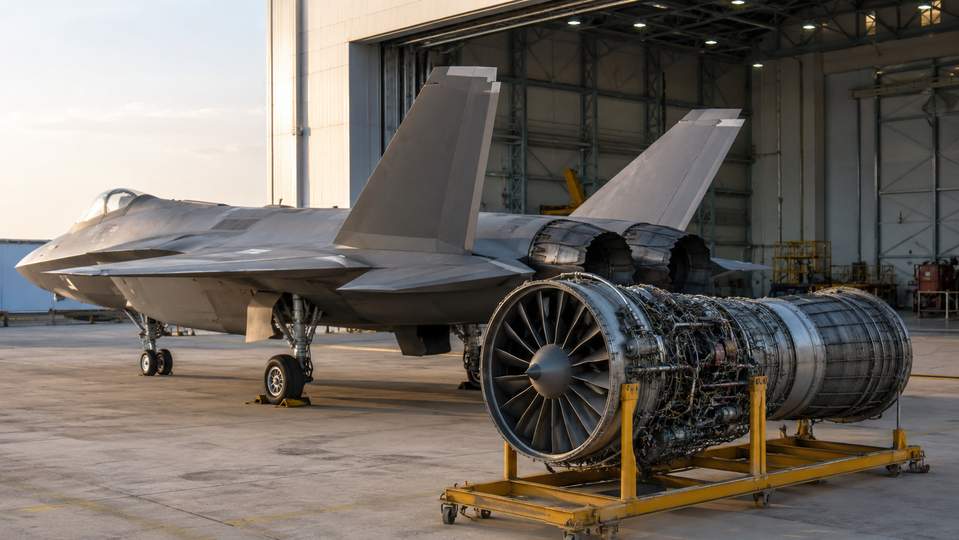
India is evaluating competing proposals from Britain’s Rolls-Royce and France’s Safran to develop a high-thrust engine for its next-generation fighter aircraft, a project that could require an investment of about $6 billion and reshape the country’s military aerospace industry.
The competition centers on the engine planned for the Advanced Medium Combat Aircraft Mk2, or AMCA Mk2. New Delhi wants the program to provide not only a domestically manufactured powerplant but also access to critical technologies that would reduce India’s longstanding dependence on foreign fighter engines.
Rolls-Royce has strengthened its position through a proposed partnership with Indian conglomerate Reliance Industries. Safran, meanwhile, is pursuing a separate development arrangement with the state-run Gas Turbine Research Establishment, which operates under India’s Defence Research and Development Organisation.
Rolls-Royce and Reliance Outline Indian Engine Partnership
Rolls-Royce and Reliance Industries announced their strategic intent on August 14 to jointly pursue the design, development, manufacture and delivery of an indigenous combat aircraft engine for the AMCA program.
The companies also plan to explore the creation of an Aerospace Gas Turbine Complex in India. The proposed facility would establish capabilities across engine design, research and development, component manufacturing, testing, production and long-term maintenance.
The partnership gives Rolls-Royce a broader industrial platform as India seeks an engine program that extends beyond the local assembly of a foreign design. The British manufacturer has previously offered full technology transfer and Indian ownership of intellectual property associated with its AMCA proposal.
Rolls-Royce has outlined a development schedule under which an engine core could be tested in 2030. A first flight would follow in 2034, with production potentially beginning in 2036 if an agreement is concluded by the end of 2026, according to a timeline reported by Defense News.
Reliance Could Expand Its Aerospace Role
Participation in the project would significantly expand Reliance Industries’ presence in India’s defense and aerospace sector. It could also provide the manufacturing scale required to build a domestic supply chain around advanced military propulsion.
For Rolls-Royce, the partnership offers access to one of the world’s fastest-growing aviation markets while positioning the company for future Indian military aircraft programs.
Safran Advances Separate Proposal with GTRE
Safran has proposed jointly developing a new high-thrust fighter engine with GTRE. The French company’s offer is focused on transferring critical propulsion technologies while involving Indian engineers and institutions throughout the development process.
Discussions between Safran and Indian authorities have covered technology transfer, intellectual-property ownership, development expenses and rights related to future exports. These issues are expected to play an important role in India’s final selection.
The proposed engine is expected to generate approximately 120 kilonewtons of thrust, providing the power required for later versions of the AMCA.
India’s initial AMCA variants are expected to use General Electric’s F414 engine. The American powerplant would provide a lower-risk option for early aircraft, while the domestically developed engine would be intended for the more capable AMCA Mk2.
Technology Transfer Remains Central to Decision
India’s evaluation is likely to focus heavily on the depth of technology each bidder is prepared to share. New Delhi is seeking expertise in hot-section components, advanced turbine systems, heat-resistant materials, precision manufacturing and engine testing.
These technologies are among the most complex and closely guarded areas of aerospace engineering. Access to them could allow India to develop and maintain future fighter engines without relying heavily on overseas suppliers.
India Seeks to Overcome Decades of Engine Challenges
India has invested for decades in developing an indigenous fighter engine but has yet to produce a powerplant capable of supporting a frontline combat aircraft.
The country’s Kaveri engine program did not achieve the thrust and performance required for the Tejas light combat aircraft. As a result, India’s domestically designed fighters have continued to rely on imported engines.
The AMCA competition provides another opportunity to close that capability gap. It also carries broader strategic importance as India expands defense manufacturing and seeks greater control over military supply chains.
The final decision will involve more than choosing between two engine manufacturers. Rolls-Royce is proposing an industrial partnership centered on Reliance, while Safran’s approach is built around collaboration with India’s government-run propulsion research organization.
Whichever proposal is selected could determine how quickly India develops the ability to design, manufacture, test and support advanced fighter engines. It could also influence future combat aircraft programs and India’s ambitions to become a larger exporter of domestically developed defense equipment.
